
The phrase “worked on” is common in everyday and professional English. It tells readers that you spent time doing something, improving something, or helping with a task or project.
However, “worked on” can sometimes sound vague, especially on a resume, in a business email, or when explaining your achievements. Choosing a more specific phrase can make your writing clearer and show exactly what you did.
What Does “Another Way to Say Worked On” Mean?

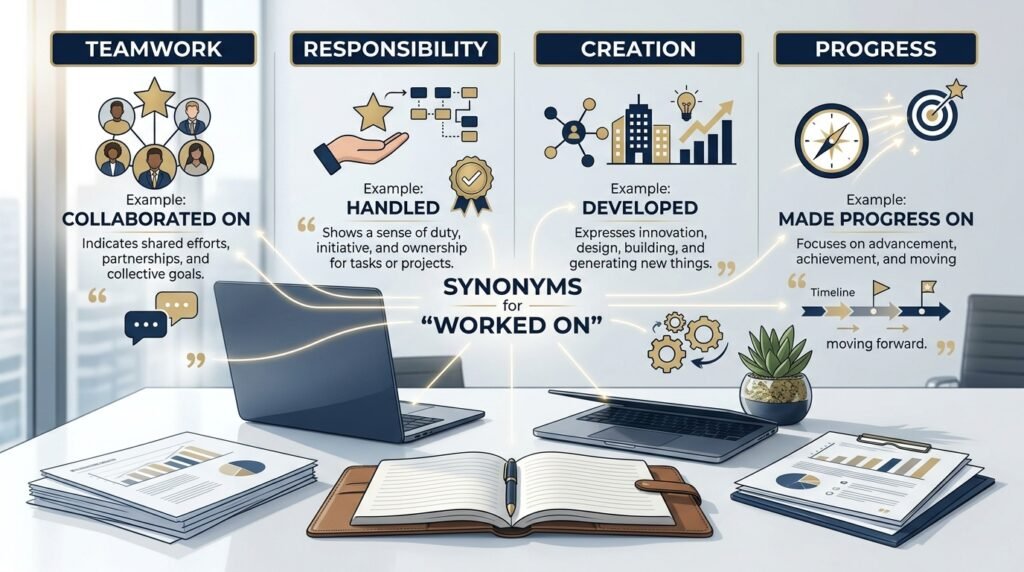
When someone searches for another way to say worked on, they usually want a synonym or alternative phrase that describes effort, participation, responsibility, or progress.
For example, instead of saying, “I worked on the website,” you could say, “I developed the website” if you built it, or “I contributed to the website” if you helped as part of a larger team.
The phrase is commonly used in resumes, cover letters, workplace communication, project descriptions, school assignments, and everyday conversations.
Why Use Other Ways to Say “Worked On”?

Using different expressions can make your communication more precise and professional. The right alternative can also tell the reader what kind of work you performed rather than simply stating that you spent time on something.
Common reasons to use an alternative include:
- Avoiding repetitive wording.
- Making a resume more specific.
- Showing your level of responsibility.
- Highlighting teamwork or collaboration.
- Describing progress more clearly.
- Making professional writing sound stronger.
10 Best Other Ways to Say “Worked On”
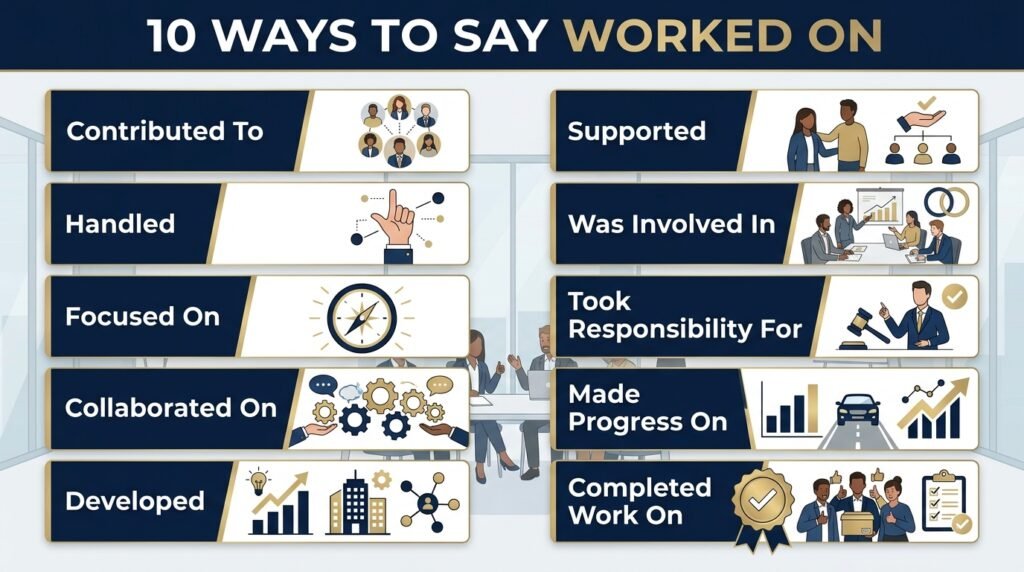
1. Contributed To
Meaning
Contributed to means you provided effort, ideas, skills, or resources to help complete a project or achieve a goal. It is especially useful when several people participated in the same piece of work.
Best For
- Professional
- Formal
- Polite
Example 1
I contributed to the company’s website redesign by improving its product pages.
Example 2
She contributed to the research project by analyzing customer survey results.
Quick Tip
Use contributed to when you want to emphasize your role without suggesting that you were solely responsible for the entire project.
2. Handled
Meaning
Handled suggests that you were responsible for managing or taking care of a particular task. It often sounds more direct and confident than “worked on.”
Best For
- Professional
- Formal
Example 1
Marcus handled the monthly sales reports for the regional office.
Example 2
I handled customer inquiries during the company’s product launch.
Quick Tip
Choose handled when you personally managed a task or responsibility from start to finish.
3. Focused On
Meaning
Focused on emphasizes where you directed your time, attention, or effort. It works well when describing the main area of a project rather than claiming complete responsibility.
Best For
- Professional
- Casual
- Formal
Example 1
Our team focused on improving the site’s mobile performance.
Example 2
During the internship, I focused on creating social media content for local businesses.
Quick Tip
Use this phrase when the important point is what your work centered on, rather than exactly what you completed.
4. Collaborated On
Meaning
Collaborated on means you worked together with other people to complete a project or solve a problem. It clearly communicates teamwork.
Best For
- Professional
- Formal
- Friendly
Example 1
I collaborated on a new marketing campaign with the company’s design team.
Example 2
The developers collaborated on an update that improved the app’s checkout process.
Quick Tip
This is a strong choice for resumes and professional profiles when teamwork was an important part of your role.
5. Developed
Meaning
Developed indicates that you created, built, designed, or improved something. It is more specific than “worked on” when you actually produced a result.
Best For
- Professional
- Formal
Example 1
I developed a content strategy that increased organic traffic to the company blog.
Example 2
The engineering team developed a new system for tracking customer orders.
Quick Tip
Use developed only when your work involved creating or substantially improving something.
6. Supported
Meaning
Supported means you helped another person, team, or project succeed. It is useful when your role was important but you were not the primary person responsible for the work.
Best For
- Professional
- Formal
- Polite
Example 1
I supported the sales team by preparing weekly performance reports.
Example 2
She supported the project manager during the company’s software migration.
Quick Tip
Choose supported when you want to accurately describe a helpful or assisting role without overstating your responsibility.
7. Was Involved In
Meaning
Was involved in indicates participation in a task, activity, or project. It is broad and useful when you want to mention your participation without specifying every responsibility.
Best For
- Professional
- Formal
- Casual
Example 1
I was involved in the planning and execution of our annual customer event.
Example 2
He was involved in several community improvement projects during college.
Quick Tip
Use this phrase when you played a role in something but don’t need to explain your exact duties.
8. Took Responsibility For
Meaning
Took responsibility for emphasizes ownership. It tells the reader that you accepted responsibility for completing, managing, or overseeing a particular task.
Best For
- Professional
- Formal
Example 1
I took responsibility for updating the company’s internal training materials.
Example 2
She took responsibility for coordinating the team’s weekly client meetings.
Quick Tip
This phrase is stronger than “worked on,” so use it when you genuinely had ownership of the task.
9. Made Progress On
Meaning
Made progress on emphasizes advancement rather than completion. It works particularly well when a project is still underway or when you want to describe steady improvement.
Best For
- Professional
- Casual
- Friendly
Example 1
We made significant progress on the new website during the first quarter.
Example 2
The research team made progress on identifying the main causes of the issue.
Quick Tip
Use this alternative when the work moved forward but was not necessarily finished.
10. Completed Work On
Meaning
Completed work on clearly communicates that you finished a particular part of a project or task. It is more precise than “worked on” when the work has reached completion.
Best For
- Professional
- Formal
Example 1
The team completed work on the company’s new employee portal last Friday.
Example 2
I completed work on three landing pages before the marketing campaign began.
Quick Tip
Use this phrase when you want to emphasize that a specific piece of work has been finished.
Comparison Table
| Alternative | Best Used In | Tone |
| Contributed to | Team projects, resumes | Professional |
| Handled | Responsibilities, tasks | Direct |
| Focused on | Areas of work, projects | Neutral |
| Collaborated on | Teamwork, group projects | Professional |
| Developed | Creation, improvement | Strong |
| Supported | Assistance, team roles | Helpful |
| Was involved in | General participation | Neutral |
| Took responsibility for | Ownership, management | Confident |
| Made progress on | Ongoing projects | Neutral |
| Completed work on | Finished tasks | Formal |
Common Mistakes
1. Using Casual Phrases in Professional Emails
Phrases such as “I messed around with” or “I did some stuff on” can sound too informal. Choose a clear alternative such as handled, contributed to, or focused on instead.
2. Choosing Overly Formal Language
Not every situation needs sophisticated wording. In a casual conversation, simply saying “I worked on the report” may sound more natural than “I took responsibility for the preparation of the report.”
3. Repeating the Same Phrase
Using “worked on” several times in a resume or paragraph can make your writing feel repetitive. Replace it with more precise alternatives when the meaning allows.
4. Forgetting Context
Not every synonym has exactly the same meaning. Developed suggests creation, while supported suggests assistance. Pick the phrase that accurately reflects what you actually did.
5. Sounding Insincere
Avoid choosing impressive-sounding words that exaggerate your role. If you helped with a project, contributed to may be more accurate than led or managed.
Frequently Asked Questions
What is a professional way to say “worked on”?
Contributed to, handled, focused on, and developed are strong professional alternatives. The best option depends on your actual role. For example, use “handled” when you managed a responsibility, while “contributed to” works better when you were one member of a larger team.
What is another way to say “worked on” for a resume?
For a resume, use a specific phrase that describes your contribution. Developed, handled, managed, supported, and contributed to can be effective depending on the work. Whenever possible, pair the phrase with a measurable result or specific responsibility.
How do you say “worked on a project” professionally?
You can say contributed to a project, collaborated on a project, supported a project, or took responsibility for a project. Your choice should reflect your role. “Collaborated on” emphasizes teamwork, while “took responsibility for” emphasizes ownership.
Is “contributed to” the same as “worked on”?
They are similar, but they are not always interchangeable. Worked on is broad and simply describes spending time or effort on something. Contributed to specifically suggests that your effort helped a larger project, goal, or group effort.
What can I say instead of “I worked on”?
You can say I handled, I developed, I contributed to, I focused on, or I supported, depending on what you actually did. For example, “I developed the website” is more specific than “I worked on the website” if you were responsible for building it.
What is a better way to say “worked on” in an email?
For professional emails, choose a phrase that clearly describes the task. You might say, “I completed work on the report,” “I focused on the customer data,” or “I handled the requested updates.” Specific wording makes your message easier to understand.
What is another way to say “worked on” in an academic setting?
In academic writing, alternatives such as conducted research on, focused on, examined, analyzed, or contributed to may be appropriate. The best choice depends on the type of work. “Analyzed” is more precise when you studied data, while “focused on” describes the main subject.
How can I make “worked on” sound more impressive?
Instead of simply replacing the phrase with a stronger synonym, describe the actual action and result. For example, “worked on the website” becomes more informative as “developed five landing pages that improved the site’s user experience.” Specific details are usually more effective than fancy wording.
Conclusion
Knowing another way to say worked on can make your writing more precise, especially in professional communication, resumes, emails, and project descriptions. While “worked on” is perfectly natural, a more specific phrase can show whether you contributed, handled a responsibility, collaborated with others, developed something, or completed a task.
Knowing another way to say worked on can make your writing more precise, especially in professional communication, resumes, emails, and project descriptions.
Sarah Whitfield is the founder and lead editor of Anchors Press. With a background in copyediting and content strategy, she reviews every guide for accuracy, tone, and everyday usefulness before it’s published.