
The pronoun “we” is one of the most common ways to refer to yourself together with another person or group. However, repeating it too often can make writing feel predictable or vague.
Fortunately, there are several natural alternatives to “we.” The right choice can make your writing more specific, professional, conversational, or personal without changing the basic meaning.
What Does “Another Way to Say We” Mean?
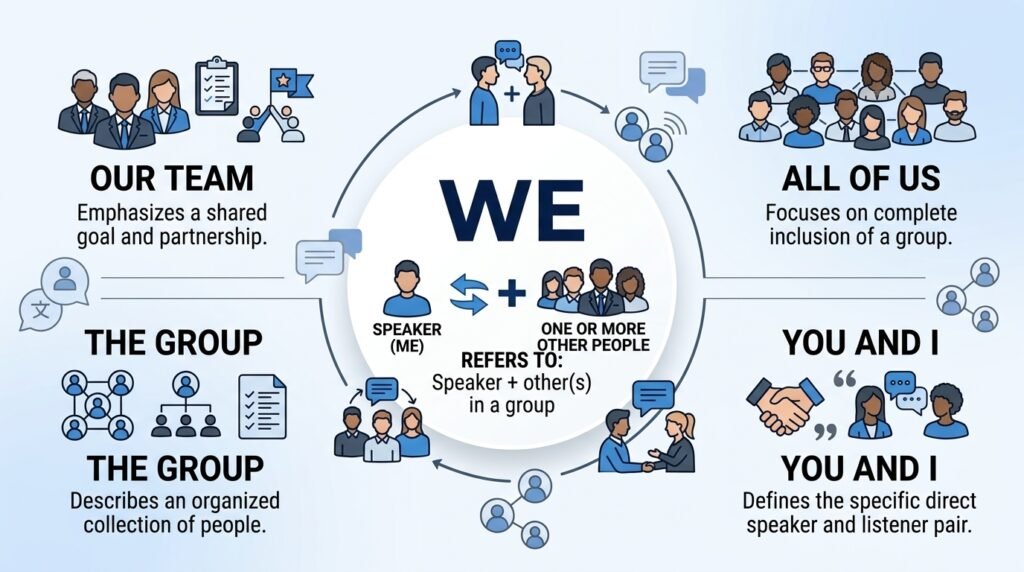
The phrase “another way to say we” refers to alternative words or phrases that can replace the pronoun “we” in a sentence.
“We” usually includes the speaker and at least one other person. For example, “We completed the project” means that the speaker and one or more other people completed it.
People often look for alternatives to “we” when they want to:
- Avoid repeating the same pronoun.
- Make the people involved clearer.
- Sound more professional.
- Create a warmer or more personal tone.
- Adapt their wording to a specific audience.
In professional writing, replacing a vague “we” with a specific phrase such as our team can also make a sentence more precise.
Why Use Other Ways to Say “We”?
Although “we” is completely natural and grammatically correct, another expression may fit a particular situation better.
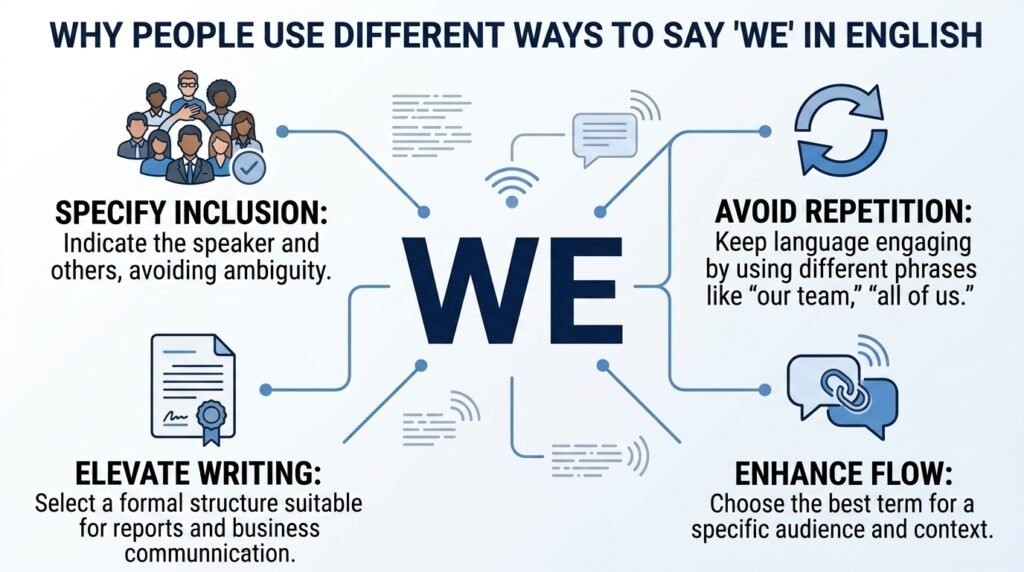
Using an alternative can help you:
- Add clarity: Identify exactly who is involved.
- Avoid repetition: Keep paragraphs from sounding monotonous.
- Improve professional writing: Use phrases such as “our team” when appropriate.
- Create connection: Expressions such as “all of us” can feel more inclusive.
- Match the situation: Choose wording that suits a formal, casual, or personal conversation.
The goal is not to replace “we” every time. Instead, choose an alternative when it communicates your meaning more effectively.
10 Best Other Ways to Say “We”
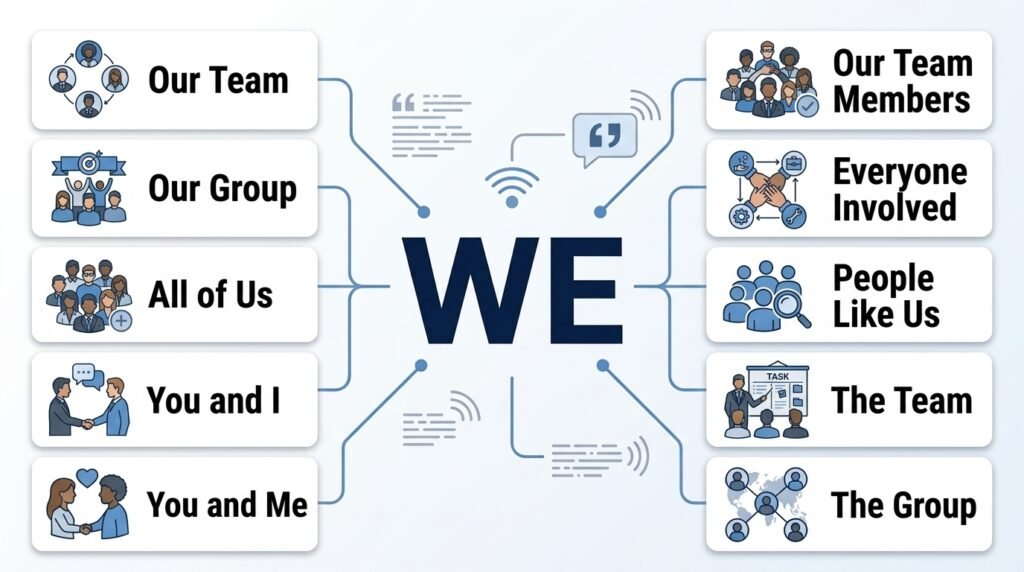
1. Our Team
Meaning
Our team is a clear alternative when “we” refers to people working together toward a shared goal. It is especially useful when the audience needs to understand that you are speaking on behalf of a professional or organized group.
Best For
- Professional
- Formal
Example 1
Our team will review the proposal before Friday.
Example 2
Our team worked closely with the client to solve the issue.
Quick Tip
Use our team when “we” could be unclear about which people you mean.
2. Our Group
Meaning
Our group refers to several people who share an activity, purpose, class, organization, or interest. It is broader than “our team” and does not necessarily suggest that everyone is working toward a specific professional goal.
Best For
- Professional
- Casual
- Friendly
Example 1
Our group meets every Thursday to discuss the new project.
Example 2
Our group decided to visit the museum after lunch.
Quick Tip
Choose our group when the people involved belong together but are not necessarily a formal team.
3. All of Us
Meaning
All of us emphasizes every person within a particular group. Unlike the simple “we,” this phrase highlights inclusion and can make a statement sound more collective.
Best For
- Friendly
- Warm
- Casual
- Polite
Example 1
All of us were excited to hear the good news.
Example 2
All of us need to contribute if we want the event to succeed.
Quick Tip
Use all of us when you want to stress that everyone in the group is included.
4. You and I
Meaning
You and I specifically identifies the speaker and the person being addressed. It is commonly used when the two people are the subjects of a sentence.
Best For
- Formal
- Professional
- Polite
Example 1
You and I can discuss the details after the meeting.
Example 2
You and I should compare our notes before making a decision.
Quick Tip
Use you and I when the phrase functions as the subject, such as “You and I agreed.”
5. You and Me
Meaning
You and me also refers to two specific people: the listener and the speaker. It is generally used when the phrase functions as an object rather than the subject.
Best For
- Casual
- Friendly
- Conversational
Example 1
The manager invited you and me to join the discussion.
Example 2
This decision will affect you and me in different ways.
Quick Tip
A simple grammar test is to remove “you and.” If “me” sounds correct by itself, you and me is usually the better choice.
6. Our Team Members
Meaning
Our team members identifies the people who belong to a particular team. It can provide more detail than “we,” especially when describing the actions or responsibilities of individual people within an organization.
Best For
- Professional
- Formal
Example 1
Our team members have completed the required training.
Example 2
Our team members will contact each customer individually.
Quick Tip
Use this phrase when you want to focus on the people within your team rather than speaking about the team as one unit.
7. Everyone Involved
Meaning
Everyone involved refers to all people participating in a situation, project, event, or decision. It is useful when the group includes people from different roles or organizations.
Best For
- Professional
- Formal
- Polite
Example 1
Everyone involved agreed that the revised schedule was more practical.
Example 2
Everyone involved deserves recognition for making the event successful.
Quick Tip
Use this expression when the group extends beyond your immediate team or organization.
8. People Like Us
Meaning
People like us refers to people who share a similar background, situation, interest, experience, or characteristic with the speaker. It creates a sense of shared identity without directly using “we.”
Best For
- Casual
- Friendly
- Warm
Example 1
People like us understand how difficult it can be to start over.
Example 2
People like us usually appreciate practical advice over complicated solutions.
Quick Tip
Make sure the shared characteristic is obvious from the surrounding context so the phrase does not sound vague.
9. The Team
Meaning
The team is a concise way to refer to a group working together. It can replace “we” when the audience already knows which team you mean.
Best For
- Professional
- Formal
- Casual
Example 1
The team will present the results at tomorrow’s meeting.
Example 2
The team has already prepared a backup plan.
Quick Tip
Use the team instead of “we” when you want a slightly more objective or report-like tone.
10. The Group
Meaning
The group refers to a collection of people who are connected by a shared activity, purpose, or situation. It works well when the exact relationship between the people is less important.
Best For
- Professional
- Casual
- Formal
Example 1
The group decided to postpone the meeting until next week.
Example 2
The group discussed several possible solutions during the workshop.
Quick Tip
Use the group when the audience already understands which people you are discussing.
Comparison Table
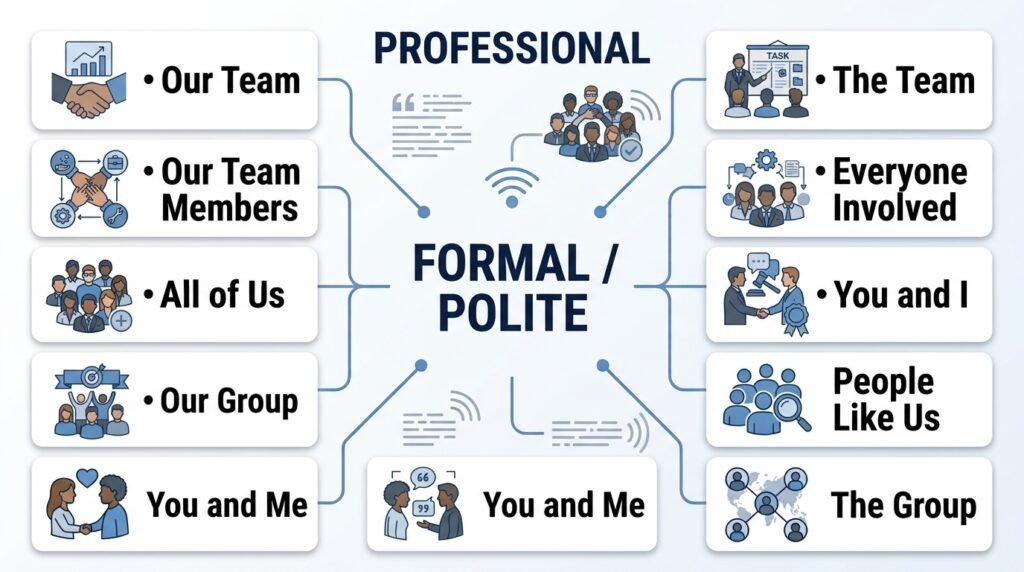
| Alternative | Best Used In | Tone |
| Our team | Workplace, business communication | Professional |
| Our group | Groups, activities, general situations | Neutral/Friendly |
| All of us | Inclusive statements | Warm |
| You and I | Two-person subject | Formal/Polite |
| You and me | Two-person object | Casual/Friendly |
| Our team members | Workplace and organizational writing | Professional |
| Everyone involved | Projects, events, formal situations | Formal/Neutral |
| People like us | Shared experiences or identities | Friendly/Warm |
| The team | Workplace and reports | Professional/Neutral |
| The group | General group situations | Neutral |
Common Mistakes
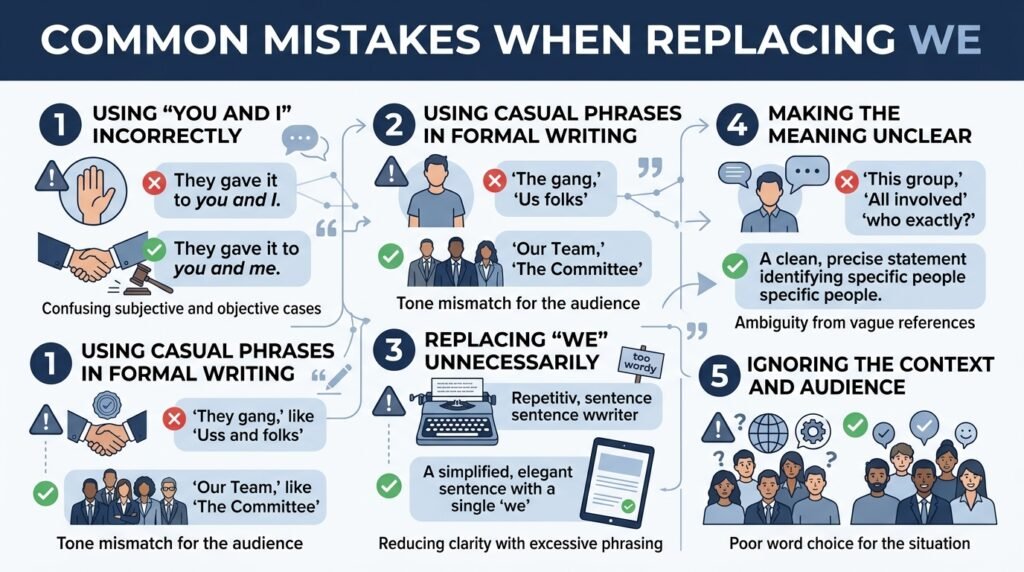
1. Using “You and I” Everywhere
“You and I” is not automatically the correct replacement for “we.” It should normally be used when the two people are the subject of the sentence.
2. Choosing Casual Phrases in Formal Writing
Expressions such as people like us can sound conversational. In a business report or formal document, our team or everyone involved may be more appropriate.
3. Making “We” More Complicated Than Necessary
Not every sentence needs an alternative. If “we” is clear and natural, changing it can make the writing sound forced.
4. Forgetting Who “We” Includes
“We” can sometimes be ambiguous. In particular, professional writing should make it clear whether “we” means your company, department, team, organization, or you and another individual.
5. Confusing “You and I” With “You and Me”
These expressions have different grammatical roles. Use you and I as a subject and you and me as an object.
Frequently Asked Questions
What is another way to say “we”?
Common alternatives include our team, our group, all of us, you and I, you and me, the team, the group, and everyone involved. The best option depends on what “we” means in your sentence. If you are writing professionally, “our team” is often clearer than a vague “we.”
What is a professional way to say “we”?
Our team is one of the best professional alternatives to “we” when you are referring to coworkers. Other options include our organization, our department, our staff, or everyone involved, depending on exactly who you mean. Choose the most specific phrase rather than replacing “we” simply for variety.
Can I use “our team” instead of “we”?
Yes, when “we” refers specifically to a team. For example, “We completed the project” can become “Our team completed the project.” However, “our team” does not always have exactly the same meaning because “we” may refer to a larger group.
What is another way to say “we” in an essay?
In an essay, you can sometimes replace “we” with researchers, the authors, the group, people, or a specific noun that identifies the people involved. However, do not avoid “we” just to sound academic. Clear, direct language is usually better than unnecessarily formal wording.
What is another way to say “we” in a business email?
In a business email, useful alternatives include our team, our company, our department, our staff, and everyone involved. For example, instead of saying “We will review your request,” you could write, “Our team will review your request.” This makes the responsible group clearer.
Is “you and I” another way to say “we”?
Sometimes. You and I means the speaker and the person being addressed, so it can replace “we” when those are the only two people included and the phrase is the subject. For example, “We should discuss this” can become “You and I should discuss this.”
Is “you and me” grammatically correct?
Yes, you and me is grammatically correct when it functions as an object. For example, “The teacher spoke with you and me” is correct. It would not normally replace “we” as the subject: “You and I completed the task” is correct.
How can I avoid repeating “we” in writing?
First, decide whether the repeated “we” actually causes a problem. If it does, replace some instances with precise nouns such as our team, the company, the researchers, everyone involved, or the group. This improves variety while also making your writing more specific.
Conclusion
Knowing another way to say we gives you more control over clarity, tone, and sentence variety. While “we” is simple and completely natural, alternatives can make your meaning more precise.
Choose our team for workplace communication, our group for a general collection of people, and all of us when you want to emphasize inclusion. When referring specifically to two people, use you and I as a subject and you and me as an object. For broader situations, everyone involved or the group may work better.

Daniel Cho writes about professional communication, drawing on years spent training teams on clear, confident workplace writing — from emails to performance reviews.