
What Does “Another Way to Say Boss” Mean?

“Another way to say boss” refers to alternative words or phrases for describing someone who manages, supervises, or leads employees. The best choice depends on the person’s actual role and the tone you want to create.
People often search for alternatives to “boss” when writing emails, resumes, workplace conversations, or professional documents. While “boss” is perfectly normal in everyday American English, a more specific term can sound clearer and more professional.
Why Use Other Ways to Say “Boss”?

Using a different word for “boss” can make your communication more precise and appropriate for the situation.
- Avoid repetition: Prevent using “boss” too many times in the same conversation or article.
- Sound more professional: Terms such as “manager” and “supervisor” fit workplace writing.
- Match the person’s role: “Director” and “team lead” describe different levels of responsibility.
- Use the right tone: Some alternatives sound formal, while others feel more conversational.
- Show respect: “Leader” can emphasize someone’s ability to guide and support a team.
10 Best Other Ways to Say “Boss”
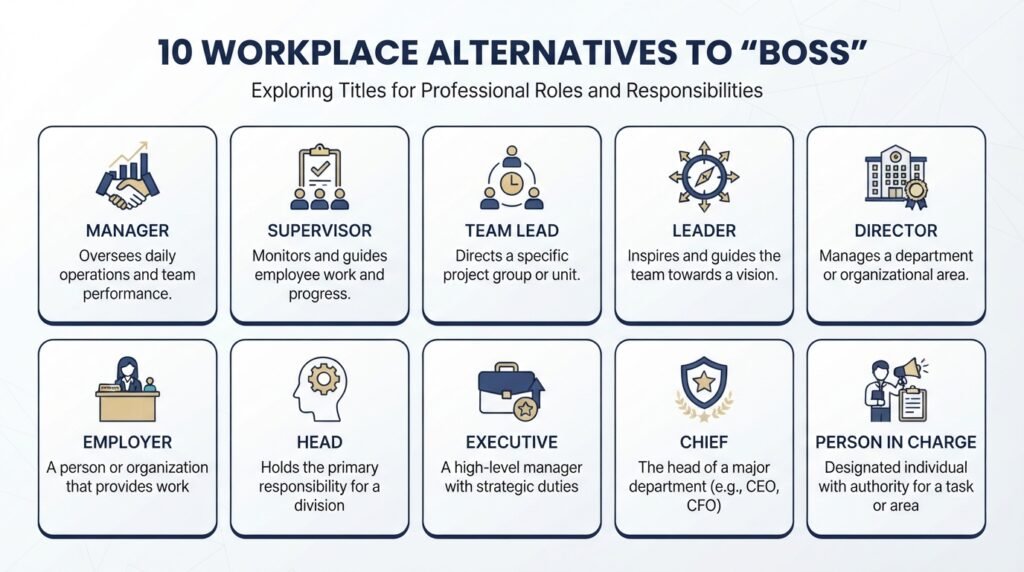
1. Manager
Meaning
“Manager” is one of the most natural and widely used alternatives to “boss.” It describes someone responsible for overseeing employees, projects, operations, or a particular department.
Best For
- Professional
- Formal
- Polite
Example 1
“My manager asked me to prepare the sales report before Friday.”
Example 2
“I scheduled a meeting with my manager to discuss my career goals.”
Quick Tip
Use “manager” when you want a neutral, professional term that works in most workplace situations.
2. Supervisor
Meaning
A “supervisor” is someone who directly oversees employees and their daily work. The word is especially common when describing a person’s formal workplace responsibilities.
Best For
- Professional
- Formal
- Polite
Example 1
“Please check with your supervisor before changing the project schedule.”
Example 2
“My supervisor gave me helpful feedback after the presentation.”
Quick Tip
Choose “supervisor” when the person specifically monitors or directs your day-to-day work.
3. Team Lead
Meaning
“Team lead” refers to someone who guides a group while helping coordinate tasks, projects, or decisions. It often sounds less hierarchical than “boss.”
Best For
- Professional
- Friendly
- Casual
Example 1
“Our team lead organized the tasks for the upcoming product launch.”
Example 2
“I asked the team lead for advice about handling the client request.”
Quick Tip
Use “team lead” when the person guides a particular team rather than managing an entire organization.
4. Leader
Meaning
“Leader” focuses on a person’s ability to guide, motivate, and influence others. It can describe someone with formal authority, but it can also refer to someone who earns respect through experience and example.
Best For
- Professional
- Formal
- Warm
Example 1
“She is a strong leader who encourages everyone to contribute ideas.”
Example 2
“Our department leader helped the team stay focused during a difficult project.”
Quick Tip
Use “leader” when you want to emphasize guidance, influence, or teamwork rather than authority.
5. Director
Meaning
“Director” is a formal job title often used for someone who oversees a department, function, or major area of an organization. It generally indicates a higher level of responsibility than “manager.”
Best For
- Professional
- Formal
- Polite
Example 1
“The marketing director approved the campaign before it went live.”
Example 2
“I presented the quarterly results to our director yesterday.”
Quick Tip
Use “director” only when it accurately reflects the person’s position or title.
6. Employer
Meaning
“Employer” refers to a person or organization that employs someone and provides their job. It is broader than “boss” and does not necessarily mean the person directly manages your work.
Best For
- Formal
- Professional
- Polite
Example 1
“My employer offers flexible working hours for full-time employees.”
Example 2
“I spoke with my employer about the company’s updated benefits package.”
Quick Tip
Use “employer” when discussing the employment relationship rather than direct supervision.
7. Head
Meaning
“Head” can describe the person in charge of a department, team, or specific function. Common workplace titles include “head of marketing” and “head of operations.”
Best For
- Professional
- Formal
Example 1
“The head of marketing reviewed our advertising strategy.”
Example 2
“I sent the proposal to the head of the design department.”
Quick Tip
Pair “head” with a department or function when you want to make the person’s responsibility clear.
8. Executive
Meaning
“Executive” generally describes a senior person who has significant responsibility for an organization or business area. It sounds more formal and usually suggests a higher position in the corporate hierarchy.
Best For
- Formal
- Professional
Example 1
“The company executive met with employees to discuss the expansion.”
Example 2
“An executive approved the final budget for the new project.”
Quick Tip
Use “executive” for senior leadership rather than as a general replacement for every type of boss.
9. Chief
Meaning
“Chief” is used in formal job titles for people with top-level responsibility, such as chief executive officer or chief financial officer. On its own, it can sound informal or context-dependent.
Best For
- Formal
- Professional
- Casual
Example 1
“The chief approved the department’s new operating plan.”
Example 2
“She reports directly to the chief executive at the company.”
Quick Tip
“Chief” works best when it is part of an established job title or when the context clearly identifies the person’s authority.
10. Person in Charge
Meaning
“Person in charge” is a clear, everyday phrase for someone responsible for a workplace, team, task, or situation. It avoids using a specific job title when you do not know the person’s exact position.
Best For
- Casual
- Friendly
- Polite
Example 1
“Could you direct me to the person in charge of customer service?”
Example 2
“The person in charge explained the new safety procedures to everyone.”
Quick Tip
Use this phrase when you need a simple description but do not know whether the person is a manager, supervisor, director, or another type of leader.
Comparison Table
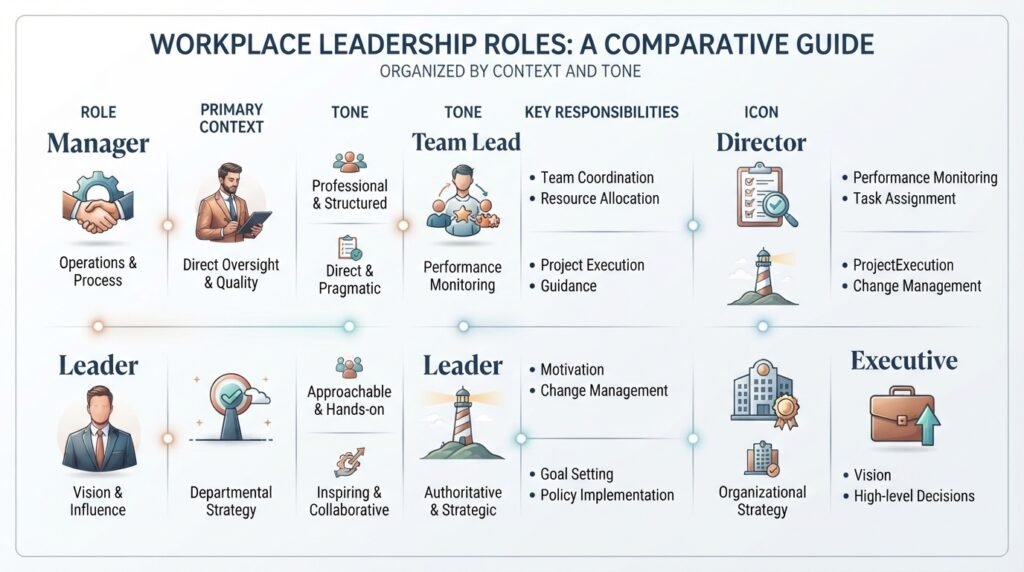
| Alternative | Best Used In | Tone |
| Manager | General workplace communication | Professional |
| Supervisor | Direct oversight situations | Formal |
| Team lead | Team and project settings | Friendly |
| Leader | Leadership and teamwork discussions | Respectful |
| Director | Senior workplace roles | Formal |
| Employer | Employment-related discussions | Professional |
| Head | Department leadership | Formal |
| Executive | Senior corporate positions | Formal |
| Chief | Senior leadership or official titles | Formal |
| Person in charge | General or uncertain situations | Neutral |
Common Mistakes

- Using casual phrases in professional emails
Words such as “boss” can sound too casual in formal writing. “Manager” or the person’s actual job title is often a better choice. - Choosing a title that is inaccurate
Not every boss is a director or executive. Use the person’s real position whenever you know it. - Using overly formal language
“Executive” or “chief” may sound unnatural when talking about someone who simply manages a small team. - Ignoring context
The best alternative changes depending on whether you’re writing a resume, sending an email, or having a casual conversation. - Making the wording sound insincere
Replacing “boss” with “leader” can feel forced if the sentence does not actually discuss leadership. Choose the word that naturally matches what the person does.
Frequently Asked Questions
What is a professional way to say “boss”?
“Manager” is usually the safest professional alternative to “boss.” Depending on the person’s position, you can also use “supervisor,” “team lead,” “director,” or their specific job title. Using the person’s actual title is often the clearest choice because it tells the reader exactly what role they have.
What is another word for boss at work?
Common workplace alternatives include “manager,” “supervisor,” “team lead,” “leader,” “director,” and “employer.” However, these words are not exact synonyms. A manager oversees people or operations, while an employer describes the person or organization that provides employment.
Is “manager” better than “boss”?
In most professional situations, “manager” is better because it sounds neutral and accurately describes a workplace role. “Boss” is common in casual American English and is not necessarily rude, but it can sound less formal in emails, reports, resumes, and business documents.
What is a polite way to refer to your boss?
A polite option is to use the person’s name, official job title, or “manager.” For example, instead of saying “my boss,” you might say “my manager” or “our department director.” In a formal email, addressing the person directly by their appropriate title can also be more professional.
What can I say instead of “my boss”?
You can say “my manager,” “my supervisor,” “my team lead,” “my director,” or “my employer,” depending on the relationship. “My manager” is generally the most natural choice when you mean the person who directly oversees your work.
What is a casual word for boss?
In casual American English, “boss” itself is completely normal. You can also say “manager,” “team lead,” or “the person in charge.” Some slang expressions exist, but they may sound unprofessional or overly familiar, so they are better avoided in workplace communication.
Can “leader” replace “boss”?
Yes, but the meanings are slightly different. “Boss” emphasizes authority or organizational position, while “leader” emphasizes guidance, influence, and the ability to motivate others. Use “leader” when those qualities are important to what you are saying.
What is the best synonym for “boss” in a resume?
For a resume, it is usually better to avoid “boss” and use a specific professional title, such as “manager,” “supervisor,” or “director.” If you are describing someone you worked for, using their actual position provides more precise and professional information.
Conclusion
Knowing another way to say “boss” helps you communicate more naturally and professionally in different situations. The best alternative depends on the person’s actual role and the tone you want to create.
The key is to focus on accuracy rather than simply finding a fancier word. Use the term that best describes the person’s role, relationship to you, and the situation. Understanding different workplace roles and responsibilities can also help you choose the most accurate term.

Sarah Whitfield is the founder and lead editor of Anchors Press. With a background in copyediting and content strategy, she reviews every guide for accuracy, tone, and everyday usefulness before it’s published.