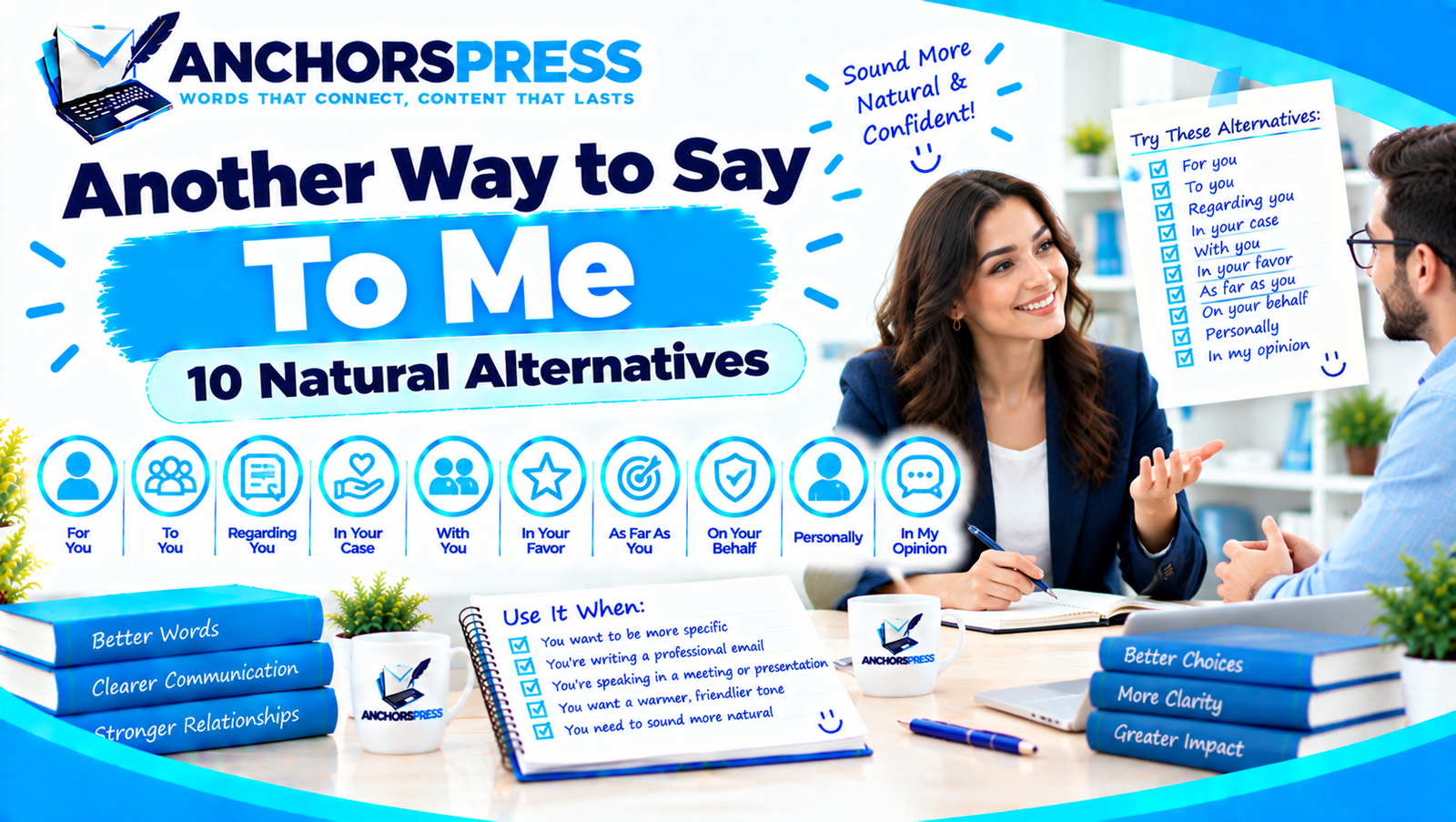
Finding another way to say “to me” can make your English sound more natural, precise, and varied. Although “to me” is correct, repeating it too often can make your writing or speech feel predictable.
The right alternative depends on what you mean. You might be sharing an opinion, describing your personal experience, expressing a feeling, or explaining how something appears from your point of view.
What Does “Another Way to Say to Me” Mean?
The phrase “another way to say to me” refers to different expressions that can replace “to me” without changing the main idea.
For example, instead of saying, “To me, this is the best option,” you could say, “In my opinion, this is the best option.” Both sentences show that the statement represents your personal view.
“To me” is common in everyday American English. You may hear it in conversations, emails, discussions, reviews, and personal writing.
However, some alternatives provide more detail about your perspective. Others sound more formal, conversational, or personal.
Why Use Other Ways to Say “To Me”?
Using different expressions can help you communicate your ideas more naturally and accurately.
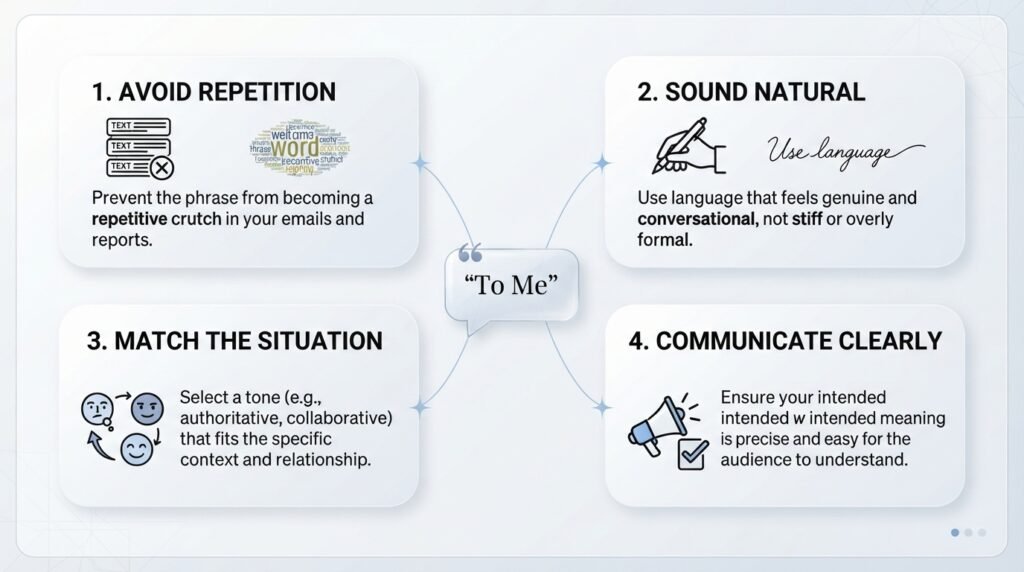
Other ways to say “to me” can help you:
- Avoid repeating the same expression.
- Make your writing sound more polished.
- Match your language to a professional or casual setting.
- Clearly introduce a personal opinion.
- Show that an idea comes from your experience or perspective.
- Add variety to conversations, essays, and emails.
The key is to choose an expression that matches your intended meaning rather than replacing “to me” mechanically.
10 Best Other Ways to Say “To Me”
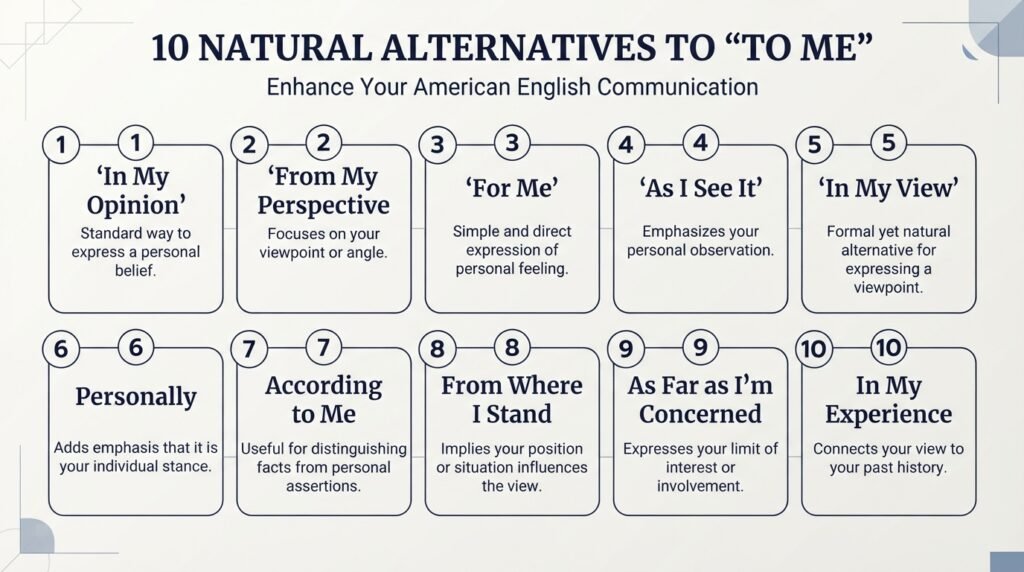
1. In My Opinion
Meaning
“In my opinion” directly tells the reader or listener that what follows is your personal judgment or belief. It is one of the clearest replacements for “to me.”
Best For
- Professional
- Formal
- Polite
Example 1
In my opinion, the second proposal offers a better long-term solution.
Example 2
In my opinion, this restaurant has one of the best burgers in town.
Quick Tip
Use “in my opinion” when you want to clearly separate your personal view from an objective fact.
2. From My Perspective
Meaning
“From my perspective” emphasizes the way you personally see or understand a situation. It can suggest that other people may have different viewpoints.
Best For
- Professional
- Formal
- Polite
Example 1
From my perspective, the team needs more time to test the new system.
Example 2
From my perspective, working remotely has improved my productivity.
Quick Tip
This phrase is especially useful during workplace discussions when several people may have different opinions.
3. For Me
Meaning
“For me” is a simple, natural alternative when you are describing your personal preference, experience, or reaction. It often sounds more conversational than “in my opinion.”
Best For
- Casual
- Friendly
- Warm
Example 1
For me, Sunday mornings are the best time to read.
Example 2
For me, the biggest advantage is how easy the app is to use.
Quick Tip
Choose “for me” when talking about your own experience or preference rather than making a broad claim.
4. As I See It
Meaning
“As I see it” introduces your personal interpretation of a situation. It has a confident but conversational tone and works well when explaining how you understand an issue.
Best For
- Casual
- Friendly
- Professional
Example 1
As I see it, we have two realistic options.
Example 2
As I see it, the problem started when the original deadline changed.
Quick Tip
Use this expression when you want to present your viewpoint clearly without sounding overly formal.
5. In My View
Meaning
“In my view” is a concise way to express a personal judgment. It is slightly more formal than “to me” and fits well in thoughtful discussions and written communication.
Best For
- Formal
- Professional
- Polite
Example 1
In my view, the policy needs a few important changes.
Example 2
In my view, patience is essential when learning a new skill.
Quick Tip
“In my view” is a strong choice for articles, reports, workplace communication, and formal discussions.
6. Personally
Meaning
“Personally” makes it clear that you are speaking from your own preferences, feelings, or beliefs. It is natural in everyday American English.
Best For
- Casual
- Friendly
- Warm
Example 1
Personally, I prefer the original design because it feels simpler.
Example 2
Personally, I would wait another week before making a final decision.
Quick Tip
Use “personally” when your individual preference matters more than presenting an argument as universal.
7. According to Me
Meaning
“According to me” can be understood as expressing your opinion, but it is less natural in standard American English than alternatives such as “in my opinion” or “in my view.”
Best For
- Casual
- Informal
Example 1
According to me, the blue version looks better than the red one.
Example 2
According to me, we should finish the first task before starting another.
Quick Tip
Although understandable, avoid “according to me” in polished professional writing. “In my opinion” usually sounds more natural.
8. From Where I Stand
Meaning
“From where I stand” means based on your current position, knowledge, or understanding. It often communicates a firm personal perspective without claiming that your view is the only correct one.
Best For
- Professional
- Casual
- Polite
Example 1
From where I stand, the project is moving in the right direction.
Example 2
From where I stand, honesty matters more than winning the argument.
Quick Tip
This phrase works particularly well when discussing disagreements, decisions, or situations with multiple viewpoints.
9. As Far as I’m Concerned
Meaning
“As far as I’m concerned” expresses a personal opinion, position, or attitude about a particular matter. Depending on the context, it can sound confident or quite firm.
Best For
- Casual
- Professional
- Polite
Example 1
As far as I’m concerned, everyone deserves a fair opportunity.
Example 2
As far as I’m concerned, the meeting can end once we agree on the next steps.
Quick Tip
Use this phrase when you want to make your personal position especially clear, but avoid overusing it because it can sound forceful.
10. In My Experience
Meaning
“In my experience” connects your statement to something you have personally seen, done, or encountered. It is different from simply giving an opinion because it suggests that your view comes from real experience.
Best For
- Professional
- Formal
- Polite
Example 1
In my experience, clear instructions prevent most misunderstandings.
Example 2
In my experience, customers respond better when they receive quick updates.
Quick Tip
Use this phrase when your personal experience provides evidence or context for what you are saying.
Comparison Table
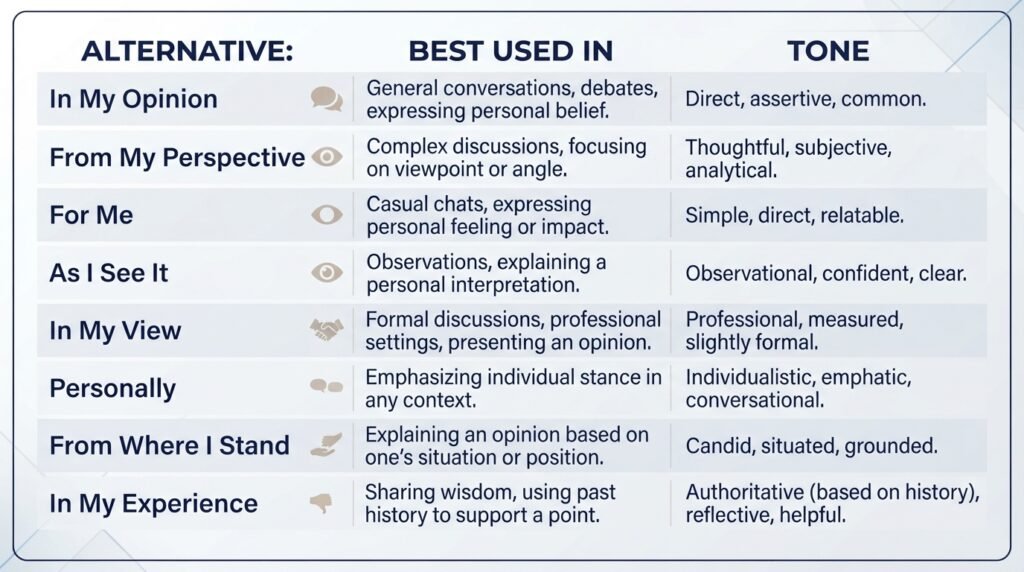
| Alternative | Best Used In | Tone |
| In my opinion | Professional, formal writing | Clear and neutral |
| From my perspective | Work discussions, formal communication | Professional |
| For me | Everyday conversation | Casual and personal |
| As I see it | Discussions and conversations | Conversational |
| In my view | Essays, reports, discussions | Formal and thoughtful |
| Personally | Everyday speech and opinions | Casual and direct |
| According to me | Informal conversation | Simple but less natural |
| From where I stand | Discussions and disagreements | Confident |
| As far as I’m concerned | Personal positions | Firm and direct |
| In my experience | Advice and professional discussions | Experienced and credible |
Common Mistakes
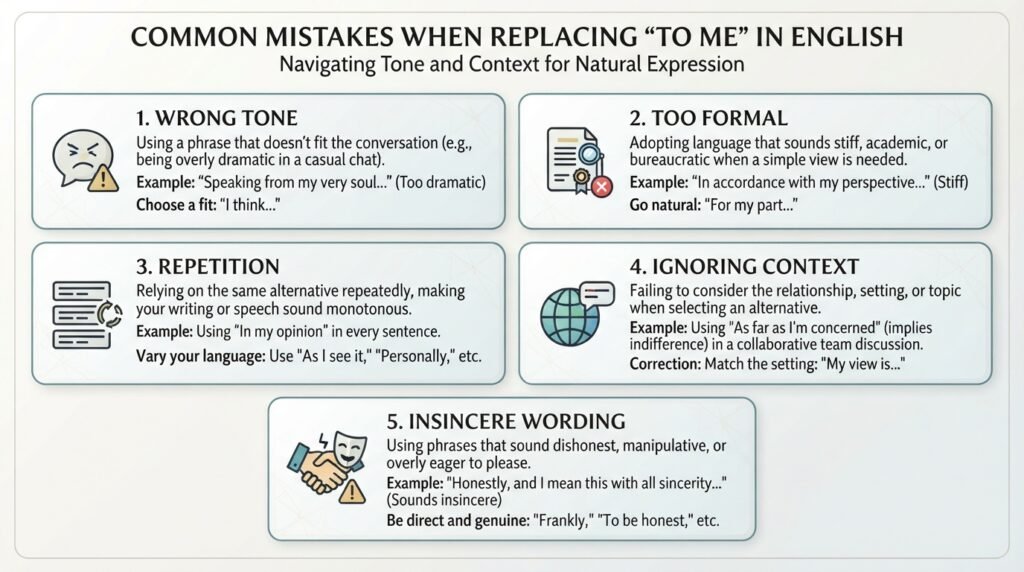
1. Using Casual Phrases in Professional Emails
Expressions such as “personally” or “for me” can work in professional communication, but they may not always fit a formal report. “In my opinion” or “from my perspective” can sound more appropriate.
2. Choosing Overly Formal Language
Not every conversation needs polished language. Saying “in my view” to a close friend may sound unnecessarily formal when “for me” or “personally” would feel more natural.
3. Repeating the Same Phrase
Using “to me” in every paragraph can make your writing repetitive. Vary your wording when the context allows, but do not replace it simply for the sake of variety.
4. Forgetting Context
Different alternatives carry slightly different meanings. “In my experience” suggests personal experience, while “in my opinion” simply introduces a judgment.
5. Sounding Insincere
Avoid using sophisticated expressions just to sound professional. Choose language that reflects how you would naturally communicate with your intended audience.
Frequently Asked Questions
What is another way to say “to me”?
Common alternatives include “in my opinion,” “from my perspective,” “for me,” “as I see it,” “in my view,” and “personally.” The best choice depends on what you are trying to express. If you are giving a straightforward opinion, “in my opinion” is usually the safest and most natural option.
What is a professional way to say “to me”?
“From my perspective” is one of the best professional alternatives to “to me.” You can also use “in my opinion” or “in my view.” These expressions work well in workplace conversations, business emails, reports, presentations, and meetings because they clearly identify your statement as a personal perspective.
What is a casual way to say “to me”?
For casual conversations, “for me” and “personally” are natural choices. For example, “For me, pizza is the perfect comfort food” sounds relaxed and conversational. You can also use “as I see it” when discussing an idea or situation with friends or family.
Is “in my opinion” the same as “to me”?
They can have the same meaning when “to me” introduces a personal opinion. For example, “To me, this plan makes sense” and “In my opinion, this plan makes sense” both communicate a personal judgment. However, “to me” can also describe a personal feeling or perception in contexts where “in my opinion” would not fit.
Is “according to me” correct English?
“According to me” is understandable, but it is not usually the most natural expression in American English. Native speakers generally prefer “in my opinion,” “in my view,” or “from my perspective.” Use “according to” when attributing information to a source, such as “According to the report.”
How can I say “to me” in an essay?
For an essay, consider “in my view,” “in my opinion,” or “from my perspective,” depending on the subject. However, academic writing often benefits from presenting evidence rather than relying heavily on personal statements. Follow your instructor’s or publication’s preferred style.
What is a better way to say “to me” in a work email?
“In my opinion” and “from my perspective” are reliable choices for work emails. If you are referring to personal experience, “in my experience” may be more precise. Choose the expression based on whether you are giving an opinion, explaining your viewpoint, or sharing something you have personally observed.
What is the difference between “for me” and “in my opinion”?
“For me” often focuses on your personal experience, preference, or reaction, while “in my opinion” directly introduces a judgment or belief. For example, “For me, mornings are more productive” describes a personal experience, while “In my opinion, the morning schedule is better” presents a specific judgment.
Conclusion
Knowing another way to say “to me” gives you more flexibility in both everyday conversations and professional writing. The best alternative depends on what you mean and how formal you want to sound.
Choose “in my opinion” for a clear personal judgment, “from my perspective” for professional discussions, and “for me” when talking about personal preferences or experiences. For more guidance on [how to express an opinion in English], see this helpful resource from Cambridge Dictionary.
Sarah Whitfield is the founder and lead editor of Anchors Press. With a background in copyediting and content strategy, she reviews every guide for accuracy, tone, and everyday usefulness before it’s published.