What Does “Another Way to Say Sounds Like a Plan” Mean?

“Sounds like a plan” is a common American English expression used to show agreement with a suggestion, idea, arrangement, or proposed course of action. It usually means “I agree with that” or “That seems like a good idea.”
People often use it after someone suggests what to do next. For example, if a friend says, “Let’s meet for lunch at noon,” you might respond, “Sounds like a plan.”
The phrase is friendly, natural, and fairly casual. It appears often in everyday conversations, text messages, workplace discussions, and informal emails.
Why Use Other Ways to Say “Sounds Like a Plan”?
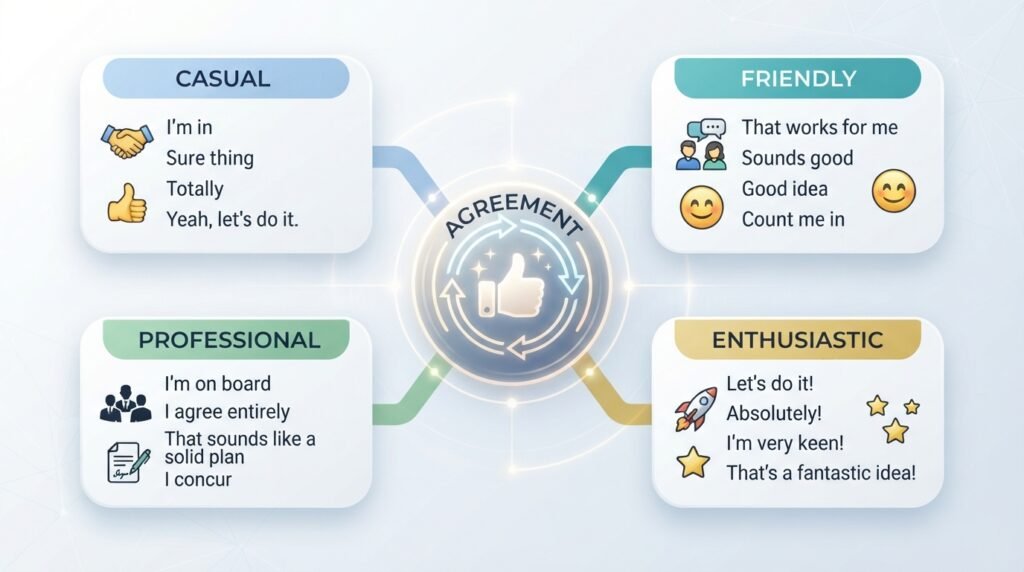
Although “sounds like a plan” is useful, repeating it too often can make your conversations feel predictable. Different alternatives also let you communicate slightly different feelings, such as enthusiasm, approval, confidence, or simple agreement.
Other expressions can help you:
- Avoid repeating the same phrase.
- Sound more natural in different conversations.
- Match your tone to the situation.
- Communicate agreement more precisely.
- Show enthusiasm when you genuinely support an idea.
- Use more professional wording at work.
10 Best Other Ways to Say “Sounds Like a Plan”
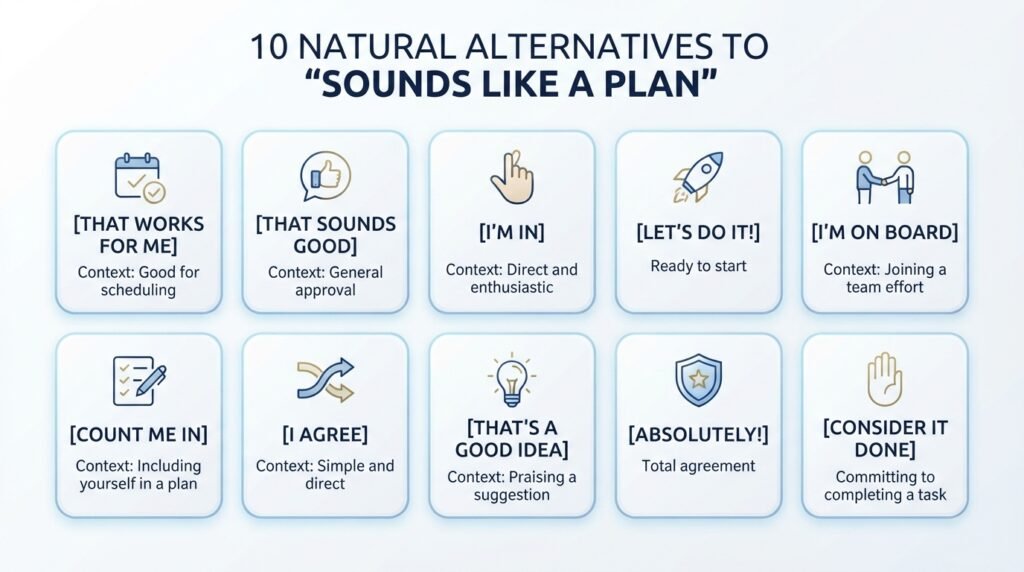
1. That Works for Me
Meaning
“That works for me” means that you agree with a proposed idea, schedule, or arrangement. It is one of the most flexible alternatives because it can express simple agreement without sounding overly excited.
Best For
- Professional
- Casual
- Friendly
- Polite
Example 1
“Thursday at 3 p.m. works for me, so I’ll send over the calendar invite.”
Example 2
“Meeting at the coffee shop after work? That works for me.”
Quick Tip
Use this when you want to sound agreeable without making your response too enthusiastic.
2. That Sounds Good
Meaning
“That sounds good” shows that you like or approve of someone’s suggestion. It is natural, friendly, and easy to use in both casual conversations and many workplace situations.
Best For
- Professional
- Casual
- Friendly
- Polite
Example 1
“We can review the presentation together tomorrow. That sounds good.”
Example 2
“You found a restaurant near the theater? That sounds good to me.”
Quick Tip
Add “to me” when you want the response to sound slightly more personal and conversational.
3. I’m In
Meaning
“I’m in” means you want to participate in a proposed activity or plan. Unlike a neutral agreement, it often communicates enthusiasm and a willingness to join.
Best For
- Casual
- Friendly
- Warm
Example 1
“You’re organizing a weekend hiking trip? I’m in.”
Example 2
“If everyone is ordering pizza for the game tonight, I’m in.”
Quick Tip
Save this phrase for situations where you genuinely want to participate rather than simply approve an idea.
4. Let’s Do It
Meaning
“Let’s do it” expresses strong agreement and readiness to move forward. It sounds confident and energetic, making it useful when a decision has already been discussed.
Best For
- Casual
- Friendly
- Warm
Example 1
“We’ve compared the options, so let’s do it and book the tickets.”
Example 2
“If you’re ready to launch the project Monday, let’s do it.”
Quick Tip
This phrase works best when you want to encourage action, not just acknowledge a suggestion.
5. I’m On Board
Meaning
“I’m on board” means that you support an idea, decision, or plan. It is especially common in American workplace conversations and can sound more professional than “I’m in.”
Best For
- Professional
- Formal
- Polite
Example 1
“I’ve reviewed the proposed changes, and I’m on board with the new approach.”
Example 2
“If the team agrees on the revised timeline, I’m on board.”
Quick Tip
Use “I’m on board with…” when you want to clearly identify the specific idea you support.
6. Count Me In
Meaning
“Count me in” means you want to be included in a planned activity or event. It has a positive, friendly tone and often shows genuine enthusiasm.
Best For
- Casual
- Friendly
- Warm
Example 1
“You’re planning a beach day Saturday? Count me in.”
Example 2
“If you need volunteers for the charity event, count me in.”
Quick Tip
Use this when someone is inviting people to participate rather than simply asking for an opinion.
7. I Agree
Meaning
“I agree” directly communicates that you share someone’s opinion or support their suggestion. It is simple and clear, although it can sound more neutral than “sounds like a plan.”
Best For
- Professional
- Formal
- Polite
Example 1
“I agree that moving the deadline gives the team enough time to finish properly.”
Example 2
“I agree with your suggestion to discuss the issue before making a final decision.”
Quick Tip
Choose this when clarity matters more than enthusiasm, especially in professional discussions.
8. That’s a Good Idea
Meaning
“That’s a good idea” tells someone that you approve of their suggestion. It focuses more on the quality of the idea than on your commitment to carrying it out.
Best For
- Casual
- Friendly
- Polite
- Warm
Example 1
“Bringing snacks for the road trip is a good idea.”
Example 2
“Starting the meeting with the most urgent issue is a good idea.”
Quick Tip
Use this when you want to compliment the suggestion itself before deciding whether to participate.
9. Absolutely
Meaning
“Absolutely” can express strong agreement, approval, or willingness. Its short form makes it especially useful in conversations where the context already makes your meaning clear.
Best For
- Professional
- Casual
- Friendly
- Warm
Example 1
“Can we move forward with the updated proposal?” “Absolutely.”
Example 2
“Would you like me to send the details before the meeting?” “Absolutely.”
Quick Tip
Because it is brief and strong, use it when you want your agreement to sound confident.
10. Consider It Done
Meaning
“Consider it done” means you are confident that you will handle a requested task or action. It goes beyond agreement by suggesting commitment and follow-through.
Best For
- Professional
- Casual
- Friendly
- Warm
Example 1
“Could you reserve the conference room for Friday?” “Consider it done.”
Example 2
“Please make sure the updated files reach the client today.” “Consider it done.”
Quick Tip
Use this when someone asks you to take action, rather than when you are simply agreeing with a general suggestion.
Comparison Table
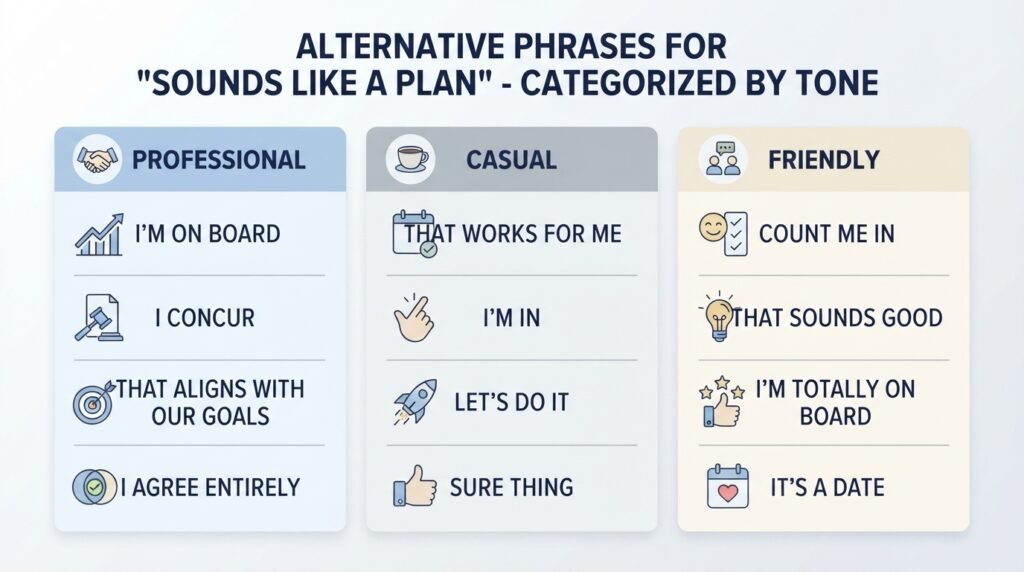
| Alternative | Best Used In | Tone |
| That works for me | Work and everyday conversations | Neutral, agreeable |
| That sounds good | General conversations | Friendly, positive |
| I’m in | Social plans | Enthusiastic |
| Let’s do it | Casual decisions | Energetic, confident |
| I’m on board | Workplace discussions | Professional, supportive |
| Count me in | Invitations and group plans | Friendly, enthusiastic |
| I agree | Opinions and decisions | Direct, neutral |
| That’s a good idea | Suggestions | Positive, encouraging |
| Absolutely | Agreement and approval | Confident, strong |
| Consider it done | Tasks and requests | Confident, committed |
Common Mistakes
- Using casual phrases in professional emails
Expressions such as “I’m in” or “Let’s do it” may sound too informal in some business settings. “That works for me” or “I’m on board” is often safer. - Choosing overly formal language
Not every conversation needs polished business language. Using stiff wording with close friends can make a simple agreement sound unnatural. - Repeating the same phrase
Saying “sounds like a plan” in every conversation can become repetitive. Rotate your wording based on what you actually want to communicate. - Forgetting context
Some alternatives express participation, while others only express approval. “I’m in” means you want to participate, whereas “That’s a good idea” may only mean you like the suggestion. - Sounding insincere
Strong expressions such as “Absolutely” can sound excessive if you do not genuinely agree. Choose language that matches your actual level of enthusiasm.
Frequently Asked Questions
What is another way to say “sounds like a plan”?
Common alternatives include “that works for me,” “that sounds good,” “I’m in,” “let’s do it,” “I’m on board,” and “count me in.” The best choice depends on whether you want to sound casual, enthusiastic, professional, or simply agreeable.
Is “that works for me” the same as “sounds like a plan”?
They are very similar, but they can have slightly different meanings. “Sounds like a plan” usually shows general agreement with a proposed course of action. “That works for me” focuses more specifically on whether the arrangement, timing, or suggestion is acceptable to you.
What is a professional way to say “sounds like a plan”?
“That works for me” and “I’m on board” are strong professional alternatives. You can also say “I agree” when discussing an opinion or decision. These expressions are clear and natural without sounding too casual for most workplace conversations.
Is “I’m in” a good replacement for “sounds like a plan”?
Yes, but “I’m in” is more enthusiastic and usually means that you want to participate. It works especially well when someone invites you to an activity or group plan. For a neutral response, “That works for me” is a better choice.
How do you say “sounds like a plan” in a formal way?
For formal situations, try “That works for me,” “I agree with that approach,” or “I’m in agreement with the proposed plan.” The first option is usually the most natural because extremely formal wording can sound awkward in everyday professional communication.
What is a friendly way to say “sounds like a plan”?
Friendly alternatives include “That sounds good,” “I’m in,” “Count me in,” and “Let’s do it.” Your choice depends on how excited you feel. “Count me in” and “Let’s do it” generally sound more energetic than “That sounds good.”
Can I use “sounds like a plan” in a work email?
Yes. “Sounds like a plan” is acceptable in many informal workplace emails and messages, especially when communicating with colleagues you know well. For a more polished or formal message, “That works for me” or “I’m on board” may be more appropriate.
What is the difference between “I agree” and “I’m on board”?
“I agree” usually means you share someone’s opinion or support a statement. “I’m on board” often suggests broader support for an idea, decision, or plan and can also imply that you are willing to help move it forward.
Conclusion
Knowing another way to say “sounds like a plan” gives you more flexibility when agreeing with ideas, schedules, and invitations. While the original phrase is friendly and natural, the best alternative depends on what you want your response to communicate.
Choose “that works for me” for a versatile and professional response, “I’m in” when you want to show enthusiasm, and “I’m on board” when discussing a plan at work. For stronger, action-focused agreement, “let’s do it” works well, while “consider it done” shows commitment to completing a task. For more examples of ways to express agreement in English, you can also explore Cambridge Dictionary’s explanation of agree.
Sarah Whitfield is the founder and lead editor of Anchors Press. With a background in copyediting and content strategy, she reviews every guide for accuracy, tone, and everyday usefulness before it’s published.