
What Does “Another Way to Say As You Are Aware” Mean?
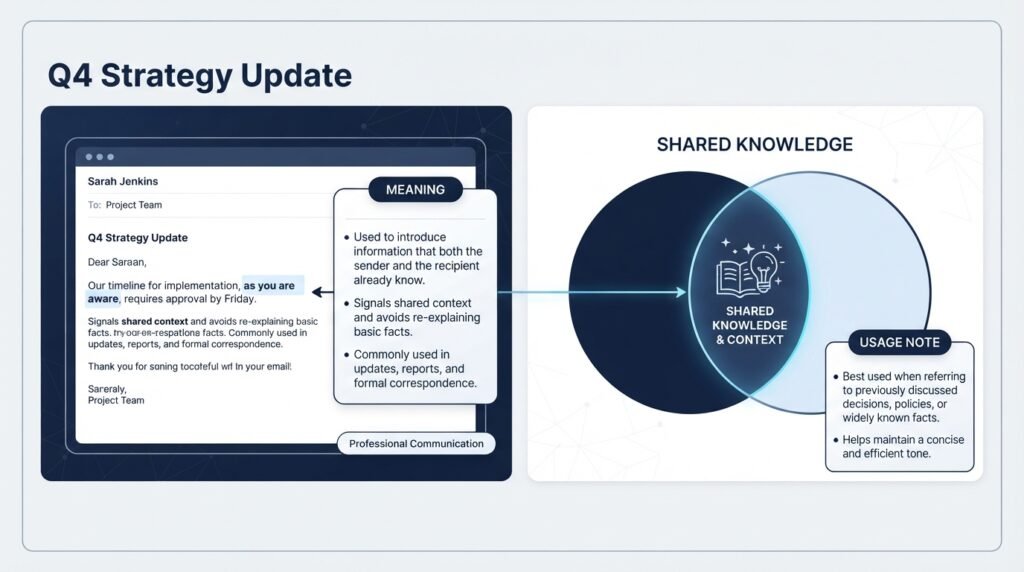
The phrase “as you are aware” means that you believe the person you are speaking or writing to already knows about something. It is common in professional emails, workplace conversations, reports, announcements, and formal correspondence.
For example, you might write, “As you are aware, the deadline has been moved to Friday.” The phrase signals that the information is not completely new to the reader.
However, “as you are aware” can sometimes sound stiff, repetitive, or overly formal. Using another way to say it can make your writing feel smoother and more natural without changing the meaning.
Why Use Other Ways to Say “As You Are Aware”?
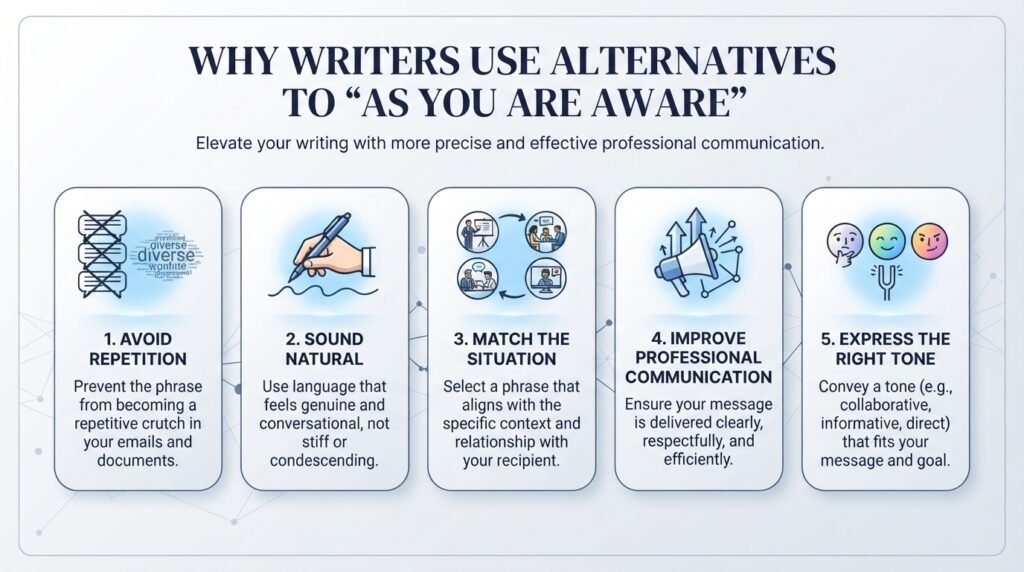
Choosing a different expression can help you match your tone to the situation. A casual conversation usually needs simpler language, while a business email may benefit from a more polished alternative.
Using alternatives can help you:
- Avoid repetitive wording.
- Make professional emails sound more natural.
- Adjust your tone for different audiences.
- Refer to shared information politely.
- Avoid sounding overly formal or scripted.
- Make your writing clearer and more conversational.
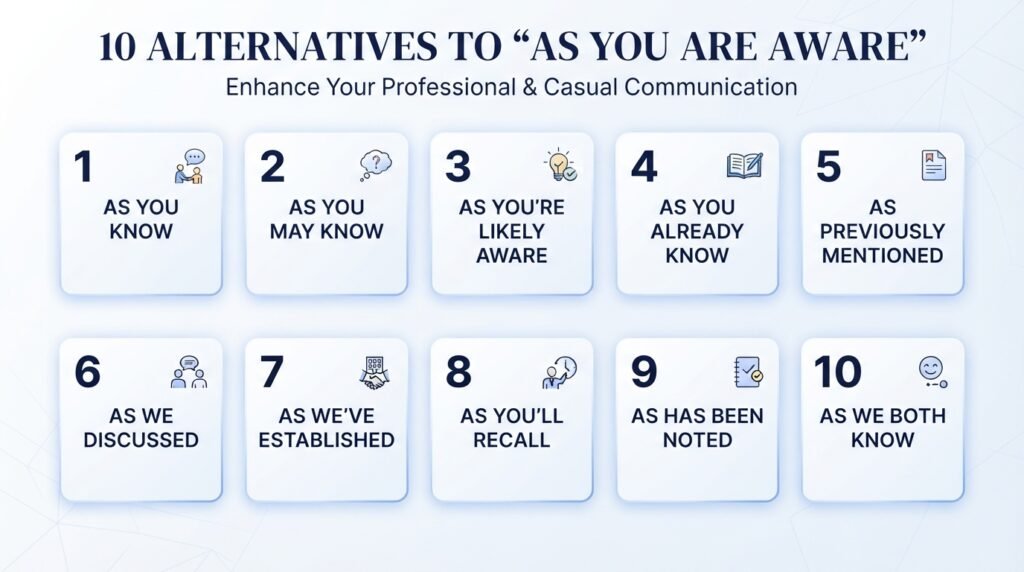
10 Best Other Ways to Say “As You Are Aware”
1. As You Know
Meaning
“As you know” directly tells someone that you believe they already know the information. It is simple, natural, and much less formal than “as you are aware.”
Best For
- Professional
- Friendly
- Casual
- Polite
Example 1
As you know, our team is preparing for the annual client meeting.
Example 2
As you know, Sarah has been leading the project since January.
Quick Tip
Use “as you know” when you want a straightforward alternative that works in both conversation and workplace writing.
2. As You May Know
Meaning
“As you may know” is a softer version of “as you know.” It does not assume with complete certainty that the reader already has the information.
Best For
- Professional
- Formal
- Polite
- Friendly
Example 1
As you may know, the company recently introduced a new vacation policy.
Example 2
As you may know, the conference will take place in Chicago this September.
Quick Tip
Choose this phrase when you think the reader probably knows something but you do not want to make an absolute assumption.
3. As You’re Likely Aware
Meaning
“As you’re likely aware” suggests that the information is probably familiar to the reader. It sounds polished without being as rigid as some formal expressions.
Best For
- Professional
- Formal
- Polite
Example 1
As you’re likely aware, the software update will affect several existing features.
Example 2
As you’re likely aware, our office will close early on Friday.
Quick Tip
This is a good choice when writing to colleagues, clients, or business contacts and you want a professional but measured tone.
4. As You Already Know
Meaning
“As you already know” emphasizes that the person has received or understood the information before. It can sound friendly, but context matters.
Best For
- Casual
- Friendly
- Professional
Example 1
As you already know, we agreed to review the proposal before sending it to the client.
Example 2
As you already know, the apartment is available starting next month.
Quick Tip
Use this phrase when previous knowledge is important to the point you are making, but avoid it if it could sound impatient or condescending.
5. As Previously Mentioned
Meaning
“As previously mentioned” refers to information that you discussed or provided earlier. Unlike “as you know,” it does not directly assume what the reader remembers.
Best For
- Professional
- Formal
- Polite
Example 1
As previously mentioned, all applications must be submitted by Friday.
Example 2
As previously mentioned, the revised contract includes three additional terms.
Quick Tip
This phrase works especially well in reports, formal emails, proposals, and documents where you need to point back to earlier information.
6. As We Discussed
Meaning
“As we discussed” is useful when you and the reader have personally talked about the subject before. It creates a direct connection to a previous conversation.
Best For
- Professional
- Friendly
- Polite
Example 1
As we discussed, I’ll send the final design files by Thursday.
Example 2
As we discussed during our meeting, the marketing budget will remain unchanged.
Quick Tip
Use this option when the information came from a previous conversation, meeting, call, or discussion between you and the reader.
7. As We’ve Established
Meaning
“As we’ve established” refers to something that has already been agreed upon or clearly determined. It works best when there is a shared understanding.
Best For
- Professional
- Formal
Example 1
As we’ve established, customer satisfaction remains our main priority.
Example 2
As we’ve established in earlier meetings, the project cannot move forward without approval.
Quick Tip
Reserve this phrase for situations where something has genuinely been settled. Otherwise, it may sound too forceful.
8. As You’ll Recall
Meaning
“As you’ll recall” politely reminds someone of information they have encountered before. It is slightly formal and works particularly well in business correspondence.
Best For
- Formal
- Professional
- Polite
Example 1
As you’ll recall, we approved the revised budget during last week’s meeting.
Example 2
As you’ll recall, the original proposal included a six-month implementation period.
Quick Tip
Use it when reminding someone about a previous decision or conversation, especially when the detail is relevant to the current discussion.
9. As Has Been Noted
Meaning
“As has been noted” focuses on information that has already been stated or recognized. It sounds formal and impersonal.
Best For
- Formal
- Professional
Example 1
As has been noted, the current system requires additional security measures.
Example 2
As has been noted in the report, sales increased significantly during the second quarter.
Quick Tip
This expression fits reports, academic-style writing, business documents, and other situations where an objective tone is appropriate.
10. As We Both Know
Meaning
“As we both know” highlights knowledge that you and another person share. It creates a sense of common understanding but should be used carefully.
Best For
- Friendly
- Casual
- Professional
Example 1
As we both know, finding reliable suppliers can take time.
Example 2
As we both know, the first few weeks of a new project can be unpredictable.
Quick Tip
Use this phrase when the shared knowledge is genuinely mutual. In formal writing, a less personal option may sound more appropriate.
Comparison Table
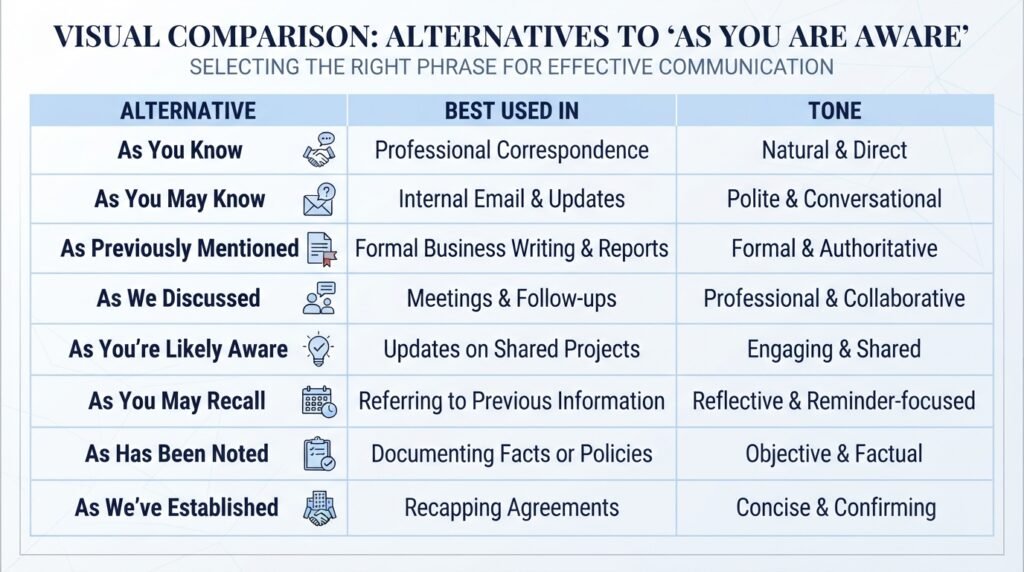
| Alternative | Best Used In | Tone |
| As you know | Everyday and professional communication | Natural |
| As you may know | Emails and introductions | Polite |
| As you’re likely aware | Business communication | Professional |
| As you already know | Familiar conversations | Friendly |
| As previously mentioned | Reports and formal emails | Formal |
| As we discussed | Follow-up emails and meetings | Professional |
| As we’ve established | Agreements and decisions | Firm |
| As you’ll recall | Reminders and correspondence | Polite |
| As has been noted | Reports and formal writing | Formal |
| As we both know | Shared understanding | Friendly |
Common Mistakes
1. Using Casual Phrases in Professional Emails
Phrases such as “as we both know” can feel too personal in certain business situations. Choose a more neutral expression when communicating with clients, managers, or unfamiliar contacts.
2. Choosing Overly Formal Language
Expressions such as “as has been noted” can sound stiff in a simple email. If the message is informal, “as you know” may communicate the same idea more naturally.
3. Repeating the Same Phrase
Using “as you are aware” throughout several emails or documents can make your writing feel repetitive. Rotate alternatives when the context genuinely calls for a different tone.
4. Forgetting the Context
Not every reader will actually know the information you are mentioning. If you are unsure, “as you may know” is often safer because it does not make a strong assumption.
5. Sounding Insincere or Condescending
Some phrases can sound like reminders that the reader should already know something. If the information may be sensitive, state the fact directly instead of emphasizing the reader’s supposed knowledge.
Frequently Asked Questions
What is the most natural alternative to “as you are aware”?
“As you know” is usually the most natural alternative. It works in everyday conversations, workplace communication, and many professional emails. If you are not certain that the reader knows the information, “as you may know” is a better choice because it sounds less assumptive.
What is a professional way to say “as you are aware”?
“As you may know,” “as you’re likely aware,” and “as previously mentioned” are strong professional alternatives. The best option depends on your meaning. Use “as you may know” for polite introductions and “as previously mentioned” when referring specifically to information discussed earlier.
Is “as you know” formal or informal?
“As you know” can work in both formal and informal settings. It is generally more conversational than “as you are aware,” which makes it a useful choice for professional emails that should sound natural rather than overly formal.
Is “as you may know” polite?
Yes. “As you may know” is generally polite because it does not assume that the reader definitely knows the information. It works particularly well when introducing a fact that may already be familiar to the recipient.
What can I say instead of “as you are aware” in an email?
For most emails, try “as you know,” “as you may know,” “as we discussed,” or “as previously mentioned.” Choose “as we discussed” when referring to a conversation and “as previously mentioned” when pointing back to something already written.
Does “as you are aware” sound rude?
Not necessarily, but it can sometimes sound stiff or slightly confrontational depending on the context. If you are reminding someone about something they may have forgotten, “as you may know” or a direct statement can sound softer.
What is the best alternative for a formal letter?
“As previously mentioned” or “as you’ll recall” can work well in formal correspondence. For highly formal reports, “as has been noted” may be appropriate when you want an objective, impersonal style.
What is a shorter way to say “as you are aware”?
The simplest option is “as you know.” It preserves the basic meaning while using fewer words. If you want to avoid assuming that the reader knows the information, use “as you may know” instead.
Conclusion
Knowing another way to say “as you are aware” gives you more flexibility when writing emails, reports, messages, and everyday conversations. While the original phrase is grammatically correct, it can sometimes sound more formal than necessary.
The key is to consider your audience and purpose before choosing a phrase. A natural alternative should make your message clearer, not simply replace words. For more guidance on professional and effective writing, Purdue OWL is a useful resource.

Daniel Cho writes about professional communication, drawing on years spent training teams on clear, confident workplace writing — from emails to performance reviews.