
What Does “Another Way to Say Stay Connected” Mean?

“Stay connected” means continuing to communicate, maintain a relationship, or keep contact with someone over time. People commonly use it after meeting someone, ending a conversation, changing jobs, moving away, or discussing an ongoing relationship.
The phrase can apply to friends, family members, coworkers, clients, professional contacts, and online communities. It usually has a warm and positive tone and suggests that both people should continue communicating.
Why Use Other Ways to Say “Stay Connected”?
Using different expressions can make your writing and conversations sound more natural. It also helps you choose language that fits the relationship and situation.
Other phrases can help you:
- Avoid repeating “stay connected.”
- Sound more natural in everyday conversations.
- Maintain a professional tone in emails.
- Express warmth and friendliness.
- Choose language that fits the level of familiarity.
- Make farewell messages feel more personal.
10 Best Other Ways to Say “Stay Connected”
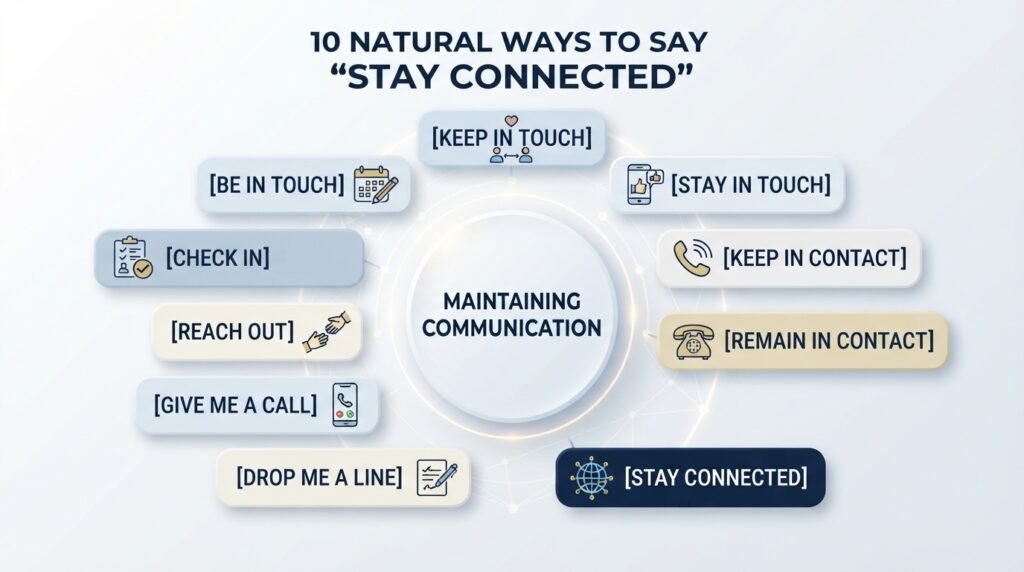
1. Keep in Touch
Meaning
“Keep in touch” means continuing to communicate with someone after a conversation, meeting, or period of time apart. It is one of the most common and natural alternatives to “stay connected.”
Best For
- Casual
- Friendly
- Warm
- Professional
Example 1
It was great working with you, so please keep in touch.
Example 2
We’re moving to different cities, but I hope we can keep in touch.
Quick Tip
Use “keep in touch” when you want a friendly phrase that works in both personal and professional situations.
2. Stay in Touch
Meaning
“Stay in touch” has almost the same meaning as “keep in touch.” It suggests that you want communication to continue even though circumstances may change.
Best For
- Friendly
- Casual
- Warm
- Polite
Example 1
Thanks for all your help during the project. Stay in touch!
Example 2
Even after graduation, we promised to stay in touch.
Quick Tip
This phrase works especially well at the end of a friendly message, email, or farewell conversation.
3. Keep in Contact
Meaning
“Keep in contact” means continuing communication with another person. It sounds a little more formal and businesslike than “keep in touch.”
Best For
- Professional
- Formal
- Polite
Example 1
I’ll keep in contact with the supplier regarding the updated schedule.
Example 2
We should keep in contact as the partnership develops.
Quick Tip
Choose this option when you are discussing an ongoing professional relationship rather than a close personal friendship.
4. Remain in Contact
Meaning
“Remain in contact” means continuing to communicate with someone over a period of time. Its formal tone makes it useful when you want your writing to sound polished and professional.
Best For
- Formal
- Professional
- Polite
Example 1
I hope we can remain in contact after the conference.
Example 2
Our teams will remain in contact throughout the transition.
Quick Tip
Use “remain in contact” in formal emails, business correspondence, and professional documents.
5. Keep the Conversation Going
Meaning
“Keep the conversation going” suggests that you want communication to continue rather than end after one interaction. It can sound more engaging than simply saying “stay connected.”
Best For
- Casual
- Friendly
- Warm
Example 1
I enjoyed discussing your ideas, so let’s keep the conversation going.
Example 2
Send me your thoughts when you have time, and we can keep the conversation going.
Quick Tip
This phrase is especially useful when you want to encourage an ongoing discussion rather than simply exchange occasional messages.
6. Keep the Lines of Communication Open
Meaning
“Keep the lines of communication open” means making sure people can continue contacting and communicating with one another. It is commonly used when discussing work, teamwork, or important relationships.
Best For
- Professional
- Formal
- Polite
Example 1
Let’s keep the lines of communication open while we finalize the agreement.
Example 2
Our support team will keep the lines of communication open throughout the process.
Quick Tip
This phrase is best suited to professional or serious situations where continued communication matters.
7. Remain Connected
Meaning
“Remain connected” communicates the idea of maintaining a relationship or connection over time. Compared with “stay connected,” it can sound slightly more polished or reflective.
Best For
- Formal
- Professional
- Warm
Example 1
We may be joining different teams, but I hope we remain connected.
Example 2
The alumni group helps former students remain connected after graduation.
Quick Tip
Use “remain connected” when you want to emphasize a lasting relationship rather than frequent communication.
8. Keep Up With Each Other
Meaning
“Keep up with each other” means continuing to know what is happening in another person’s life. It often suggests occasional updates rather than regular communication.
Best For
- Casual
- Friendly
- Warm
Example 1
Let’s exchange numbers so we can keep up with each other.
Example 2
We don’t see each other often, but we still keep up with each other online.
Quick Tip
This phrase feels natural among friends, classmates, former coworkers, and other familiar contacts.
9. Continue the Connection
Meaning
“Continue the connection” emphasizes maintaining an existing relationship or bond. It is less common in everyday conversation but can work well when discussing professional relationships or meaningful interactions.
Best For
- Professional
- Formal
- Warm
Example 1
We hope this event gives participants a chance to continue the connection.
Example 2
Our team would like to continue the connection we established during the workshop.
Quick Tip
Use this phrase sparingly because more common expressions such as “keep in touch” usually sound more natural in casual speech.
10. Let’s Keep in Contact
Meaning
“Let’s keep in contact” directly suggests that both people should continue communicating. It is slightly more businesslike than “let’s keep in touch.”
Best For
- Professional
- Polite
- Formal
Example 1
It was a pleasure meeting you at the conference. Let’s keep in contact.
Example 2
I’ll send you the updated information next week, and let’s keep in contact.
Quick Tip
Use this version when you want to suggest future communication without sounding overly personal.
Comparison Table
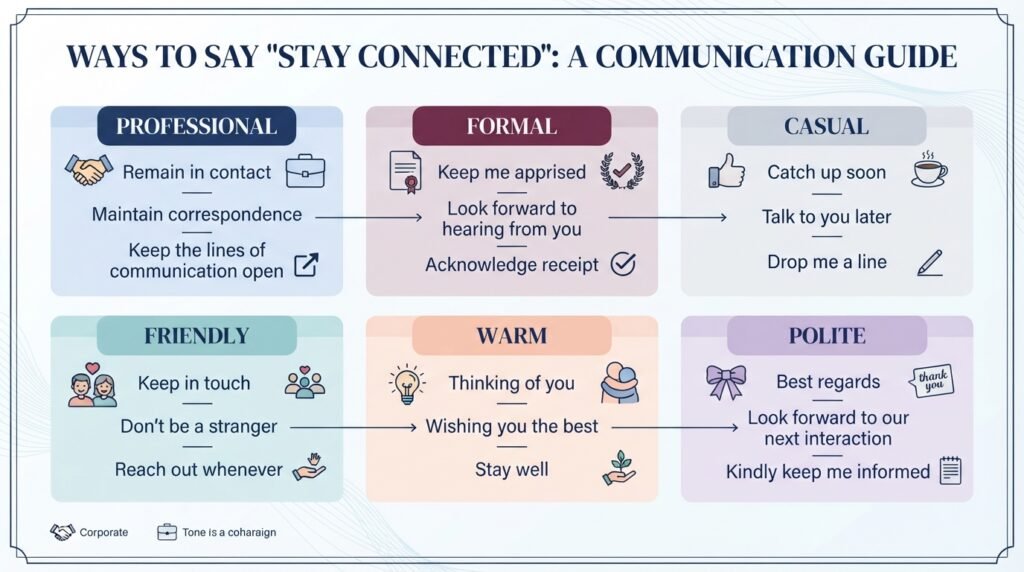
| Alternative | Best Used In | Tone |
| Keep in touch | Everyday conversations | Friendly |
| Stay in touch | Farewells and personal messages | Warm |
| Keep in contact | Workplace communication | Professional |
| Remain in contact | Formal correspondence | Formal |
| Keep the conversation going | Ongoing discussions | Engaging |
| Keep the lines of communication open | Business and teamwork | Professional |
| Remain connected | Long-term relationships | Warm/Formal |
| Keep up with each other | Friends and acquaintances | Casual |
| Continue the connection | Events and professional relationships | Formal/Warm |
| Let’s keep in contact | Business follow-ups | Polite |
Common Mistakes
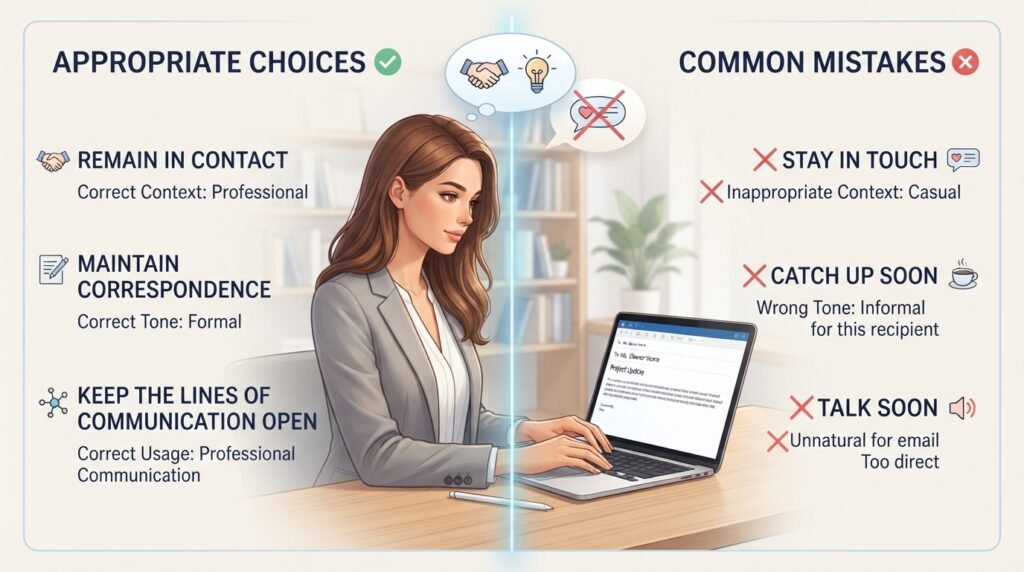
1. Using Casual Phrases in Professional Emails
“Keep in touch” can work professionally, but highly formal messages may benefit from “remain in contact” or “keep in contact.” Always consider your relationship with the recipient.
2. Choosing Overly Formal Language
Not every situation requires formal wording. Saying “remain in contact” to a close friend may sound stiff when “keep in touch” feels much more natural.
3. Repeating the Same Phrase
Using “stay connected” several times in one article, email, or conversation can make your language feel repetitive. Vary your wording when the context allows it.
4. Forgetting Context
Different alternatives communicate slightly different ideas. “Keep the conversation going” focuses on an active discussion, while “remain connected” emphasizes maintaining a relationship.
5. Sounding Insincere
A phrase such as “let’s keep in touch” can feel automatic when used without genuine intent. If you truly want future communication, consider adding a specific next step, such as suggesting a call or follow-up.
Frequently Asked Questions
What is the most natural way to say “stay connected”?
“Keep in touch” is probably the most natural alternative to “stay connected” in everyday American English. It works with friends, coworkers, former classmates, clients, and acquaintances. For a more formal situation, “remain in contact” or “keep in contact” may be a better choice.
What is a professional way to say “stay connected”?
“Keep in contact,” “remain in contact,” and “keep the lines of communication open” are strong professional alternatives. “Remain in contact” is particularly useful in formal emails, while “keep the lines of communication open” works well when discussing teamwork or an ongoing business relationship.
Is “keep in touch” the same as “stay connected”?
Yes, the two phrases are very similar. Both suggest continuing communication or maintaining a relationship. However, “keep in touch” is often more conversational and natural in everyday American English, while “stay connected” can also refer to maintaining a broader personal, professional, or digital connection.
How do you say “stay connected” in a friendly way?
“Keep in touch” and “stay in touch” are excellent friendly choices. You can also say “let’s keep talking” or “keep up with each other” when speaking with someone you know well. The best option depends on whether you want to encourage regular communication or simply maintain the relationship.
What is a formal way to say “stay connected”?
“Remain in contact” is one of the clearest formal alternatives. “Keep the lines of communication open” is another strong option, especially in business settings. These phrases sound more polished than casual expressions and can fit professional emails, workplace communication, and formal correspondence.
How do you say “stay connected” in an email?
The best wording depends on your relationship with the recipient. For a friendly professional email, try “I hope we can keep in touch.” For a more formal message, use “I hope we can remain in contact.” You can also suggest a specific follow-up to make the message more genuine.
What is another way to say “let’s stay connected”?
You can say “let’s keep in touch,” “let’s stay in touch,” “let’s keep in contact,” or “let’s keep the conversation going.” “Let’s keep in touch” is the most natural general-purpose choice, while “let’s keep in contact” has a more professional tone.
Can I use “stay connected” in a professional setting?
Yes. “Stay connected” is perfectly acceptable in professional communication, particularly when discussing networking, collaboration, clients, or former coworkers. However, the phrase can sometimes sound broad or promotional. If you mean continued communication specifically, “keep in touch” or “remain in contact” may be more precise.
Conclusion
Knowing another way to say “stay connected” gives you more flexibility in personal and professional communication. While “stay connected” is clear and versatile, alternatives such as “keep in touch,” “stay in touch,” and “keep in contact” can make your message better suited to the situation.
Choose “keep in touch” for a natural, friendly expression, “remain in contact” for formal communication, and “keep the lines of communication open” when discussing professional relationships or teamwork. For ongoing conversations, “keep the conversation going” is a more engaging choice.

Daniel Cho writes about professional communication, drawing on years spent training teams on clear, confident workplace writing — from emails to performance reviews.