

What Does “Another Way to Say On Behalf of” Mean?

The phrase “on behalf of” means acting, speaking, writing, or making a decision for another person, organization, or group. For example, “I am writing on behalf of our manager” means you are communicating as a representative of your manager.
The phrase is common in business emails, formal letters, speeches, legal documents, customer service, and workplace communication. However, repeating it can make your writing feel predictable, so choosing a suitable alternative can make your message more natural.
Why Use Other Ways to Say “On Behalf of”?

Different situations call for different levels of formality. A phrase that sounds appropriate in a legal letter may feel too stiff in a friendly email.
Using alternatives can help you:
- Avoid repeating the same expression.
- Make professional writing sound more natural.
- Clarify who you represent.
- Match your wording to the situation.
- Show whether you are speaking, acting, or writing for someone else.
- Create a more polished and precise message.
10 Best Other Ways to Say “On Behalf of”
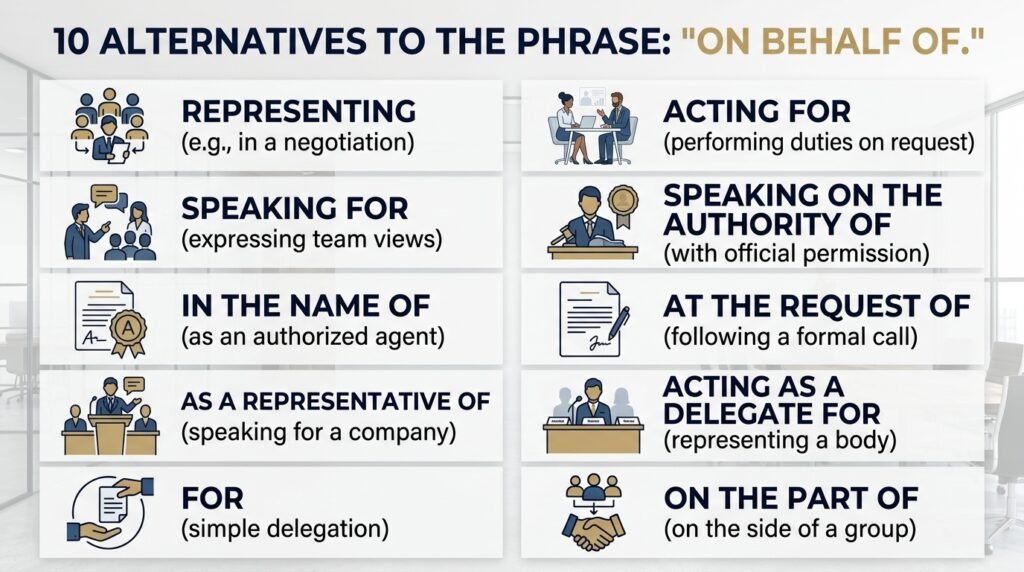
1. Representing
Meaning
“Representing” means acting or speaking as an authorized representative of a person, company, organization, or group. It is one of the most versatile replacements for “on behalf of,” especially in professional communication.
Best For
- Professional
- Formal
- Polite
Example 1
Representing our entire sales team, I would like to thank you for your support.
Example 2
She attended the conference representing the company’s marketing department.
Quick Tip
Use “representing” when you want your sentence to sound concise and professional without being overly formal.
2. Speaking for
Meaning
“Speaking for” means expressing the thoughts, opinions, or position of another person or group. It is especially useful when you are communicating a message or viewpoint rather than performing a task.
Best For
- Professional
- Casual
- Friendly
Example 1
Speaking for everyone on the committee, I appreciate your hard work.
Example 2
I believe I can say, speaking for the whole team, that we are pleased with the results.
Quick Tip
Choose “speaking for” when the main idea is that you are communicating someone’s feelings, opinions, or response.
3. In the Name of
Meaning
“In the name of” can mean acting or speaking with the authority of a person, organization, or group. It has a formal quality and is often appropriate when making an official statement or acknowledgment.
Best For
- Formal
- Professional
- Polite
Example 1
In the name of the board, I welcome all of our new members.
Example 2
He accepted the award in the name of his late mentor.
Quick Tip
Use this phrase when you want to emphasize an official connection or representational role.
4. As a Representative of
Meaning
“As a representative of” clearly identifies you as someone acting for a particular person, company, or organization. It is especially useful when your role or authority needs to be clear.
Best For
- Formal
- Professional
- Polite
Example 1
As a representative of our organization, I am pleased to attend today’s meeting.
Example 2
She spoke as a representative of the local business community.
Quick Tip
This is a strong choice when clarity matters more than brevity, such as in official correspondence or introductions.
5. For
Meaning
In some sentences, the simple word “for” can replace “on behalf of” without changing the basic meaning. It works best when the surrounding sentence clearly shows that you are acting for someone else.
Best For
- Casual
- Friendly
- Professional
Example 1
I accepted the package for my supervisor while she was away.
Example 2
He signed the document for the department manager.
Quick Tip
Use “for” only when the meaning remains unmistakable. In formal or sensitive situations, “representing” may provide more clarity.
6. Acting for
Meaning
“Acting for” means performing a task or making a decision for another person or organization. It emphasizes action and responsibility rather than simply communicating a message.
Best For
- Professional
- Formal
Example 1
She was acting for the director during his absence.
Example 2
Our attorney is acting for the company in this matter.
Quick Tip
Use “acting for” when someone has a specific responsibility or authority to handle something for another party.
7. Speaking on the Authority of
Meaning
“Speaking on the authority of” indicates that someone is communicating with permission or authority from another person or organization. It is more formal than everyday alternatives.
Best For
- Formal
- Professional
Example 1
Speaking on the authority of the board, I can confirm that the proposal has been approved.
Example 2
She issued the statement speaking on the authority of the organization’s leadership.
Quick Tip
Reserve this phrase for situations where authorization or official authority is important.
8. At the Request of
Meaning
“At the request of” means you are doing something because another person or organization asked you to do it. Unlike “representing,” it focuses on the reason for your action rather than your representative role.
Best For
- Professional
- Formal
- Polite
Example 1
At the request of the director, I have attached the revised proposal.
Example 2
We scheduled the additional meeting at the request of several department heads.
Quick Tip
Use this phrase when the other person’s request is more important than the idea of formal representation.
9. Acting as a Delegate for
Meaning
“Acting as a delegate for” means temporarily representing someone or a group, often at a meeting, event, or official function. It highlights a delegated role or responsibility.
Best For
- Formal
- Professional
Example 1
I attended the conference acting as a delegate for our regional office.
Example 2
Maria joined the negotiations acting as a delegate for the employees.
Quick Tip
This expression works best when someone has been specifically chosen or appointed to represent another party.
10. On the Part of
Meaning
“On the part of” is a formal expression that can sometimes communicate an action, feeling, or position associated with a particular person or group. It is less direct than “representing,” so context matters.
Best For
- Formal
- Professional
- Polite
Example 1
We appreciate the cooperation shown on the part of your entire team.
Example 2
There was considerable interest on the part of the organization’s members.
Quick Tip
Use this expression carefully because it does not always mean exactly the same thing as “on behalf of.” “Representing” is usually clearer when you mean formal representation.
Comparison Table

| Alternative | Best Used In | Tone |
| Representing | Business emails, statements, introductions | Professional |
| Speaking for | Opinions, thanks, group responses | Friendly |
| In the name of | Official statements, ceremonies | Formal |
| As a representative of | Official communication, introductions | Formal |
| For | Everyday communication | Casual |
| Acting for | Duties, responsibilities, decisions | Professional |
| Speaking on the authority of | Official announcements | Formal |
| At the request of | Requests, instructions, assignments | Professional |
| Acting as a delegate for | Meetings, conferences, negotiations | Formal |
| On the part of | Formal descriptions and statements | Formal |
Common Mistakes

1. Using Casual Phrases in Professional Emails
Replacing “on behalf of” with an overly casual expression can make an email sound less polished. Choose “representing” or “as a representative of” when writing to clients, executives, or external organizations.
2. Choosing Overly Formal Language
Not every situation requires formal wording. In a simple workplace message, “for” may sound much more natural than “speaking on the authority of.”
3. Repeating the Same Phrase
Using “on behalf of” several times in one document can make your writing repetitive. Vary the wording when the meaning and context allow it.
4. Forgetting the Context
Not every alternative has exactly the same meaning. For example, “at the request of” focuses on someone’s request, while “representing” focuses on your role as a representative.
5. Sounding Insincere
A highly formal expression can create distance when the situation calls for warmth. When thanking people or expressing a group’s feelings, “speaking for” may sound more genuine.
Frequently Asked Questions
What is another way to say “on behalf of” in a professional email?
“Representing” is one of the best choices for a professional email. For example, instead of saying “I am writing on behalf of our team,” you can write, “I am writing representing our team.” Depending on the sentence, “for” or “as a representative of” may also work naturally.
What is a formal synonym for “on behalf of”?
Formal alternatives include “as a representative of,” “in the name of,” and “acting for.” The best option depends on the context. “As a representative of” is particularly clear when you need to identify your official role, while “in the name of” can sound more ceremonial.
Can I use “representing” instead of “on behalf of”?
Yes. “Representing” is often a natural and concise replacement. For example, “Representing the company, she attended the meeting” communicates that she attended as the company’s representative. However, make sure the sentence remains grammatically natural after making the substitution.
What is another way to say “on behalf of our team”?
You can say “representing our team,” “speaking for our team,” or simply “for our team,” depending on the situation. “Representing our team” works well in professional communication, while “speaking for our team” is useful when expressing the group’s opinion, appreciation, or feelings.
What is a casual way to say “on behalf of”?
The simplest casual alternative is often “for.” For example, “I picked up the documents for Sarah” can replace “I picked up the documents on behalf of Sarah.” “Speaking for” is another natural option when you are expressing someone’s thoughts or feelings.
Is “in the name of” the same as “on behalf of”?
Not always. “In the name of” can suggest acting with someone’s authority or representing a person or group in an official way. “On behalf of” is broader and commonly describes communicating or acting for someone else. Choose based on the exact meaning you want to convey.
How do I say “on behalf of the company” professionally?
Good professional options include “representing the company” and “as a representative of the company.” For example, “Representing the company, I would like to welcome you” sounds concise and polished. “As a representative of the company” is slightly more explicit and formal.
What is the difference between “for” and “on behalf of”?
“For” is broader and more conversational, while “on behalf of” clearly indicates that you are acting or communicating as another person’s representative. In formal situations, “on behalf of” can prevent ambiguity. In everyday situations, “for” is often simpler and more natural.
Conclusion
Knowing another way to say on behalf of gives you more flexibility in professional and everyday communication. While “on behalf of” remains clear and useful, alternatives such as “representing,” “speaking for,” and “as a representative of” can make your writing more precise.
The key is to match the phrase with your meaning, audience, and level of formality. When the context is clear, the right alternative can make even a simple sentence sound more natural and confident. This is especially important in professional communication, where word choice can affect clarity and tone.

Amara Reyes has taught English to adult learners for over eight years. She focuses on how phrases are actually used in everyday conversation, not just textbook definitions.