What Does “What Is Another Way to Say With That Being Said” Mean?
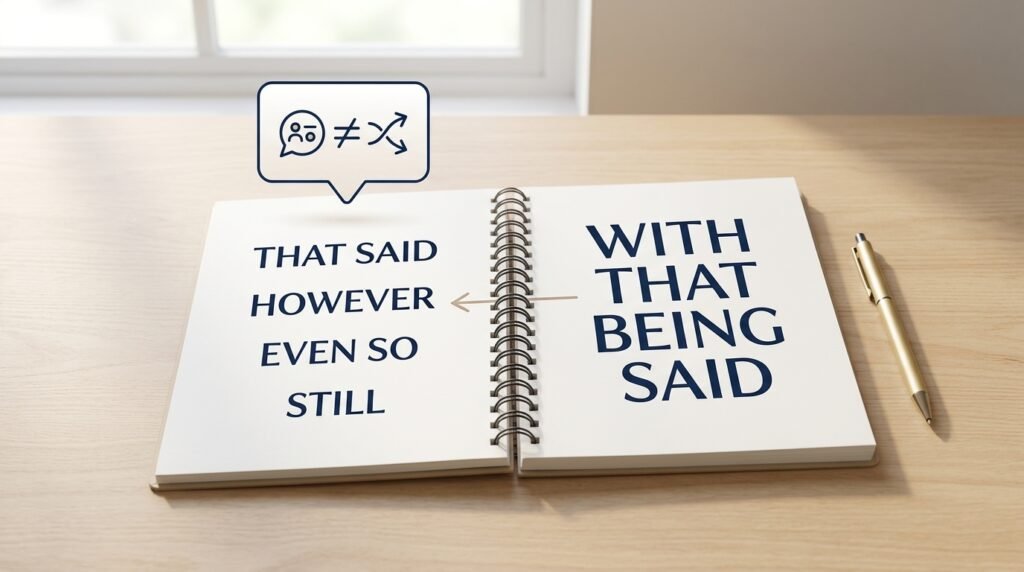
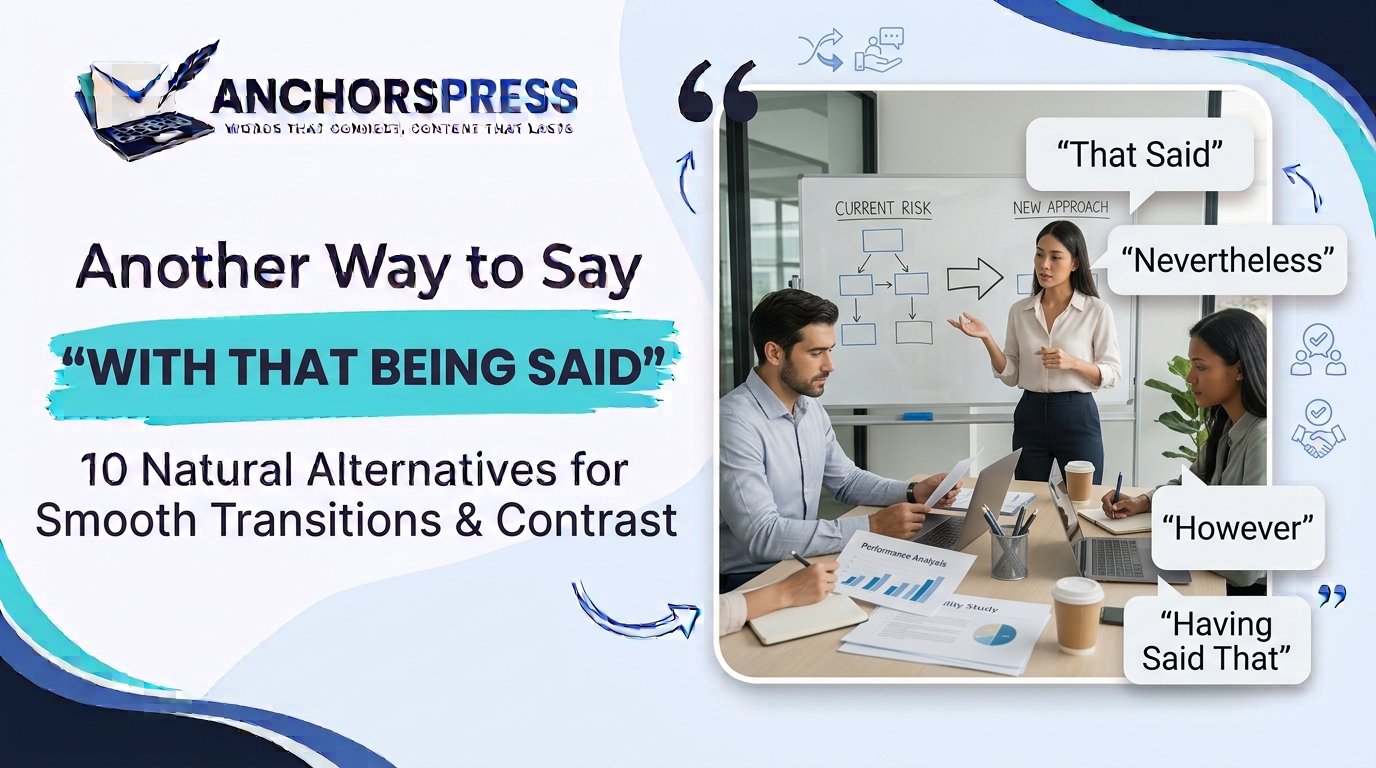
The phrase “what is another way to say with that being said” means you are looking for a different expression that can replace “with that being said” while keeping a similar meaning.
“With that being said” often signals a contrast, qualification, or shift in perspective. It is common in conversations, essays, business writing, presentations, emails, and online content.
For instance:
The project will require more time than expected. With that being said, the final result should be worth the wait.
The phrase connects two related thoughts while showing that the second point adds nuance to the first.
Why Use Other Ways to Say “With That Being Said”?
Although “with that being said” is grammatically correct and widely understood, it can become repetitive when used too frequently.
Using alternatives can help you:
- Avoid repeating the same transition.
- Make your writing sound more natural.
- Match your language to the situation.
- Create smoother transitions between ideas.
- Make professional writing more concise.
- Show contrast or qualification more precisely.
The key is to choose an expression that fits the exact relationship between your ideas.
10 Best Other Ways to Say “With That Being Said”
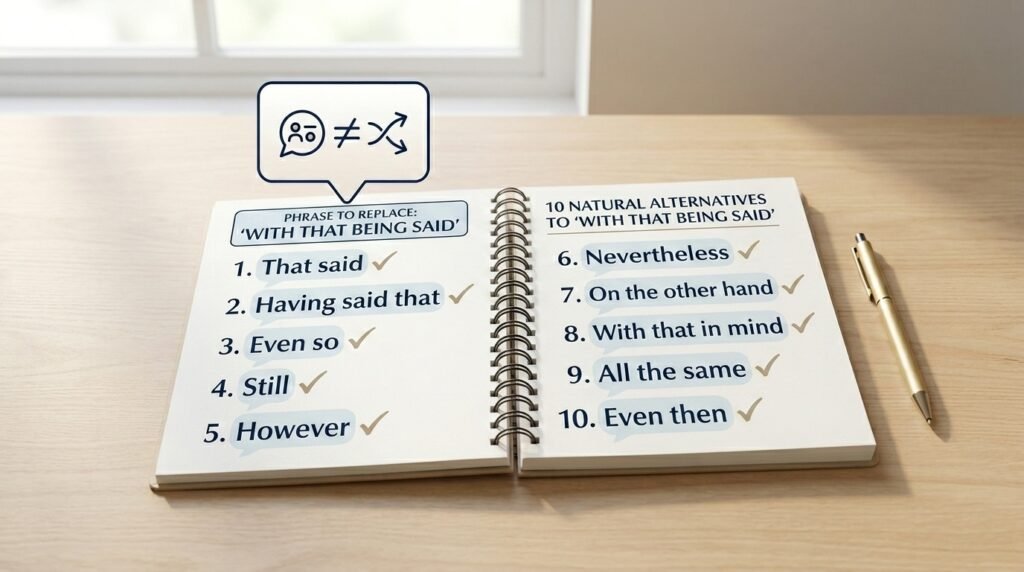
1. That Said
Meaning
“That said” is probably the closest and most natural replacement for “with that being said.” It introduces a contrasting or qualifying thought without sounding overly formal.
Best For
- Professional
- Casual
- Friendly
- Polite
Example 1
The training program is demanding. That said, it gives new employees the skills they need to succeed.
Example 2
I understand why you want to leave early. That said, we still have two important items to discuss.
Quick Tip
Use “that said” when you want a short, polished transition that works in both conversation and writing.
2. Having Said That
Meaning
“Having said that” acknowledges the previous statement before introducing another perspective. It is very close in meaning to “with that being said,” but often sounds more conversational.
Best For
- Professional
- Formal
- Friendly
- Polite
Example 1
The restaurant has limited seating. Having said that, the food and service are excellent.
Example 2
I know the schedule is already packed. Having said that, we may need another meeting to finish the planning.
Quick Tip
Choose this phrase when you want to clearly recognize the previous point before adding a qualification.
3. Even So
Meaning
“Even so” means “despite that” or “nevertheless.” It emphasizes that the next statement remains true despite what was just mentioned.
Best For
- Casual
- Friendly
- Professional
Example 1
The weather forecast looks uncertain. Even so, we’re planning to hold the event outdoors.
Example 2
The repair was more expensive than expected. Even so, replacing the old equipment was the right decision.
Quick Tip
Use “even so” when the second idea remains valid despite a problem, fact, or objection in the first sentence.
4. Still
Meaning
“Still” is a simple and natural way to introduce a contrasting thought. It sounds less formal than many other alternatives and fits everyday American English well.
Best For
- Casual
- Friendly
- Professional
Example 1
The drive takes nearly three hours. Still, the beach is worth visiting for the weekend.
Example 2
We didn’t receive as many applications as expected. Still, several candidates were highly qualified.
Quick Tip
Use “still” when you want a relaxed transition that does not make your writing sound overly formal.
5. However
Meaning
“However” introduces a contrast between two ideas and is one of the most useful choices for formal or professional writing. It is direct, familiar, and widely accepted.
Best For
- Professional
- Formal
- Polite
Example 1
The software is more expensive than competing products. However, it includes several advanced features.
Example 2
We originally planned to launch in June. However, additional testing pushed the release date back.
Quick Tip
Use “however” when clarity and professionalism matter, especially in reports, academic writing, and business communication.
6. Nevertheless
Meaning
“Nevertheless” means “despite what was just mentioned.” It creates a stronger sense of contrast and generally sounds more formal than “still” or “even so.”
Best For
- Formal
- Professional
- Polite
Example 1
The first proposal received several criticisms. Nevertheless, the committee decided to move forward with it.
Example 2
The conditions were difficult throughout the expedition. Nevertheless, the team completed its objective.
Quick Tip
Use “nevertheless” when you want to emphasize that the second point remains true despite the previous situation.
7. On the Other Hand
Meaning
“On the other hand” presents a different side of an issue. Unlike some alternatives, it often suggests that two perspectives should be compared rather than simply showing a minor qualification.
Best For
- Professional
- Casual
- Friendly
- Formal
Example 1
Working remotely gives employees more flexibility. On the other hand, some people miss having coworkers nearby.
Example 2
The smaller car costs less to operate. On the other hand, the larger model offers much more storage space.
Quick Tip
Use this expression when you are deliberately comparing two sides, options, opinions, or possibilities.
8. With That in Mind
Meaning
“With that in mind” is useful when the next statement follows logically from something previously discussed. It focuses less on contrast and more on applying information to a decision or action.
Best For
- Professional
- Formal
- Polite
Example 1
The team wants to reduce unnecessary expenses. With that in mind, we should review our monthly subscriptions.
Example 2
The neighborhood has limited parking. With that in mind, visitors should consider using public transportation.
Quick Tip
Do not use this phrase simply to show contrast. Choose it when the previous information directly influences what comes next.
9. All the Same
Meaning
“All the same” means “despite that” or “nevertheless.” It is useful when you want to acknowledge a drawback while emphasizing that your main conclusion has not changed.
Best For
- Casual
- Friendly
- Professional
Example 1
The hotel room was smaller than we expected. All the same, the location made the stay convenient.
Example 2
She knew the position would be challenging. All the same, she decided to accept the offer.
Quick Tip
Use “all the same” when you want a natural alternative to “nevertheless” that feels slightly less formal.
10. Even Then
Meaning
“Even then” emphasizes that something remains true despite a particular condition or circumstance. It works best when the second statement refers directly to a possible outcome or limitation.
Best For
- Casual
- Friendly
- Professional
Example 1
We may finish the renovation by Friday. Even then, the furniture probably won’t arrive until next week.
Example 2
He could explain the problem clearly. Even then, the client might still want a second opinion.
Quick Tip
Use “even then” when the second idea remains possible or relevant despite the situation described before it.
Comparison Table
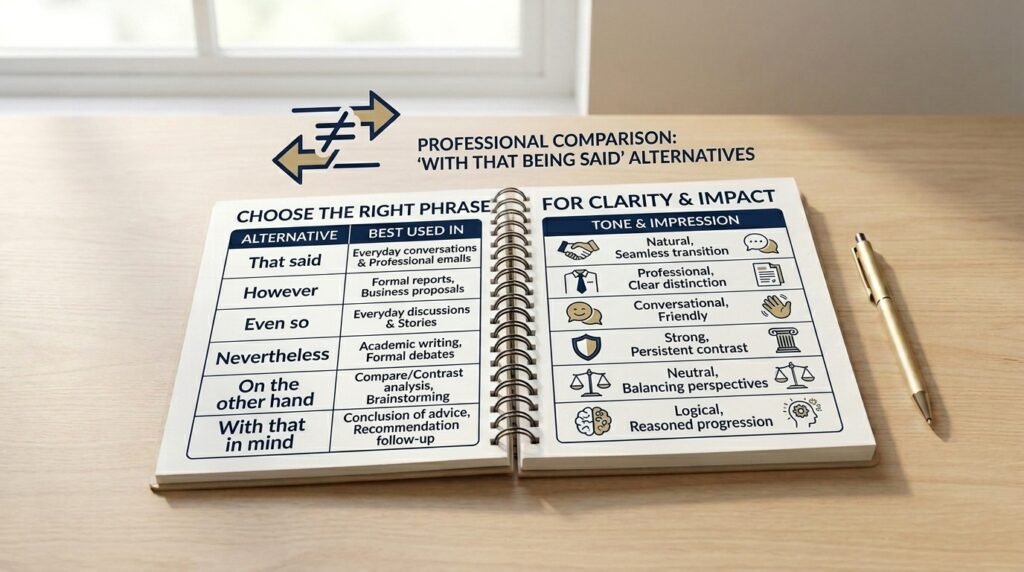
| Alternative | Best Used In | Tone |
| That said | Everyday and professional writing | Natural, polished |
| Having said that | Conversations and professional communication | Conversational, thoughtful |
| Even so | Everyday conversation and writing | Natural, contrasting |
| Still | Casual and everyday communication | Relaxed, simple |
| However | Business, academic, and formal writing | Professional, formal |
| Nevertheless | Formal writing and serious discussion | Formal, strong |
| On the other hand | Comparisons and balanced arguments | Neutral, comparative |
| With that in mind | Recommendations and decisions | Professional, logical |
| All the same | Everyday and professional writing | Natural, reflective |
| Even then | Conditional or situation-based statements | Conversational, qualifying |
Common Mistakes
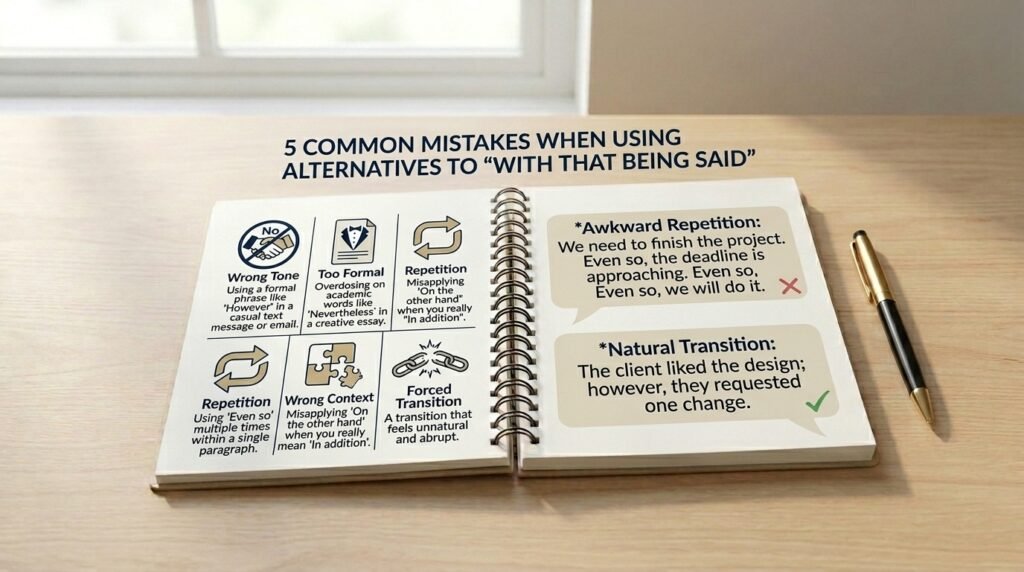
1. Using Casual Phrases in Professional Emails
Expressions such as “still” may work perfectly well in many emails, but a formal report may benefit from “however” or “nevertheless.” Always consider your audience.
2. Choosing an Overly Formal Expression
Using “nevertheless” in every casual conversation can make your speech sound stiff. In relaxed situations, “that said,” “still,” or “even so” may sound more natural.
3. Repeating the Same Transition
Using “with that being said” several times in one article or email can become distracting. Rotate your transitions when the meaning allows it.
4. Forgetting the Context
Not every alternative means exactly the same thing. For example, “on the other hand” usually compares two sides, while “with that in mind” connects information to a decision or action.
5. Sounding Insincere
A transition should genuinely connect the ideas around it. Adding “that said” or “however” simply to make writing sound sophisticated can make the sentence feel forced.
Frequently Asked Questions
What is the closest synonym for “with that being said”?
“That said” is the closest natural alternative. It performs almost the same job while being shorter and less wordy. It works well in everyday conversations, professional emails, articles, presentations, and other forms of writing where you want to acknowledge one point before introducing another.
Is “that said” better than “with that being said”?
Often, yes. “That said” is more concise and usually sounds cleaner in modern American English. However, “with that being said” is not incorrect. If you prefer a more conversational or slightly more deliberate transition, either expression can work depending on the sentence.
Is “however” another way to say “with that being said”?
Yes, “however” can replace “with that being said” when the purpose is to introduce a contrast. It is especially useful in professional, academic, and formal writing. However, the two phrases are not interchangeable in every situation because “however” focuses more directly on contrast.
What is a professional way to say “with that being said”?
For professional communication, good choices include “that said,” “however,” “nevertheless,” and “with that in mind.” The best option depends on your meaning. Use “however” for straightforward contrast and “with that in mind” when the previous information leads to a recommendation or decision.
Can I use “having said that” in an email?
Yes. “Having said that” is appropriate in many professional emails, especially when you want to acknowledge a previous point before adding another perspective. For a shorter and more polished business style, “that said” or “however” may be preferable.
Is “with that being said” grammatically correct?
Yes, “with that being said” is a grammatically acceptable expression. It is commonly used as a transition to introduce a contrasting, qualifying, or related idea. The issue is usually not correctness but repetition. If you use it frequently, a shorter alternative can make your writing more varied.
What can I say instead of “with that being said” in an essay?
In an essay, “however,” “nevertheless,” “that said,” and “on the other hand” can work well. Choose according to your intended relationship between ideas. “However” is especially versatile, while “on the other hand” is better when comparing two distinct perspectives.
Is “with that in mind” the same as “with that being said”?
Not exactly. “With that in mind” usually means that the previous information should influence what you do or think next. “With that being said” generally introduces a contrasting or qualifying point. They can overlap in some contexts, but they serve different purposes.
Conclusion
Knowing what is another way to say with that being said gives you more options for making your English clear, natural, and varied. While the original phrase is perfectly acceptable, alternatives can make your writing more concise or better suited to a particular situation.
Choose the phrase that accurately shows how your two ideas are connected, and your writing will sound more natural and purposeful. For more guidance on using transition words effectively, see Purdue OWL’s advice on paragraph organization and flow.
Amara Reyes has taught English to adult learners for over eight years. She focuses on how phrases are actually used in everyday conversation, not just textbook definitions.