
What Does “Another Way to Say Something” Mean?
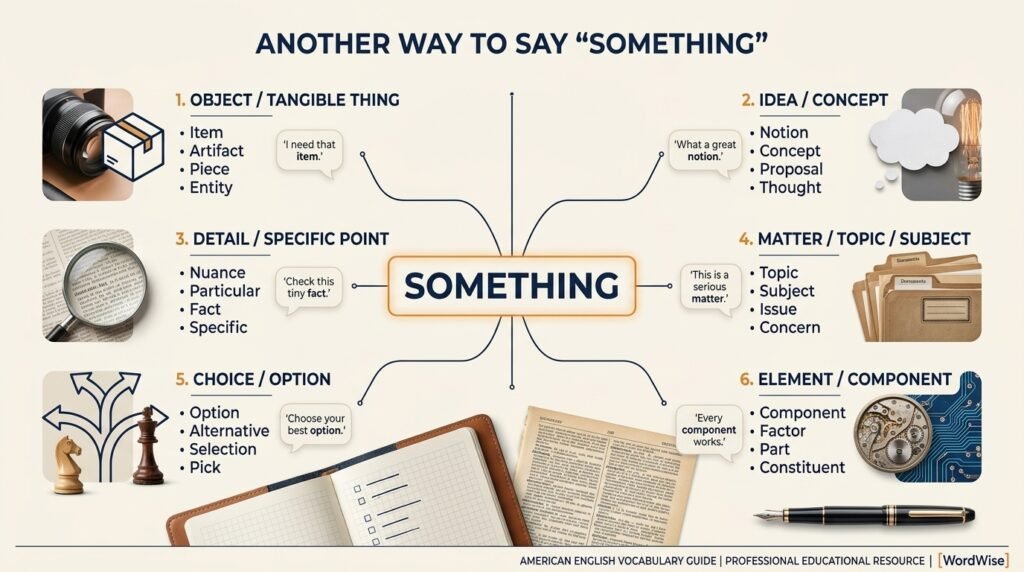
The phrase another way to say something usually means looking for a different word or expression with a similar meaning. People often search for alternatives to avoid repetition, make writing more precise, or find a word that better matches a specific situation.
The word something itself refers to an unspecified person, object, idea, action, or matter. For example, you might say, “I need something for dinner,” when you do not have a specific food in mind.
Because something is so broad, the best replacement depends on what you actually mean. A physical object may be an item or object, while an issue may be a matter.
Why Use Other Ways to Say “Something”?
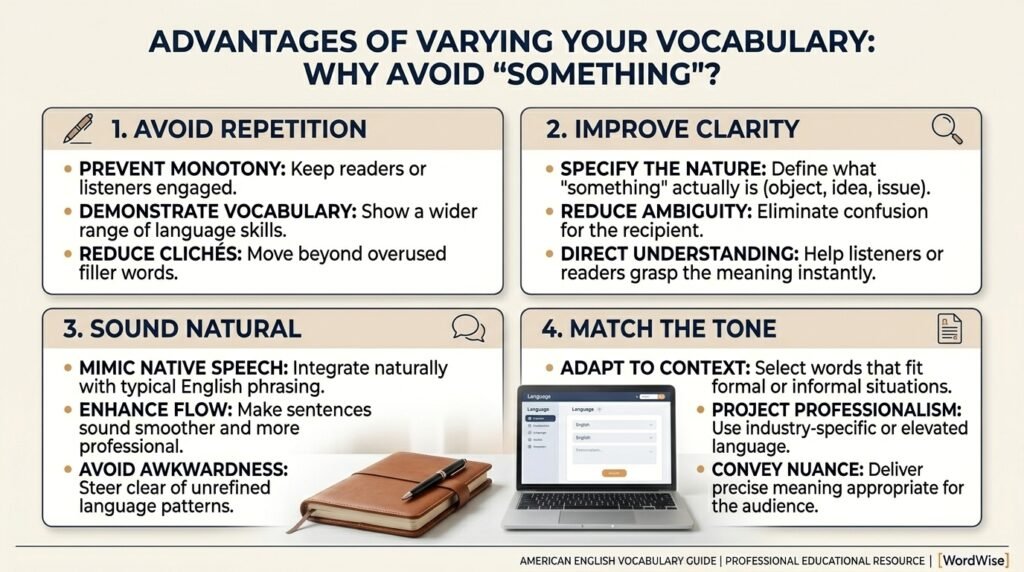
Using a more precise alternative can make your English sound clearer and more natural. Although something is grammatically correct in most everyday situations, it can sometimes be too vague.
Here are a few reasons to choose another expression:
- Avoid repetition: Prevent the same word from appearing too often.
- Improve clarity: Tell readers exactly what you mean.
- Sound more natural: Match your wording to the situation.
- Improve professional communication: Choose precise vocabulary for work or academic writing.
- Add variety: Make conversations and writing more engaging.
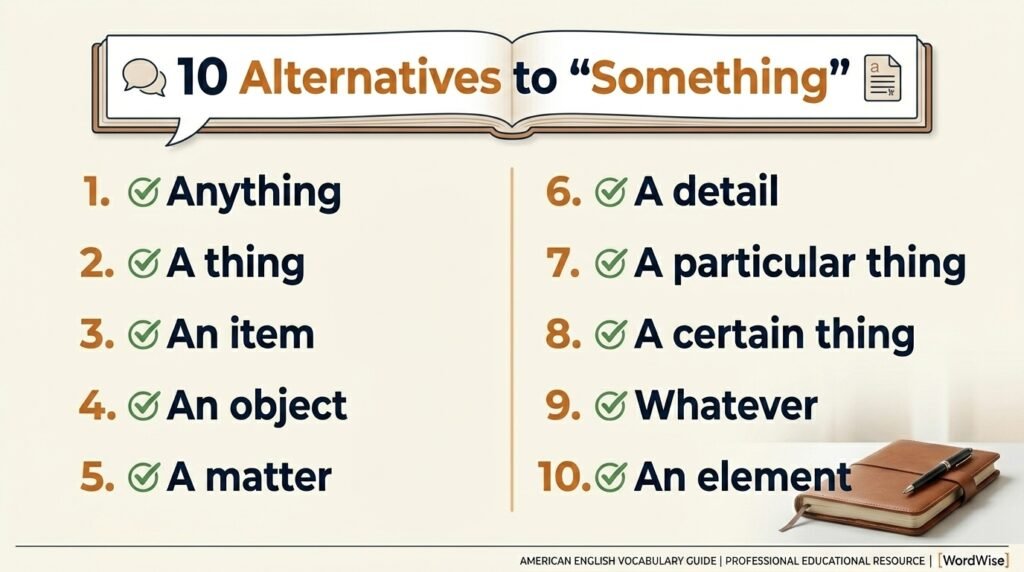
10 Best Other Ways to Say “Something”
1. Anything
Meaning
Anything refers to an unspecified thing, choice, or possibility. It is especially common in questions, negative statements, and sentences involving conditions.
Best For
- Casual
- Friendly
- Polite
Example 1
“Would you like anything from the store?”
Example 2
“I don’t think anything can change her decision now.”
Quick Tip
Use anything when the meaning involves an open choice or possibility rather than one unspecified thing.
2. A Thing
Meaning
A thing is a simple, conversational alternative when you mean one unspecified object, idea, or matter. It sounds natural in everyday American English.
Best For
- Casual
- Friendly
Example 1
“There’s a thing I need to tell you before we leave.”
Example 2
“Every thing in the room has a purpose.”
Quick Tip
Use a thing mainly in casual speech. In polished writing, a more specific noun often sounds better.
3. An Item
Meaning
An item usually refers to a particular object, product, entry, or individual thing in a group. It is more precise than something when discussing physical or listed objects.
Best For
- Professional
- Formal
Example 1
“Please select an item from the menu.”
Example 2
“One item was missing from the shipment.”
Quick Tip
Choose item when the unspecified thing belongs to a collection, list, order, or group.
4. An Object
Meaning
An object specifically describes a physical thing that can usually be seen or touched. It is useful when you want to distinguish a material thing from an idea or situation.
Best For
- Formal
- Professional
Example 1
“The researchers found an object beneath the old floorboards.”
Example 2
“Keep any sharp object away from young children.”
Quick Tip
Use object for a physical thing, not normally for an abstract idea or general situation.
5. A Matter
Meaning
A matter works well when something refers to an issue, concern, subject, or situation. It has a more serious and professional tone.
Best For
- Professional
- Formal
- Polite
Example 1
“We need to discuss a matter before making a final decision.”
Example 2
“The manager said the complaint was a matter of company policy.”
Quick Tip
Use a matter when you are talking about an issue that deserves attention or discussion.
6. A Detail
Meaning
A detail refers to one specific piece of information or part of a larger situation. It is a strong alternative when something means information rather than a physical object.
Best For
- Professional
- Formal
Example 1
“There’s a detail in the contract that we should review.”
Example 2
“She remembered a detail that everyone else had overlooked.”
Quick Tip
Choose detail when you can replace “something” with “one piece of information.”
7. A Particular Thing
Meaning
A particular thing identifies one specific but unnamed thing. It keeps some of the vagueness of something while suggesting that the speaker has a specific thing in mind.
Best For
- Casual
- Friendly
- Polite
Example 1
“There’s a particular thing about that movie that I really enjoy.”
Example 2
“He seemed worried about a particular thing during the meeting.”
Quick Tip
Use this phrase when you know exactly what you mean but do not want to name it directly.
8. A Certain Thing
Meaning
A certain thing refers to a specific but intentionally unnamed matter, object, or idea. It can create a sense of mystery or imply that the listener already understands the reference.
Best For
- Casual
- Friendly
- Polite
Example 1
“She has a certain thing she always does before an interview.”
Example 2
“There’s a certain thing about his approach that makes people trust him.”
Quick Tip
Use a certain thing when the identity of the thing is deliberately left unstated.
9. Whatever
Meaning
Whatever can refer to an unspecified thing or choice. It often means “anything you choose,” but its tone depends heavily on context and can sometimes sound dismissive.
Best For
- Casual
- Friendly
Example 1
“Choose whatever you think will work best.”
Example 2
“We can watch whatever you want tonight.”
Quick Tip
Be careful with whatever in professional communication because it can sound careless or indifferent.
10. An Element
Meaning
An element refers to one part or feature of a larger situation, design, system, or idea. It is a useful choice when something means a component rather than an entire object.
Best For
- Professional
- Formal
Example 1
“Trust is an important element of a successful team.”
Example 2
“The designer added an element of contrast to the new layout.”
Quick Tip
Use element when the unnamed thing is one contributing part of a larger whole.
Comparison Table
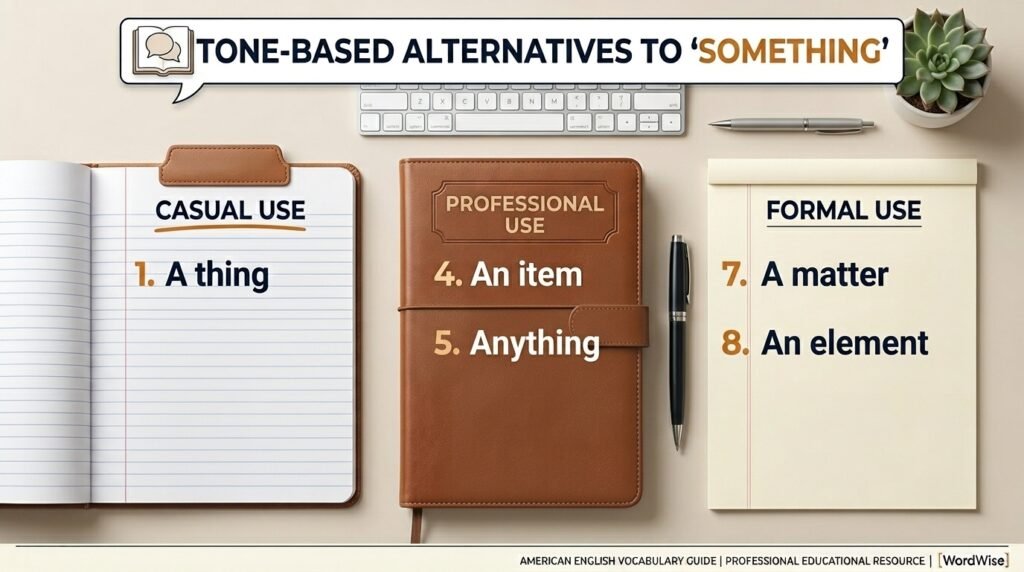
| Alternative | Best Used In | Tone |
| Anything | Questions and open choices | Casual, friendly |
| A thing | Everyday conversation | Casual |
| An item | Products, lists, collections | Professional, formal |
| An object | Physical things | Formal, professional |
| A matter | Issues and concerns | Professional, formal |
| A detail | Specific information | Professional, formal |
| A particular thing | Specific but unnamed references | Casual, friendly |
| A certain thing | Deliberately unnamed references | Casual, polite |
| Whatever | Choices and possibilities | Casual, friendly |
| An element | Parts of a larger whole | Professional, formal |
Common Mistakes
1. Using “anything” when you mean “something”
These words are not always interchangeable. Something usually identifies an unspecified thing, while anything often refers to an unrestricted choice, possibility, or thing in questions and negative statements.
2. Using casual phrases in professional writing
Expressions such as a thing and whatever may sound too informal in a business email or report. Consider an item, a matter, or a detail when the situation requires a professional tone.
3. Choosing an overly formal word
Not every sentence needs sophisticated vocabulary. Replacing simple something with an element or a matter can make everyday conversation sound unnatural.
4. Ignoring the context
The meaning of something changes from sentence to sentence. If it refers to a physical object, object may work; if it means information, detail may be much better.
5. Trying too hard to avoid repetition
There is nothing wrong with using something when it is the clearest choice. A natural, familiar word is often better than an unusual synonym that makes the sentence harder to understand.
Frequently Asked Questions
What is another way to say “something”?
Common alternatives include anything, a thing, an item, an object, a matter, a detail, a particular thing, a certain thing, whatever, and an element. The right choice depends on what “something” represents in your sentence, such as a physical object, piece of information, issue, or unspecified choice.
What is a more professional word for “something”?
For professional writing, an item, a matter, a detail, or an element can work well. The best option depends on the meaning. For example, use an item for a product or list entry, a matter for an issue, and a detail for specific information.
What is a formal way to say “something”?
There is no single formal replacement for something because its meaning changes with context. Depending on the sentence, an item, an object, a matter, a detail, or an element may be more appropriate. Choosing a precise noun is usually better than simply replacing the word.
Is “anything” the same as “something”?
Not always. Something usually refers to an unspecified thing, while anything often suggests an unrestricted choice or possibility. For example, “I need something to eat” means the speaker wants an unspecified food, while “You can eat anything” means there are no restrictions on the choice.
Can I use “a thing” instead of “something”?
Yes, especially in casual American English. For example, “There’s something I want to discuss” can become “There’s a thing I want to discuss.” However, a thing can sound less polished in formal writing, so a more precise noun may be preferable.
What is another word for “something” in an essay?
The best choice depends on your meaning. In an essay, you might use an issue, a matter, an aspect, a detail, an element, an object, or an item. Academic writing usually benefits from replacing vague words with nouns that clearly identify the idea being discussed.
What is a better word than “something” in a professional email?
A specific noun is usually better than a general synonym. For example, use a detail for information, an item for a product or task, a matter for an issue, or a question when asking for clarification. Precision makes professional emails easier to understand.
How can I avoid repeating “something” in writing?
First, determine what something actually represents. Then replace it with a precise noun when possible. Instead of writing “something important happened,” you might write “an important change occurred.” This approach improves clarity without forcing an unnatural synonym into the sentence.
Conclusion
Knowing another way to say something can help you make your English more precise, natural, and varied. While something is a perfectly useful everyday word, a more specific alternative can communicate your meaning more clearly.
The key is to focus on meaning first and vocabulary second. The best alternative is not always the fanciest word—it is the one that sounds natural and accurately expresses what you mean. Choosing the right synonym can also help you communicate your meaning more clearly.

Daniel Cho writes about professional communication, drawing on years spent training teams on clear, confident workplace writing — from emails to performance reviews.