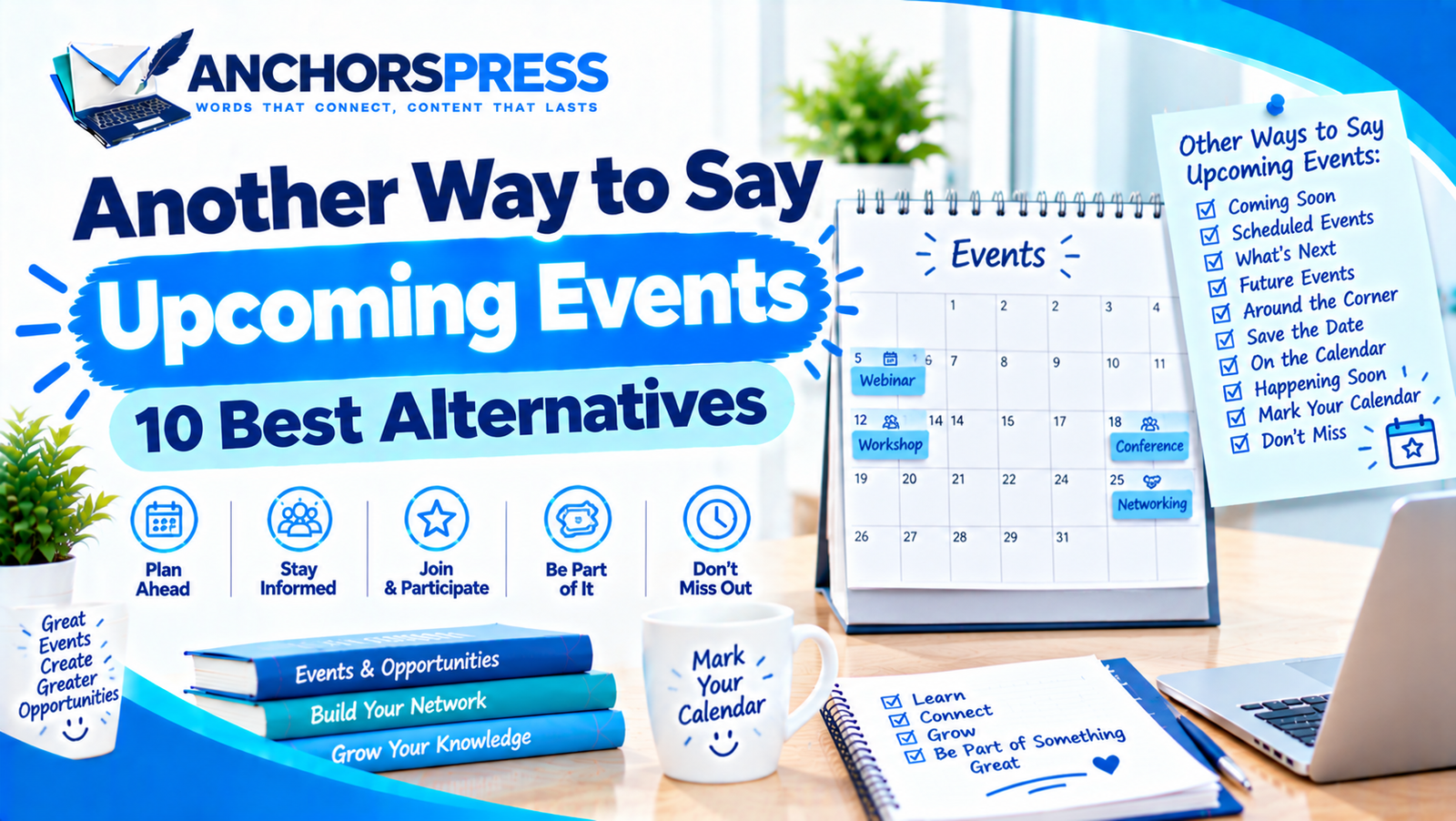
Finding another way to say upcoming events can make your writing sound more natural, professional, and varied. Although “upcoming events” is perfectly correct, repeating it across emails, websites, announcements, and social media posts can make your content feel predictable.
The right alternative depends on what you want to communicate. Some phrases emphasize events that are scheduled, while others simply refer to things that will happen in the near future.
What Does “Another Way to Say Upcoming Events” Mean?
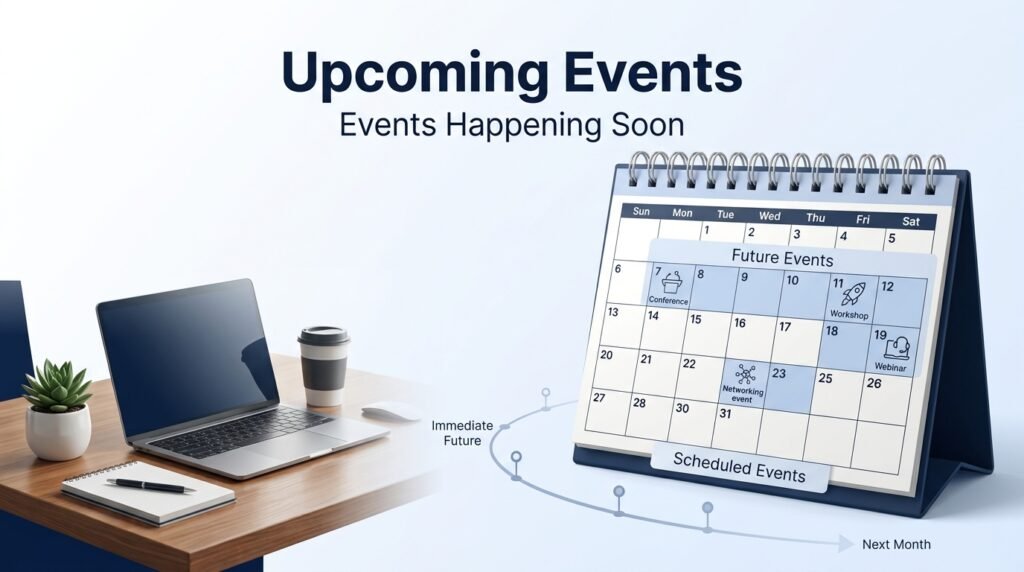
The phrase “upcoming events” refers to events that are expected or planned to happen in the future, usually relatively soon. It can describe conferences, meetings, festivals, workshops, celebrations, webinars, sports activities, and community gatherings.
People commonly use the phrase in event calendars, newsletters, business websites, school announcements, and promotional materials. For example, a website might have a section called “Upcoming Events” to show visitors what is happening next.
Looking for another expression usually means you want a synonym or alternative phrase that fits a particular tone. A business announcement may need formal wording, while a social media post may sound better with something more conversational.
Why Use Other Ways to Say “Upcoming Events”?
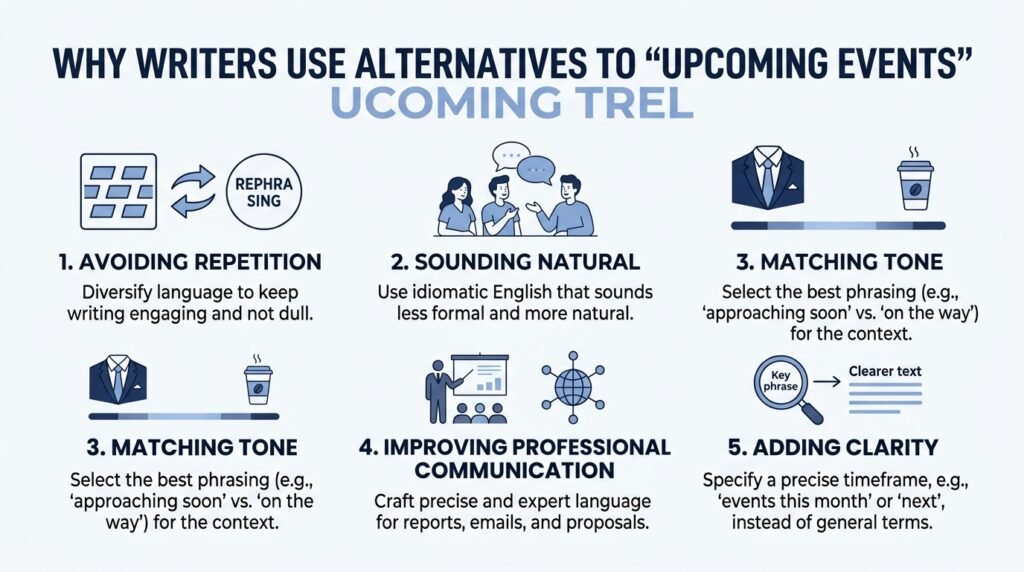
Using different expressions can improve your writing without changing its basic meaning. The best phrase can also provide more specific information about whether an event is planned, scheduled, approaching, or simply expected.
Here are a few reasons to use alternatives:
- Avoid repetition when discussing several events.
- Sound more natural in everyday communication.
- Match your audience in professional, formal, or casual settings.
- Add precision when an event has already been scheduled.
- Create stronger promotional copy for websites and announcements.
10 Best Other Ways to Say “Upcoming Events”
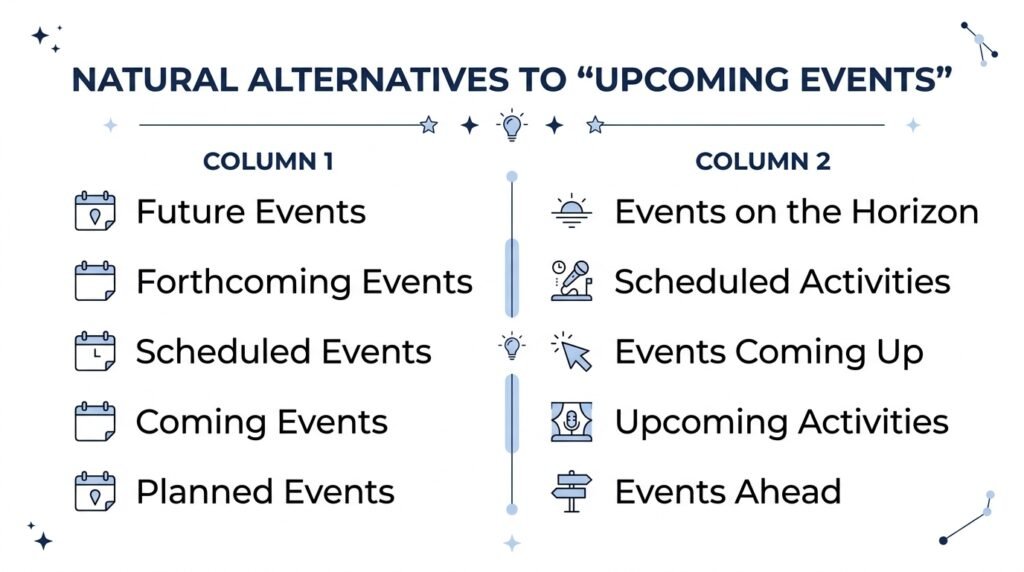
1. Future Events
Meaning
Future events is a broad and straightforward alternative to “upcoming events.” It refers to events that have not happened yet, without suggesting that they are necessarily happening soon.
Best For
- Professional
- Formal
- Casual
Example 1
Our calendar includes information about future events at each community center.
Example 2
The team will discuss future events during Friday’s planning meeting.
Quick Tip
Use “future events” when you want a neutral phrase and the exact timing is not important.
2. Forthcoming Events
Meaning
Forthcoming events refers to events that are expected to happen soon or have already been announced. It has a more polished and formal tone than “upcoming events.”
Best For
- Professional
- Formal
Example 1
The university has announced several forthcoming events for the fall semester.
Example 2
Details about forthcoming events will be shared with members by email.
Quick Tip
Choose this phrase for professional announcements, newsletters, reports, and institutional websites.
3. Scheduled Events
Meaning
Scheduled events specifically suggests that the events have been arranged for particular dates or times. It is more precise than “upcoming events” when the event schedule is confirmed.
Best For
- Professional
- Formal
Example 1
Please review the list of scheduled events before booking the conference room.
Example 2
Guests can find all scheduled events in the member portal.
Quick Tip
Use “scheduled events” when you want to emphasize that plans are already set.
4. Coming Events
Meaning
Coming events is a natural and simple expression for events that will happen soon. It has a friendly tone and works well when communicating with a general audience.
Best For
- Casual
- Friendly
- Warm
Example 1
Check our website for details about coming events and local activities.
Example 2
We have several exciting coming events planned for the summer.
Quick Tip
This phrase works especially well in conversational announcements and community content.
5. Planned Events
Meaning
Planned events focuses on events that organizers intend to hold. It can suggest that preparations are underway, even if every detail has not been finalized.
Best For
- Professional
- Formal
- Casual
Example 1
The committee reviewed the planned events for the next quarter.
Example 2
Parents will receive updates about planned events through the school newsletter.
Quick Tip
Use this phrase when you want to emphasize preparation or intention rather than timing.
6. Events on the Horizon
Meaning
Events on the horizon is a more expressive alternative that suggests something is approaching. It can make promotional or editorial writing feel more engaging.
Best For
- Casual
- Friendly
- Warm
Example 1
There are several exciting events on the horizon for our members.
Example 2
Keep an eye on our newsletter for events on the horizon this fall.
Quick Tip
Use this idiomatic expression when you want a lively tone rather than strictly formal wording.
7. Scheduled Activities
Meaning
Scheduled activities works when the things being announced include more than traditional events. It can cover workshops, classes, meetings, programs, and recreational activities.
Best For
- Professional
- Formal
- Friendly
Example 1
Visitors can view all scheduled activities on the recreation center’s website.
Example 2
The teacher sent parents a calendar of scheduled activities for May.
Quick Tip
Choose this option when your list includes smaller activities as well as major events.
8. Events Coming Up
Meaning
Events coming up is a conversational alternative to “upcoming events.” It sounds natural in speech, emails, newsletters, and informal announcements.
Best For
- Casual
- Friendly
- Polite
Example 1
Here are the events coming up at our downtown location this month.
Example 2
Do you know which events are coming up next weekend?
Quick Tip
This phrase is especially useful when writing for a broad audience and aiming for an approachable tone.
9. Upcoming Activities
Meaning
Upcoming activities has nearly the same meaning as “upcoming events,” but it can sound more flexible. It is useful for calendars that contain classes, programs, gatherings, and other planned activities.
Best For
- Professional
- Friendly
- Casual
Example 1
The center has posted its upcoming activities for the holiday season.
Example 2
Students can register online for upcoming activities and workshops.
Quick Tip
Use this phrase when “events” feels too narrow for everything included in your calendar.
10. Events Ahead
Meaning
Events ahead is a concise phrase that points to events that will happen in the future. It has a modern, slightly promotional feel and works well for headings.
Best For
- Casual
- Friendly
- Warm
Example 1
Take a look at the events ahead and save your favorite dates.
Example 2
Our newsletter previews the events ahead for the next few months.
Quick Tip
“Events ahead” works best as a heading or short promotional phrase rather than in highly formal documents.
Comparison Table

| Alternative | Best Used In | Tone |
| Future events | General writing, reports | Neutral |
| Forthcoming events | Professional announcements | Formal |
| Scheduled events | Calendars, business communication | Professional |
| Coming events | Community announcements | Friendly |
| Planned events | Planning documents | Professional |
| Events on the horizon | Marketing, newsletters | Warm |
| Scheduled activities | Schools, organizations | Professional |
| Events coming up | Emails, casual announcements | Conversational |
| Upcoming activities | Programs, calendars | Friendly |
| Events ahead | Headings, promotional content | Warm |
Common Mistakes
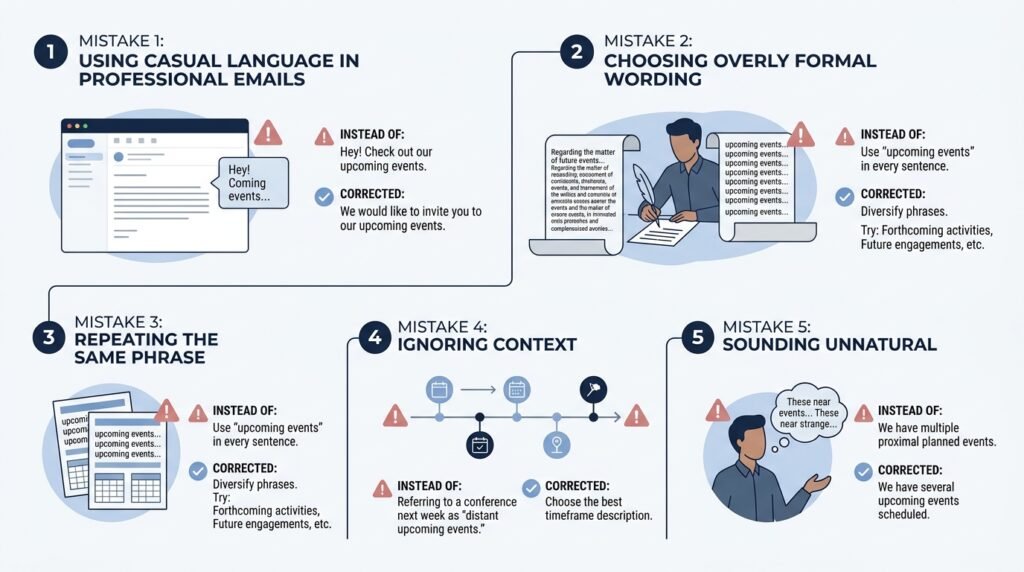
1. Using Casual Phrases in Professional Emails
Phrases such as “events coming up” can sound too conversational in certain formal settings. For business reports or official announcements, “scheduled events” or “forthcoming events” may be a better fit.
2. Choosing Overly Formal Language
Not every situation requires sophisticated wording. Using “forthcoming events” in a casual text message can sound unnecessarily formal when “coming events” would feel more natural.
3. Repeating the Same Phrase
Using “upcoming events” several times in the same paragraph can make your writing repetitive. Replace it with a suitable alternative when the context allows.
4. Forgetting Context
Not every alternative has exactly the same emphasis. “Scheduled events” implies that arrangements have been made, while “future events” can refer to anything that may happen later.
5. Sounding Insincere
Avoid choosing an elaborate phrase simply to make your writing sound impressive. Clear, familiar language is usually more effective than wording that feels forced.
Frequently Asked Questions
What is another professional way to say upcoming events?
“Forthcoming events” and “scheduled events” are strong professional alternatives. “Forthcoming events” sounds formal and polished, while “scheduled events” is more precise because it suggests that dates or times have already been arranged. For business websites and official announcements, either phrase can work depending on the context.
What is a formal word for upcoming events?
A formal alternative is “forthcoming events.” It is commonly used when referring to events that are expected to happen in the near future. Another option is “scheduled events” when the events have confirmed dates. The best choice depends on whether you want to emphasize timing or confirmed arrangements.
What is another way to say upcoming events in an email?
In an email, you can say “events coming up,” “scheduled events,” “future events,” or “forthcoming events.” For a friendly email, “events coming up” sounds natural. For a professional message, “scheduled events” is usually clearer and more polished.
Is “forthcoming events” the same as “upcoming events”?
Yes, the two phrases have very similar meanings. Both refer to events that are expected to happen in the future, often relatively soon. The main difference is tone: “forthcoming events” sounds more formal, while “upcoming events” is more common in everyday American English.
What is a casual way to say upcoming events?
“Coming events” and “events coming up” are natural casual alternatives. They work well in conversations, social media posts, friendly emails, and community announcements. “Events coming up” often sounds especially conversational because it closely matches how people naturally speak.
Can I use “future events” instead of “upcoming events”?
Yes, but the meaning can be slightly broader. “Upcoming events” often suggests events happening relatively soon, whereas “future events” can refer to anything that will happen later. If you are discussing next month’s calendar, “upcoming events” may be more specific.
What is the best phrase for an event calendar?
“Upcoming events” remains one of the clearest choices for an event calendar. However, “scheduled events” is useful when every item has a confirmed date and time. “Upcoming activities” can be better when the calendar includes classes, workshops, programs, and other activities.
How can I avoid repeating “upcoming events”?
You can alternate it with phrases such as “future events,” “forthcoming events,” “scheduled events,” “planned events,” or “events coming up.” However, do not replace the phrase automatically. Choose an alternative only when it fits the meaning and tone of the surrounding sentence.
Conclusion
Knowing another way to say upcoming events gives you more flexibility when writing emails, announcements, website copy, calendars, and promotional content. The best alternative depends on what you want the phrase to communicate.
Use “forthcoming events” for a formal or professional tone, and choose “scheduled events” when the dates are already confirmed. “Future events” is a simple, neutral option, while “events coming up” and “coming events” work well in friendly communication. For more engaging promotional copy, “events on the horizon” can add personality.
Amara Reyes has taught English to adult learners for over eight years. She focuses on how phrases are actually used in everyday conversation, not just textbook definitions.