
What Does “Another Way to Say This Is” Mean?
The phrase “another way to say this is” introduces a different way of expressing the same idea. People commonly use it when they want to clarify, simplify, paraphrase, or explain something in different words.
For example, you might write, “Another way to say this is that the project needs more time.” The phrase signals that the next statement will restate the previous idea.
You may see this expression in essays, workplace communication, presentations, educational writing, conversations, and explanations. It is especially useful when the original wording may be unclear or too complicated.
Why Use Other Ways to Say “This Is”?
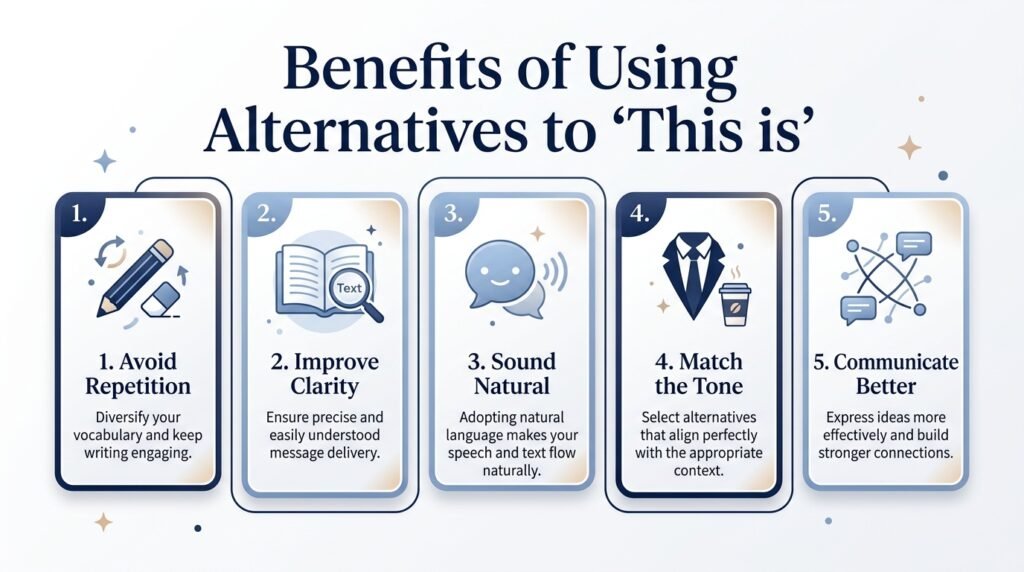
Using different expressions can make your writing more flexible and natural. It also helps you choose language that fits the situation instead of relying on the same phrase repeatedly.
Other benefits include:
- Avoiding repetition: Your writing sounds less predictable.
- Improving clarity: Some alternatives explain an idea more directly.
- Matching the situation: Certain phrases work better in formal or casual settings.
- Making explanations smoother: A good transition helps readers follow your reasoning.
- Simplifying complex ideas: Some expressions make difficult information easier to understand.
10 Best Other Ways to Say “This Is”
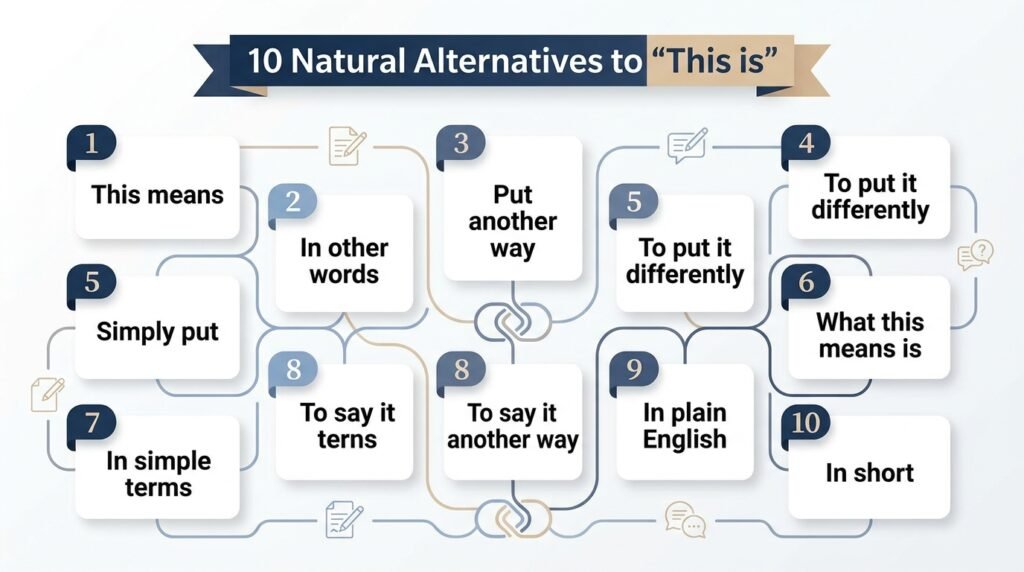
1. This Means
Meaning
“This means” directly explains the meaning, result, or implication of something that was just mentioned. It is simple, clear, and easy for most readers to understand.
Best For
- Professional
- Formal
- Casual
- Educational
Example 1
The company reduced its operating hours. This means customers will need to place orders earlier.
Example 2
Your application was approved, which means you can begin the program next month.
Quick Tip
Use “this means” when you are explaining what a fact, decision, or statement means for the reader.
2. In Other Words
Meaning
“In other words” introduces a restatement of an idea using different language. It is especially helpful when the original statement may be technical, complicated, or easy to misunderstand.
Best For
- Professional
- Casual
- Friendly
- Educational
Example 1
The deadline cannot be extended. In other words, all applications must arrive by Friday.
Example 2
She wants to work independently. In other words, she prefers to manage the project without constant supervision.
Quick Tip
Choose this phrase when your main goal is to make an earlier statement clearer.
3. Put Another Way
Meaning
“Put another way” signals that you are expressing the same thought from a different angle. It sounds natural and polished without being overly formal.
Best For
- Professional
- Formal
- Casual
Example 1
The product needs a stronger marketing strategy. Put another way, customers need a clearer reason to choose it.
Example 2
The instructions are optional, but they can prevent mistakes. Put another way, following them is helpful even though it is not required.
Quick Tip
Use “put another way” when you want to paraphrase an idea without changing its basic meaning.
4. To Put It Differently
Meaning
“To put it differently” is a polished way to introduce a reworded version of an earlier point. It works particularly well in explanatory and professional writing.
Best For
- Professional
- Formal
- Educational
- Polite
Example 1
The proposal focuses on long-term growth. To put it differently, the company is prioritizing stability over quick profits.
Example 2
The policy gives employees more flexibility. To put it differently, workers have greater control over when they complete certain tasks.
Quick Tip
This phrase is a strong option when you want your writing to sound thoughtful and precise.
5. Simply Put
Meaning
“Simply put” tells the reader that you are about to explain something in a simpler or more direct way. It is useful when a topic contains complicated details.
Best For
- Casual
- Friendly
- Professional
- Educational
Example 1
The software automatically backs up your files. Simply put, your important documents are protected if something goes wrong.
Example 2
The plan requires fewer resources. Simply put, it will cost less to implement.
Quick Tip
Use “simply put” when your goal is to remove unnecessary complexity from an explanation.
6. What This Means Is
Meaning
“What this means is” introduces a direct explanation of a previous statement. It has a conversational quality and can help guide readers toward the main point.
Best For
- Casual
- Friendly
- Professional
- Polite
Example 1
The store is changing its return policy. What this means is customers will have 30 days instead of 60 days to return purchases.
Example 2
The team has completed the testing phase. What this means is the product is almost ready for release.
Quick Tip
This phrase works especially well when you want to connect information with its practical effect.
7. In Simple Terms
Meaning
“In simple terms” tells readers that you are about to explain an idea using straightforward language. It is useful when the subject includes technical or specialized information.
Best For
- Educational
- Professional
- Friendly
- Polite
Example 1
The device uses machine learning to analyze patterns. In simple terms, it learns from previous data to improve its predictions.
Example 2
The contract includes an automatic renewal clause. In simple terms, the agreement will continue unless someone cancels it.
Quick Tip
Use this expression when your audience may not be familiar with the terminology you are discussing.
8. To Say It Another Way
Meaning
“To say it another way” directly signals that you are about to restate an idea. It is natural, flexible, and suitable for both spoken and written English.
Best For
- Casual
- Friendly
- Professional
- Educational
Example 1
The first option requires less maintenance. To say it another way, it will take less effort to manage over time.
Example 2
The manager wants faster results. To say it another way, the team needs to complete the work sooner.
Quick Tip
Use this phrase when you want a straightforward alternative to “another way to say this is.”
9. In Plain English
Meaning
“In plain English” means you are translating an idea into language that is easier for an average reader to understand. It is particularly useful for technical, legal, business, or academic information.
Best For
- Professional
- Friendly
- Educational
- Polite
Example 1
The agreement contains several legal conditions. In plain English, you need to meet certain requirements before receiving the payment.
Example 2
The report uses several financial terms. In plain English, the company earned more money than it spent.
Quick Tip
Use “in plain English” when simplifying specialized language for a general audience.
10. In Short
Meaning
“In short” introduces a brief summary of a longer explanation. Rather than simply rewording one sentence, it can condense several points into one clear conclusion.
Best For
- Professional
- Formal
- Casual
- Educational
Example 1
The project faced delays, budget changes, and staffing problems. In short, the original schedule was unrealistic.
Example 2
The product is affordable, reliable, and easy to maintain. In short, it offers good value for small businesses.
Quick Tip
Choose “in short” when you want to summarize the main point rather than provide a word-for-word restatement.
Comparison Table
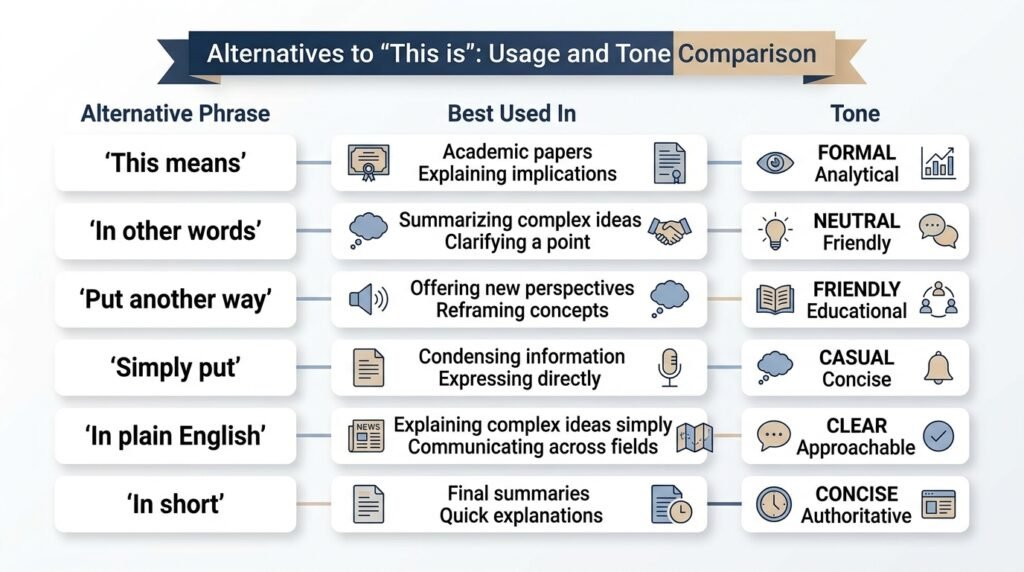
| Alternative | Best Used In | Tone |
| This means | Explanations, workplace writing | Clear |
| In other words | Clarification, conversation | Natural |
| Put another way | Restating ideas | Polished |
| To put it differently | Professional explanations | Formal |
| Simply put | Simplifying complex ideas | Direct |
| What this means is | Practical explanations | Conversational |
| In simple terms | Educational content | Accessible |
| To say it another way | General communication | Natural |
| In plain English | Technical or specialized topics | Clear |
| In short | Summaries and conclusions | Concise |
Common Mistakes
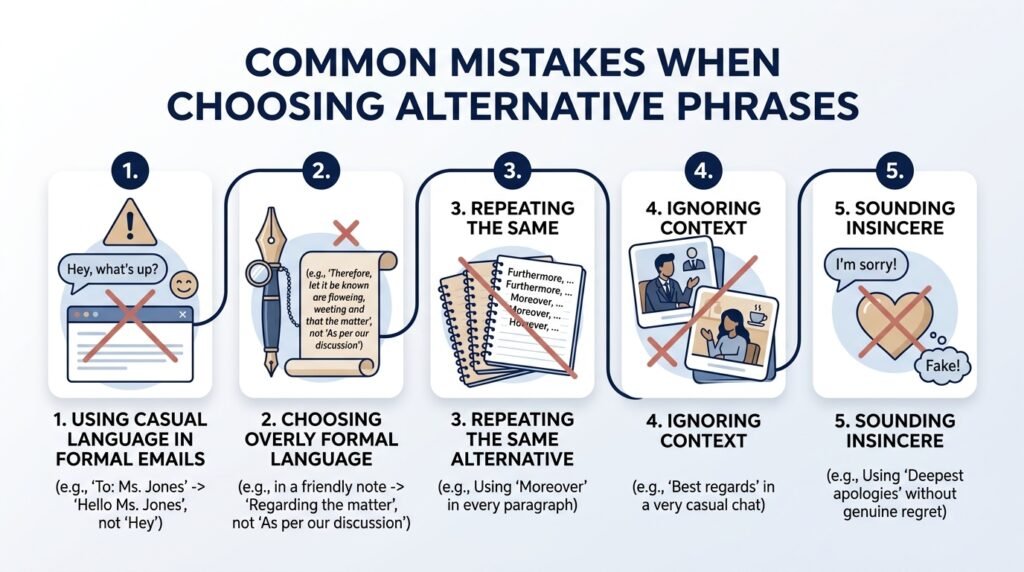
1. Using Casual Phrases in Professional Emails
Expressions such as “to say it another way” can work in workplace communication, but a phrase like “simply put” may sometimes sound too conversational for highly formal documents. Always consider your audience.
2. Choosing Overly Formal Language
Using “to put it differently” in every sentence can make ordinary writing sound stiff. Simple expressions such as “this means” are often more effective.
3. Repeating the Same Alternative
Replacing “this is” with “in other words” every time does not solve the repetition problem. Vary your transitions according to what you are actually trying to explain.
4. Forgetting Context
Not every alternative has the same function. “In short” usually summarizes information, while “in plain English” simplifies specialized language.
5. Sounding Insincere or Mechanical
A transition should help the reader, not simply fill space. If the second sentence adds no clarity or useful information, you may not need an alternative phrase at all.
Frequently Asked Questions
What is another way to say “this is”?
Common alternatives include “this means,” “in other words,” “put another way,” “to put it differently,” and “simply put.” The best choice depends on your purpose. Use “this means” to explain an implication, while “in other words” works well when you want to clarify or restate an idea.
What is a professional way to say “another way to say this is”?
For professional writing, try “to put it differently,” “put another way,” “this means,” or “in other words.” These expressions sound polished without being unnecessarily complicated. “To put it differently” is especially useful when you are presenting a revised explanation in a report, presentation, or business document.
What is another way to say “in other words”?
You can replace “in other words” with “put another way,” “to put it differently,” “to say it another way,” or “simply put.” Choose based on your intended tone. “Put another way” sounds natural, while “simply put” is better when you want to make a complicated point easier to understand.
How can I say “this means” differently?
Instead of “this means,” you can use “what this means is,” “in other words,” “this indicates,” or “put another way.” However, these expressions are not always interchangeable. “This indicates,” for example, is better when discussing evidence or signs rather than simply restating an idea.
Is “put another way” grammatically correct?
Yes. “Put another way” is a standard English expression used to introduce a different explanation of an idea. It can appear in professional writing, essays, articles, presentations, and everyday conversation. It is concise and natural, making it a useful alternative to longer phrases such as “another way to say this is.”
Is “simply put” formal or informal?
“Simply put” is neither strongly formal nor strongly informal. It is a flexible expression that appears in professional, educational, and everyday writing. It works best when you want to reduce complexity and give readers the main idea in direct language.
What is the best alternative for academic writing?
For academic writing, “in other words,” “to put it differently,” and “put another way” are strong choices. They allow you to clarify or restate an argument without sounding overly conversational. Still, academic writing should prioritize precision, so use a transition only when it genuinely improves understanding.
Can I use these alternatives in emails?
Yes, most of them work well in emails. “This means,” “in other words,” and “put another way” are especially natural for workplace communication. For a highly formal email, choose a precise expression and avoid adding a transition simply to make the message sound more sophisticated.
Conclusion
Knowing another way to say “this is” gives you more control over your writing and helps you communicate ideas with greater clarity. The best alternative depends on what you want the reader to understand.
The key is to match the expression to your purpose rather than replacing “this is” mechanically. A well-chosen phrase should improve sentence clarity, make your writing more natural, and make your ideas easier to understand.

Daniel Cho writes about professional communication, drawing on years spent training teams on clear, confident workplace writing — from emails to performance reviews.