

What Does “another way to say solid foundation” Mean?
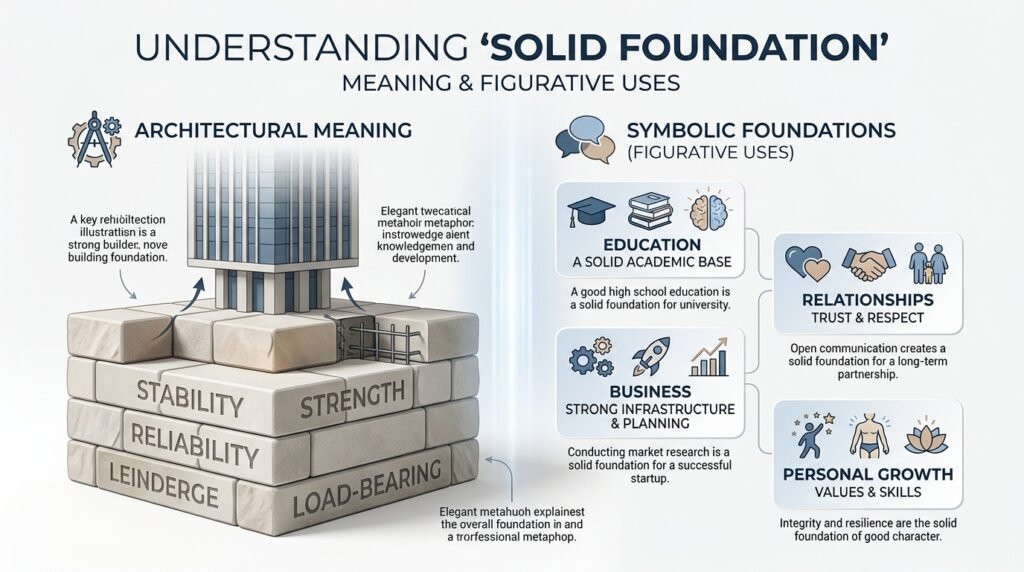
The phrase “solid foundation” describes a strong and dependable base on which something can develop or succeed. It can refer to a physical structure, such as a building, or something less tangible, such as a relationship, education, business, career, or plan.
People often use the expression to emphasize stability and long-term potential. For example, someone might say that good communication provides a solid foundation for a healthy relationship.
The phrase commonly appears in business, education, construction, personal development, relationships, and professional writing.
Why Use Other Ways to Say “Solid Foundation”?
Using different expressions can make your writing more precise and prevent the same phrase from appearing repeatedly. The right alternative can also show exactly what kind of strength or preparation you mean.
Other expressions can help you:
- Avoid repetitive wording.
- Make your writing sound more natural.
- Match professional or casual situations.
- Explain stability more precisely.
- Strengthen business, academic, and everyday communication.
- Emphasize preparation, reliability, or long-term support.
10 Best Other Ways to Say “Solid Foundation”
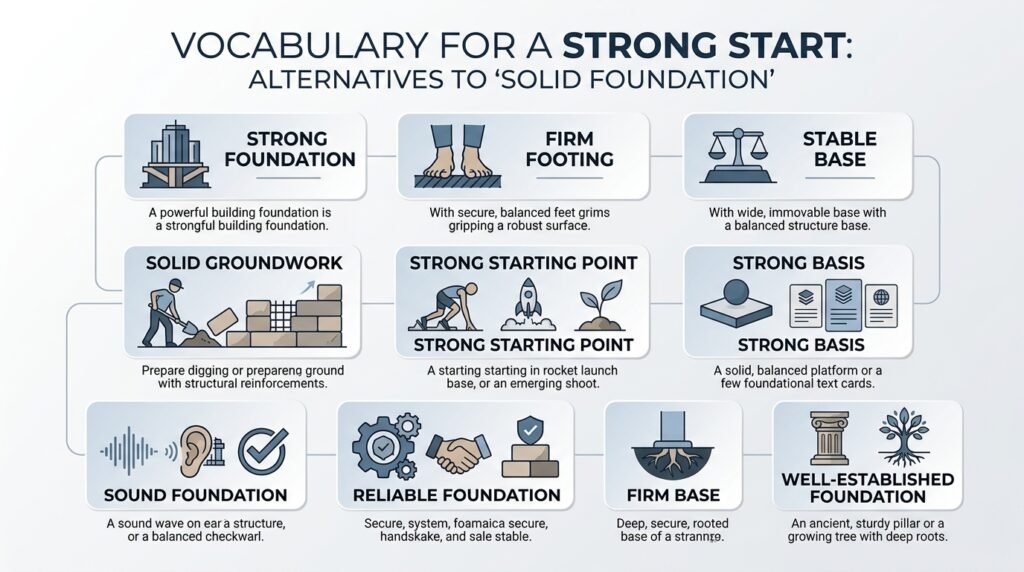
1. Strong Foundation
Meaning
“Strong foundation” is the closest and most versatile alternative to “solid foundation.” It suggests that something has a dependable base that can support future growth, progress, or success.
Best For
- Professional
- Formal
- Casual
- Friendly
Example 1
A strong foundation in mathematics helped her succeed in engineering school.
Example 2
Trust and honest communication give their partnership a strong foundation.
Quick Tip
Use “strong foundation” when you want a natural replacement that works in almost any context.
2. Firm Footing
Meaning
“Firm footing” suggests stability, security, or confidence. It is especially useful when describing a person, organization, or project that has reached a stable position.
Best For
- Professional
- Formal
Example 1
After two successful years, the company is now on a firm footing.
Example 2
The training program gave new employees a firm footing as they began their careers.
Quick Tip
Choose “firm footing” when the focus is on stability rather than the literal base of something.
3. Stable Base
Meaning
“Stable base” emphasizes reliability and consistency. It works well when something needs dependable support before it can expand or develop further.
Best For
- Professional
- Formal
- Casual
Example 1
The nonprofit needs a stable base of donors before expanding its programs.
Example 2
A stable base of knowledge makes it easier to understand advanced subjects.
Quick Tip
Use this phrase when you want to highlight security, consistency, or dependable support.
4. Strong Basis
Meaning
“Strong basis” means that an idea, decision, argument, or plan is supported by good evidence or sound reasoning. Unlike “strong foundation,” it often focuses on logic rather than development.
Best For
- Professional
- Formal
Example 1
The research provides a strong basis for changing the company’s safety policy.
Example 2
Her proposal has a strong basis in customer feedback and market data.
Quick Tip
Use “strong basis” for arguments, decisions, claims, research, and recommendations.
5. Sound Foundation
Meaning
“Sound foundation” describes a dependable base that is logically or structurally reliable. It has a polished tone and often appears in professional, academic, and formal writing.
Best For
- Professional
- Formal
Example 1
The course gives students a sound foundation in financial literacy.
Example 2
Careful planning created a sound foundation for the organization’s expansion.
Quick Tip
Choose “sound foundation” when you want your writing to sound polished without becoming overly complicated.
6. Solid Groundwork
Meaning
“Solid groundwork” refers to the preparation, research, planning, or early work that makes future success more likely. It focuses more on preparation than stability.
Best For
- Professional
- Formal
- Casual
Example 1
The marketing team laid solid groundwork before launching the new product.
Example 2
Years of community research provided solid groundwork for the development project.
Quick Tip
Use “solid groundwork” when describing work that prepares the way for a later result.
7. Strong Starting Point
Meaning
“Strong starting point” describes a favorable beginning that gives someone or something a good chance of making progress. It is more conversational than “sound foundation.”
Best For
- Casual
- Friendly
- Professional
Example 1
The first draft gives us a strong starting point for the final report.
Example 2
Her internship was a strong starting point for a career in journalism.
Quick Tip
Use this phrase when you want to emphasize a good beginning rather than long-term stability.
8. Reliable Foundation
Meaning
“Reliable foundation” highlights trustworthiness and dependable support. It works particularly well when the foundation must continue supporting something over time.
Best For
- Professional
- Formal
- Warm
Example 1
Open communication creates a reliable foundation for teamwork.
Example 2
The company built a reliable foundation through consistent service and customer support.
Quick Tip
Choose “reliable foundation” when dependability is more important than strength alone.
9. Firm Base
Meaning
“Firm base” describes something stable enough to support further activity or development. It can be used literally, but it also works figuratively in business, education, and personal development.
Best For
- Professional
- Casual
- Formal
Example 1
The small business has a firm base of loyal customers.
Example 2
Students need a firm base of vocabulary before tackling more advanced reading.
Quick Tip
Use “firm base” when you want a concise expression that emphasizes stability and support.
10. Well-Established Foundation
Meaning
“Well-established foundation” suggests that the underlying support has already been developed and proven over time. It is especially appropriate when describing organizations, systems, knowledge, or long-term practices.
Best For
- Professional
- Formal
Example 1
The organization has a well-established foundation of community partnerships.
Example 2
His years of teaching experience gave the program a well-established foundation.
Quick Tip
Use this phrase when you want to emphasize experience, history, and proven stability.
Comparison Table
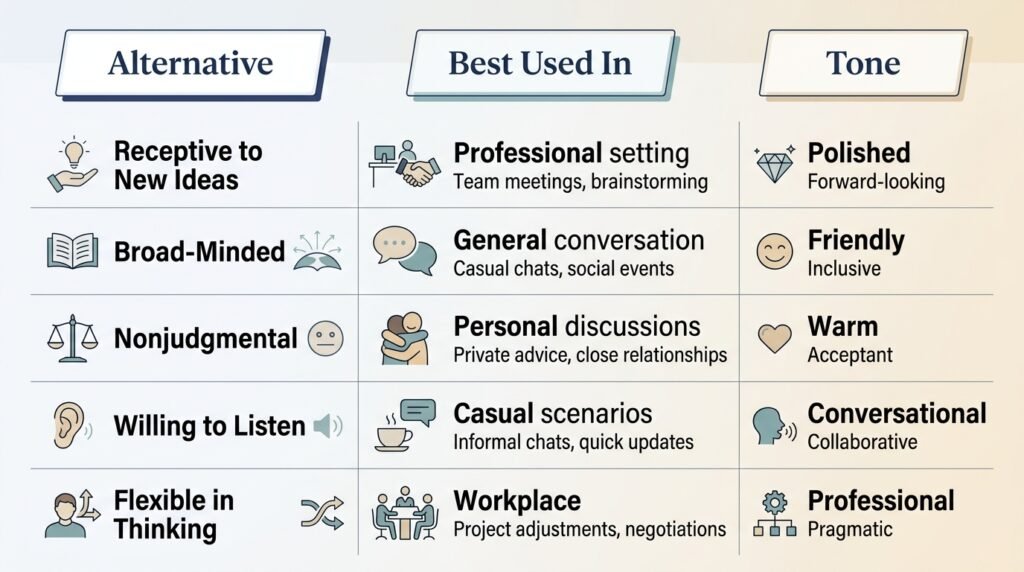
| Alternative | Best Used In | Tone |
| Strong foundation | General, professional, personal | Natural |
| Firm footing | Business, career, stability | Professional |
| Stable base | Business, education, organizations | Neutral |
| Strong basis | Arguments, research, decisions | Formal |
| Sound foundation | Education, business, planning | Polished |
| Solid groundwork | Projects, research, preparation | Professional |
| Strong starting point | Beginnings, careers, projects | Conversational |
| Reliable foundation | Relationships, teams, organizations | Trustworthy |
| Firm base | Business, education, development | Direct |
| Well-established foundation | Organizations, systems, experience | Formal |
Common Mistakes
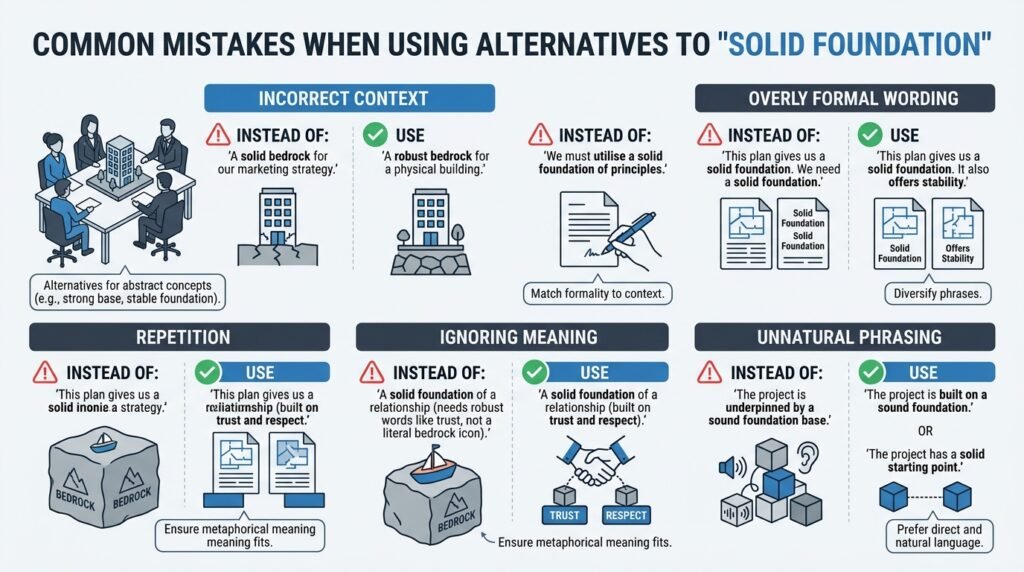
1. Using Casual Phrases in Professional Writing
Expressions such as “good start” may sound too informal in a business report or academic paper. Choose “sound foundation” or “strong basis” when the setting requires a more polished tone.
2. Choosing an Overly Formal Expression
Not every sentence needs sophisticated wording. In everyday conversation, “strong foundation” may sound much more natural than “well-established foundation.”
3. Ignoring the Intended Meaning
“Strong basis” and “solid groundwork” are not always interchangeable with “solid foundation.” A basis usually supports an argument or decision, while groundwork refers to preparation.
4. Repeating the Same Phrase
Using “solid foundation” several times in one paragraph can make writing feel repetitive. Replace it with a contextually appropriate alternative instead of forcing the exact phrase throughout the text.
5. Using a Phrase That Does Not Fit the Context
“Firm footing” works well for stability, but it may sound awkward when discussing the physical foundation of a house. Always consider what the sentence is actually describing.
Frequently Asked Questions
What is another way to say “solid foundation”?
The best general alternative is “strong foundation.” Other options include “firm footing,” “stable base,” “sound foundation,” “strong basis,” and “solid groundwork.” The best choice depends on whether you are talking about physical stability, preparation, education, relationships, business, or logical support.
What is a professional way to say “solid foundation”?
“Sound foundation,” “strong basis,” and “firm footing” are strong professional alternatives. For example, “The training provides a sound foundation for future leadership” sounds polished and appropriate for workplace or academic communication.
What is another word for a strong foundation?
Depending on the context, you could use base, groundwork, footing, basis, support, or framework. These words do not have exactly the same meaning, so choose one that matches the type of support you are describing.
What is a better way to say “build a solid foundation”?
You can say “establish a strong foundation,” “lay solid groundwork,” “create a stable base,” or “establish a firm footing.” “Lay solid groundwork” is especially useful when talking about preparation for a project, plan, or future goal.
How do you say “solid foundation” in a business context?
In business writing, alternatives include “strong foundation,” “firm footing,” “stable base,” and “sound foundation.” For example, “The company has established a firm footing in the regional market” emphasizes business stability and growth.
What is another way to say “solid foundation” in education?
In education, “strong foundation,” “sound foundation,” and “firm base of knowledge” work particularly well. For example, you could say, “The course gives students a sound foundation in writing skills.”
What is another way to say “solid foundation” in a relationship?
For relationships, “strong foundation,” “reliable foundation,” and “basis of trust” can work well. “Mutual trust provides a strong foundation for a lasting relationship” sounds natural and clearly explains what creates stability.
Is “firm footing” the same as “solid foundation”?
The two phrases are similar but not identical. “Solid foundation” usually describes the underlying support for something, while “firm footing” emphasizes being stable, secure, or well-positioned. “Firm footing” is often more figurative.
Conclusion
Knowing another way to say solid foundation can make your writing more precise, natural, and varied. The best alternative depends on what you want to emphasize.
Use “strong foundation” as the safest general replacement. Choose “firm footing” when you mean stability or security, while “strong basis” works better for arguments, decisions, and research. For preparation and planning, “solid groundwork” is often the clearest choice. If you want to highlight a favorable beginning, “strong starting point” may fit better.

Sarah Whitfield is the founder and lead editor of Anchors Press. With a background in copyediting and content strategy, she reviews every guide for accuracy, tone, and everyday usefulness before it’s published.