
What Does “Another Way to Say Throughout History” Mean?
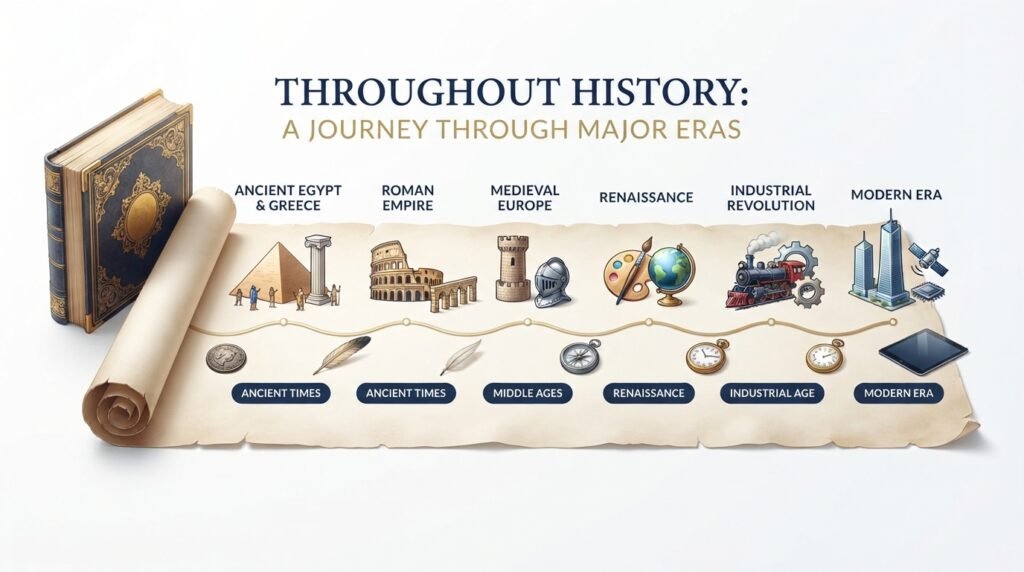
“Throughout history” means during many or all periods of the past, from earlier times up to the present or another stated point in time. It is commonly used when discussing events, traditions, beliefs, inventions, people, or patterns that have existed across different historical periods.
For example, “People have used storytelling throughout history” suggests that storytelling has been common across many generations.
People often search for another way to say “throughout history” because they want to avoid repetition, make their writing more precise, or choose wording that better matches a formal, academic, or conversational setting.
Why Use Other Ways to Say “Throughout History”?
Using different expressions can make historical writing smoother and more precise. Although “throughout history” is perfectly natural, repeating it several times can make an article or essay sound monotonous.
Other options can help you:
- Avoid unnecessary repetition.
- Make historical statements sound more natural.
- Match formal and informal writing styles.
- Emphasize long periods, gradual change, or specific eras.
- Create more varied and engaging sentences.
10 Best Other Ways to Say “Throughout History”
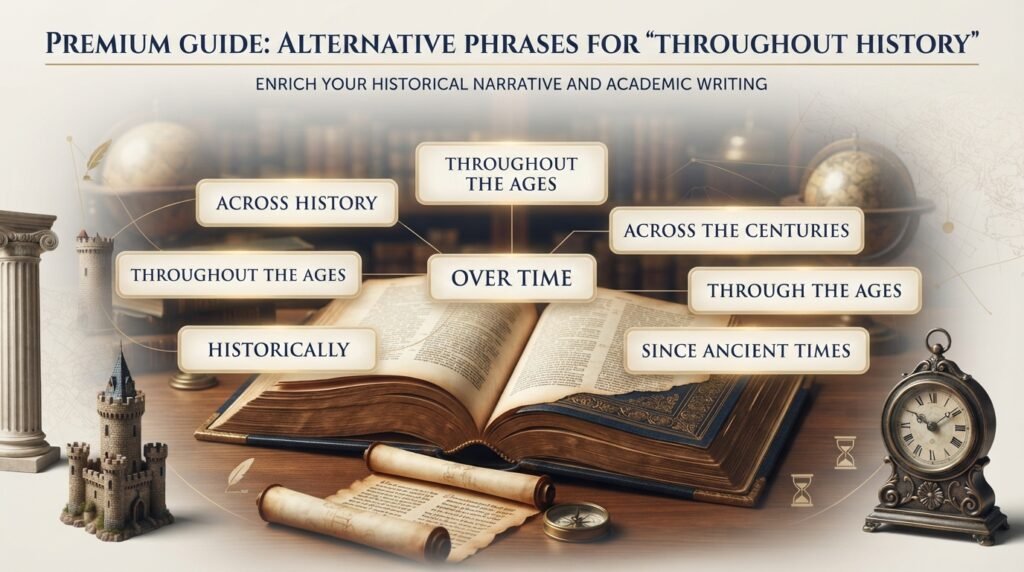
1. Across History
Meaning
“Across history” means during different periods of the past. It has nearly the same meaning as “throughout history” but can sound slightly more concise and polished.
Best For
- Professional
- Formal
- Academic
Example 1
Artists across history have used color to communicate emotion.
Example 2
Across history, societies have developed different ways to preserve cultural traditions.
Quick Tip
Use “across history” when you want a direct replacement that fits naturally into essays, articles, and informational content.
2. Throughout the Ages
Meaning
“Throughout the ages” refers to a very long span of human history, often emphasizing different generations or eras. It has a slightly literary quality compared with the straightforward “throughout history.”
Best For
- Formal
- Warm
- Friendly
Example 1
Throughout the ages, people have searched for better ways to understand the natural world.
Example 2
Stories of courage have inspired communities throughout the ages.
Quick Tip
Choose this phrase when you want your writing to emphasize generations, tradition, or the passage of centuries.
3. Over the Course of History
Meaning
“Over the course of history” describes something that happened or developed during the long progression of historical events. It often draws attention to a process rather than simply stating that something existed.
Best For
- Professional
- Formal
- Academic
Example 1
Over the course of history, transportation has changed dramatically.
Example 2
Political borders have shifted repeatedly over the course of history.
Quick Tip
This is an excellent choice for academic writing when discussing historical development or gradual transformation.
4. Historically
Meaning
“Historically” means from a historical perspective or based on what has happened in the past. Unlike “throughout history,” it does not always suggest that something occurred continuously across every period.
Best For
- Professional
- Formal
Example 1
Historically, coastal cities have played an important role in international trade.
Example 2
Historically, this region has relied heavily on agriculture.
Quick Tip
Use “historically” when you want a shorter, more authoritative alternative, especially at the beginning of a sentence.
5. Over Time
Meaning
“Over time” refers to changes or developments that occur gradually. It is broader than “throughout history” and does not necessarily refer to a long historical period.
Best For
- Professional
- Casual
- Friendly
Example 1
The meaning of the word changed over time.
Example 2
Over time, communities adapted their traditions to new circumstances.
Quick Tip
Use “over time” when your main idea is change or evolution, not simply something existing in many historical periods.
6. Since Ancient Times
Meaning
“Since ancient times” means from the distant past, particularly ancient civilizations, until a later or present period. It is more specific than “throughout history.”
Best For
- Formal
- Academic
Example 1
People have valued olive oil for its many uses since ancient times.
Example 2
Trade has connected distant cultures since ancient times.
Quick Tip
Only use this phrase when the subject genuinely reaches back to the ancient world.
7. Across the Centuries
Meaning
“Across the centuries” emphasizes a span covering many hundreds of years. It works especially well when discussing traditions, cultural practices, discoveries, or long-term historical patterns.
Best For
- Formal
- Warm
- Academic
Example 1
The tradition has survived across the centuries despite major social changes.
Example 2
Across the centuries, architecture has reflected the values of different societies.
Quick Tip
Choose this phrase when the length of time itself is important to your point.
8. Through the Ages
Meaning
“Through the ages” means across many different historical periods and generations. It is expressive and slightly more literary than “throughout history.”
Best For
- Warm
- Friendly
- Formal
Example 1
Music has brought people together through the ages.
Example 2
Through the ages, families have passed important traditions from one generation to another.
Quick Tip
This phrase works particularly well in cultural, historical, and reflective writing.
9. In Recorded History
Meaning
“In recorded history” refers specifically to the period for which written or otherwise documented historical evidence exists. It is more precise than “throughout history.”
Best For
- Professional
- Formal
- Academic
Example 1
The city has remained an important trading center in recorded history.
Example 2
Few inventions have changed communication as dramatically in recorded history.
Quick Tip
Use this phrase when historical documentation matters and you want to avoid making a claim about prehistoric periods.
10. From Ancient Times to the Present
Meaning
“From ancient times to the present” clearly identifies a time span that begins in the ancient world and continues through today. It is useful when you want to make the historical range unmistakable.
Best For
- Formal
- Academic
- Professional
Example 1
From ancient times to the present, humans have searched for ways to improve health.
Example 2
From ancient times to the present, written language has helped societies preserve knowledge.
Quick Tip
Use this longer phrase when precision matters more than brevity and you want to clearly show the beginning and end of the time period.
Comparison Table
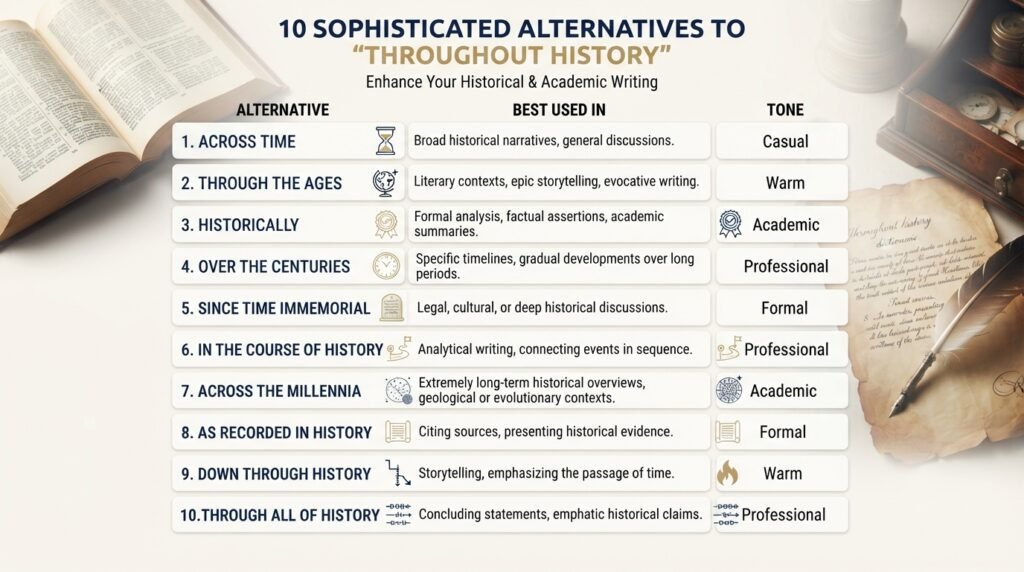
| Alternative | Best Used In | Tone |
| Across history | Essays, articles, general writing | Neutral/Formal |
| Throughout the ages | Cultural and reflective writing | Literary/Warm |
| Over the course of history | Academic and professional writing | Formal |
| Historically | Academic, professional, analytical writing | Formal |
| Over time | General and conversational writing | Neutral |
| Since ancient times | Historical and academic writing | Formal |
| Across the centuries | Cultural and historical writing | Formal/Literary |
| Through the ages | Reflective and cultural writing | Warm/Literary |
| In recorded history | Research and academic writing | Precise/Formal |
| From ancient times to the present | Detailed historical writing | Formal |
Common Mistakes

- Using casual phrases in formal writing
Expressions such as “way back when” may sound too informal for academic or professional work. Choose “historically” or “over the course of history” instead. - Choosing an overly broad phrase
“Throughout history” can imply a very long period. If you mean only gradual change, “over time” may be more accurate. - Using “since ancient times” without evidence
This phrase makes a specific historical claim. Make sure the subject actually dates back to ancient civilizations. - Ignoring the intended tone
“Through the ages” has a more literary feel, while “historically” sounds more analytical. Match the phrase to your audience. - Repeating the same expression too often
Even a useful phrase can become distracting when repeated throughout an article. Vary your wording naturally while keeping the meaning accurate.
Frequently Asked Questions

What is the best alternative to “throughout history”?
The best general alternative is “across history.” It is concise, natural, and works in both professional and academic writing. However, “over the course of history” is better when discussing historical development, while “over time” works better when focusing on gradual change.
What is a formal way to say “throughout history”?
“Historically,” “over the course of history,” and “across the centuries” are strong formal alternatives. For academic writing, choose the phrase that matches your exact meaning rather than simply replacing “throughout history” word for word.
What is another way to say “throughout history” in an essay?
For an essay, consider “across history,” “over the course of history,” or “historically.” These alternatives sound polished without being unnecessarily complicated. “Over the course of history” is especially useful when explaining how an idea, event, or practice developed.
Is “through the ages” the same as “throughout history”?
They are very similar, but they have slightly different tones. “Throughout history” sounds neutral and direct, while “through the ages” sounds more literary and often emphasizes generations or long-standing human experiences.
Can I use “over time” instead of “throughout history”?
Yes, but only when the meaning fits. “Over time” focuses on gradual change or development, while “throughout history” usually refers to something occurring across many historical periods. They are related but not always interchangeable.
What is a synonym for “throughout history”?
Useful alternatives include “across history,” “throughout the ages,” “historically,” “over the course of history,” “across the centuries,” and “through the ages.” The most appropriate choice depends on whether you want a formal, conversational, literary, or highly precise tone.
How do you say “throughout history” professionally?
In professional writing, use expressions such as “historically,” “across history,” or “over the course of history.” “Historically” is especially useful when you need a concise expression, while “over the course of history” provides more emphasis on historical progression.
What is the difference between “throughout history” and “in recorded history”?
“Throughout history” is broad and can refer generally to the human past. “In recorded history” is more specific because it refers to periods for which historical records or documentation exist. Use the second phrase when historical evidence or documentation is important to your claim.
Conclusion
Knowing another way to say “throughout history” can make your writing more precise, varied, and natural. The best alternative depends on what you want to emphasize and the tone you need.
The key is to consider your context before replacing the phrase. A well-chosen alternative should not only sound different—it should communicate your exact meaning more clearly. For additional historical resources, you can explore the Library of Congress’s history research guides.
Sarah Whitfield is the founder and lead editor of Anchors Press. With a background in copyediting and content strategy, she reviews every guide for accuracy, tone, and everyday usefulness before it’s published.