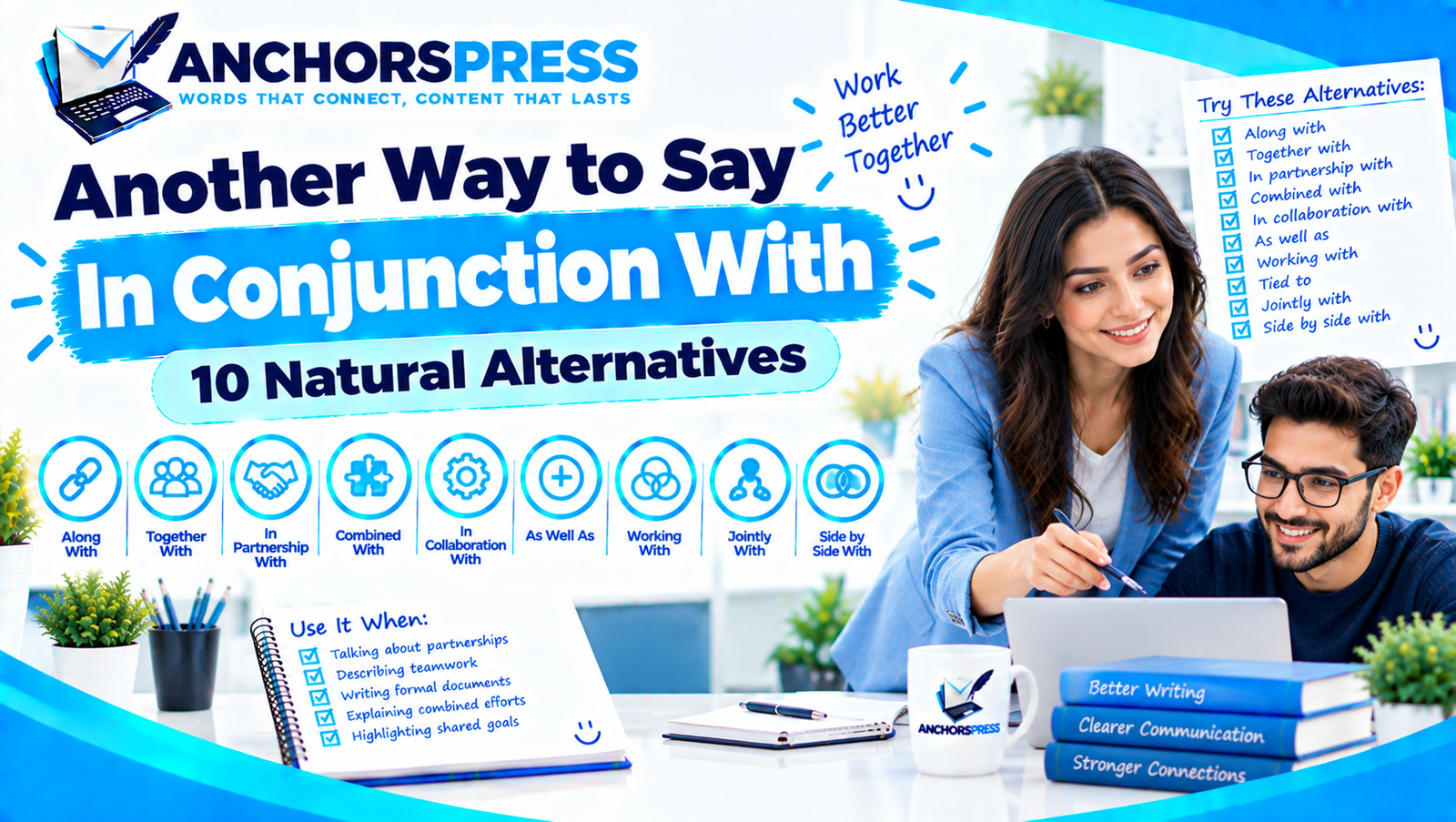
What Does “In Conjunction With” Mean?
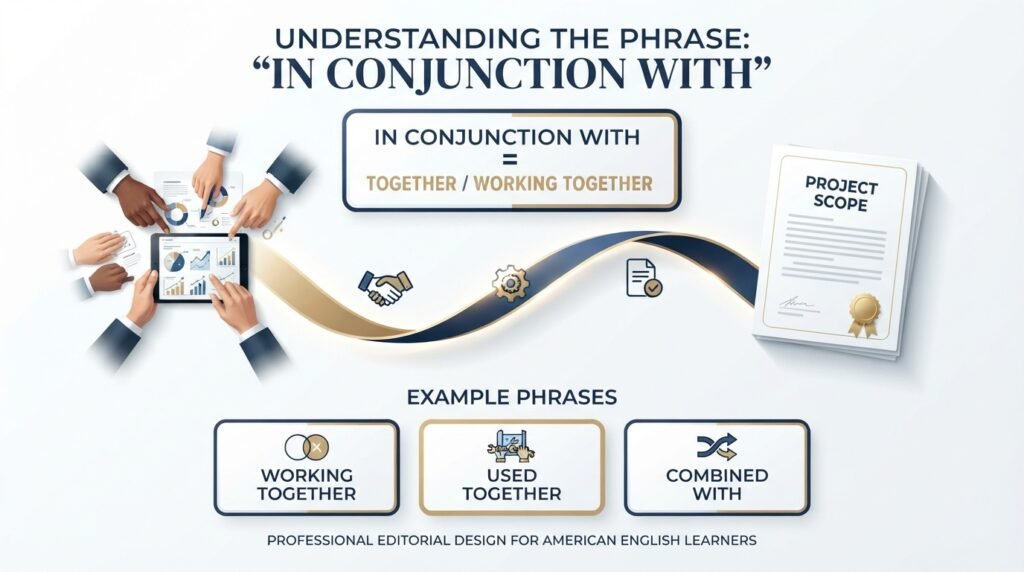
The phrase “in conjunction with” means that two or more people, things, or actions are connected, combined, or happening together. It often describes situations where separate elements work together toward the same purpose.
For example, you might say, “The company launched the campaign in conjunction with a local charity.” This means the company and charity worked together on the campaign.
The phrase is common in professional, academic, technical, legal, and formal writing. Although it is correct, it can sometimes sound more formal than necessary.
Why Use Other Ways to Say “In Conjunction With”?
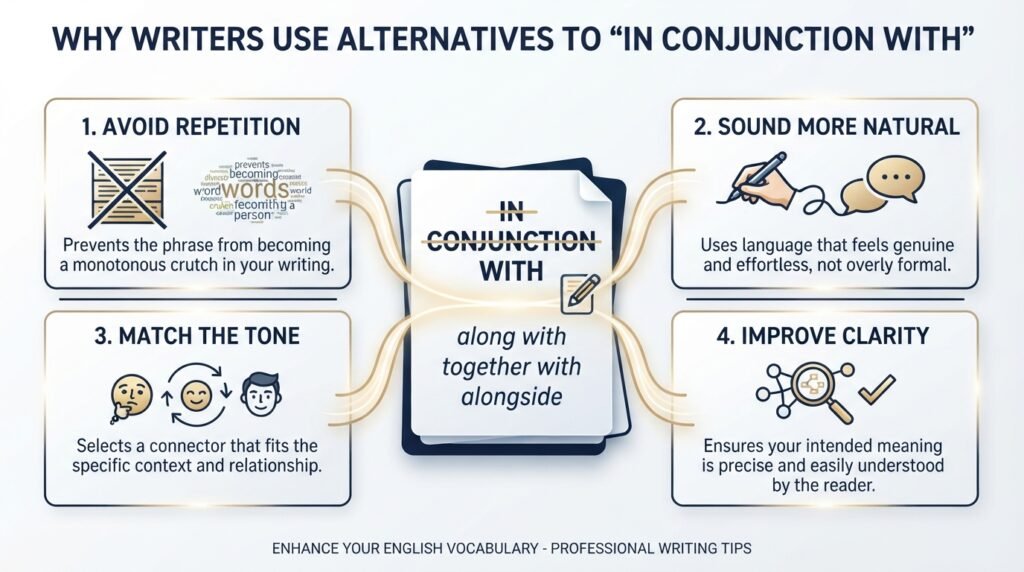
Replacing “in conjunction with” can make your writing clearer and more natural. A shorter alternative may also fit your audience better.
Other expressions can help you:
- Avoid repeating the same phrase.
- Make sentences easier to read.
- Match casual or professional situations.
- Make relationships between ideas clearer.
- Choose a tone that fits your audience.
- Avoid unnecessarily formal wording.
10 Best Other Ways to Say “In Conjunction With”
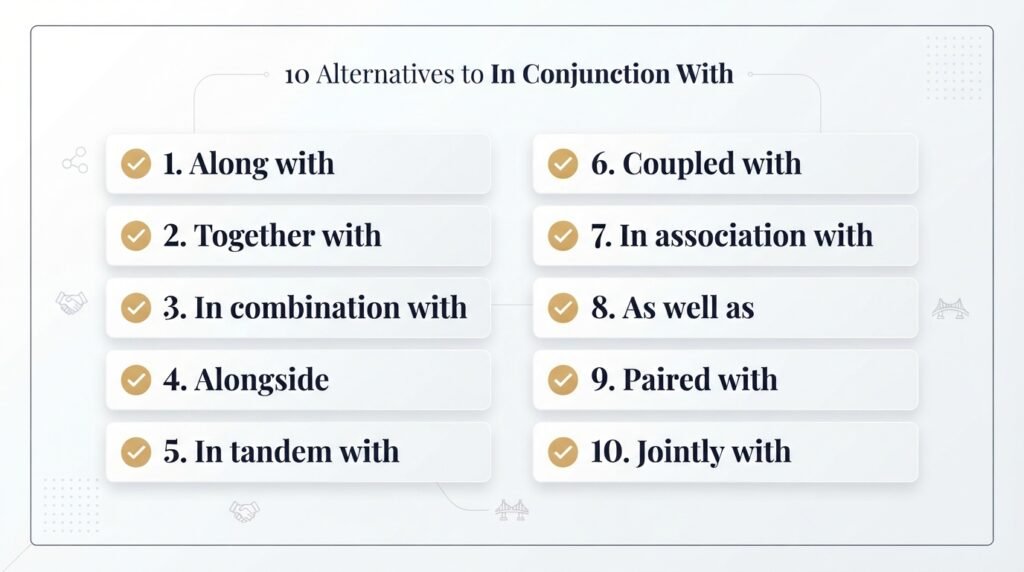
1. Along With
Meaning
“Along with” means together with or in addition to someone or something else. It is one of the simplest and most natural replacements for “in conjunction with.”
Best For
- Casual
- Professional
- Friendly
Example 1
The marketing team created the campaign along with the sales department.
Example 2
Please submit your application along with two professional references.
Quick Tip
Use “along with” when you want a clear, natural phrase without making your sentence sound overly formal.
2. Together With
Meaning
“Together with” emphasizes that two or more people or things are involved at the same time. It works especially well when highlighting cooperation or shared involvement.
Best For
- Professional
- Friendly
- Polite
Example 1
The researchers worked together with local universities to complete the study.
Example 2
She attended the conference together with three members of her team.
Quick Tip
Choose “together with” when the idea of collaboration or shared participation matters.
3. In Combination With
Meaning
“In combination with” describes two or more things being used or considered together. It is particularly useful when the combined elements create a result that may not occur independently.
Best For
- Formal
- Professional
Example 1
Regular exercise in combination with a balanced diet can support overall wellness.
Example 2
The software works in combination with existing security tools.
Quick Tip
Use this phrase when you want to emphasize that two elements produce an effect by being combined.
4. Alongside
Meaning
“Alongside” means beside, together with, or working at the same time as something else. It is concise and often sounds smoother than the longer original phrase.
Best For
- Professional
- Formal
- Casual
Example 1
The nonprofit partnered alongside community leaders to organize the event.
Example 2
The new program will operate alongside existing educational services.
Quick Tip
“Alongside” is an excellent choice when you want to make your sentence shorter without losing meaning.
5. In Tandem With
Meaning
“In tandem with” means working or occurring together in a coordinated way. It suggests that two actions, systems, or groups complement each other.
Best For
- Professional
- Formal
Example 1
The company updated its website in tandem with a new branding strategy.
Example 2
The two departments worked in tandem with one another to meet the deadline.
Quick Tip
Use “in tandem with” when coordination is more important than simple association.
6. Coupled With
Meaning
“Coupled with” means combined or associated with another factor. It is often used when explaining how one condition, action, or feature affects an outcome.
Best For
- Professional
- Formal
Example 1
Strong customer service, coupled with competitive pricing, helped the business grow.
Example 2
The delay, coupled with bad weather, caused several flights to be canceled.
Quick Tip
Use “coupled with” when one factor adds to or strengthens the effect of another.
7. In Association With
Meaning
“In association with” means connected with or working with another person, group, or organization. It is common when describing partnerships, events, and professional relationships.
Best For
- Formal
- Professional
Example 1
The museum hosted the exhibition in association with a regional arts foundation.
Example 2
The course was developed in association with experienced industry professionals.
Quick Tip
This phrase is a good fit for formal announcements, partnerships, and organizational relationships.
8. As Well As
Meaning
“As well as” means in addition to or together with. It can replace “in conjunction with” when the sentence simply needs to identify another person, item, or activity.
Best For
- Casual
- Professional
- Polite
Example 1
The package includes training materials as well as technical support.
Example 2
The manager reviewed the budget as well as the department’s hiring plans.
Quick Tip
Use “as well as” when you mean “in addition to” rather than emphasizing a close partnership.
9. Paired With
Meaning
“Paired with” means matched or combined with another thing. It often suggests that two elements complement each other effectively.
Best For
- Casual
- Friendly
- Professional
Example 1
The presentation was paired with a detailed handout for attendees.
Example 2
This lightweight jacket looks great paired with dark jeans.
Quick Tip
“Paired with” works especially well when two things are intentionally matched or used together.
10. Jointly With
Meaning
“Jointly with” means together with another person or organization, usually when responsibility or participation is shared. It is more formal than many alternatives.
Best For
- Formal
- Professional
Example 1
The report was prepared jointly with the state transportation department.
Example 2
The organizations jointly announced the initiative with several community partners.
Quick Tip
Use “jointly” when you want to stress shared responsibility, ownership, or action.
Comparison Table
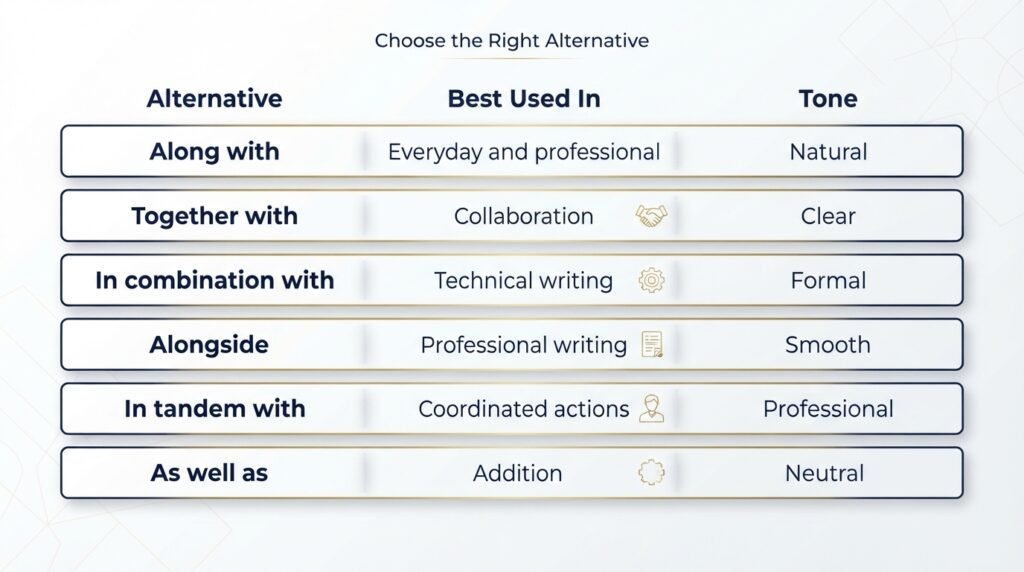
| Alternative | Best Used In | Tone |
| Along with | Everyday and professional writing | Natural |
| Together with | Collaboration and shared activities | Clear |
| In combination with | Technical and formal writing | Formal |
| Alongside | General and professional writing | Smooth |
| In tandem with | Coordinated actions | Professional |
| Coupled with | Cause-and-effect descriptions | Formal |
| In association with | Partnerships and organizations | Formal |
| As well as | Addition or inclusion | Neutral |
| Paired with | Matching or combining things | Conversational |
| Jointly with | Shared responsibility | Formal |
Common Mistakes
1. Using a casual phrase in a formal context
Words such as “along with” are perfectly correct, but some legal, academic, or technical documents may require more precise wording. Always consider your audience before choosing an alternative.
2. Choosing overly formal language
Not every sentence needs “in association with” or “in tandem with.” In ordinary communication, a simpler expression such as “along with” often sounds more natural.
3. Repeating the same phrase
Using “in conjunction with” several times in one article can make your writing feel repetitive. Vary your wording when the meaning remains accurate.
4. Forgetting the context
Not every alternative has exactly the same meaning. “As well as” often means “in addition to,” while “in combination with” emphasizes that elements are combined.
5. Sounding more complicated than necessary
Long phrases can make otherwise simple ideas harder to understand. If “together with” communicates your meaning clearly, there is usually no need to use a more complicated expression.
Frequently Asked Questions
What is the simplest way to say “in conjunction with”?
The simplest alternative is usually “along with.” It is natural, widely understood, and appropriate for many everyday and professional situations. For example, “The report was submitted along with supporting documents” is simpler than “The report was submitted in conjunction with supporting documents.”
What is a professional way to say “in conjunction with”?
Several professional alternatives work well, including “together with,” “alongside,” “in association with,” and “in combination with.” The best option depends on your meaning. “In association with” is useful for formal partnerships, while “in combination with” works well when describing combined effects.
Is “along with” the same as “in conjunction with”?
They can have the same meaning in many sentences, but they are not always interchangeable. “Along with” usually means together with or in addition to, while “in conjunction with” can place stronger emphasis on cooperation, coordination, or combined action.
What is another way to say “in conjunction with” in a formal sentence?
For formal writing, consider “in association with,” “in combination with,” “in tandem with,” or “coupled with.” Your choice should reflect the relationship between the elements. For example, “coupled with” works well when discussing factors that contribute to a particular result.
Can I use “alongside” instead of “in conjunction with”?
Yes. “Alongside” can be a strong replacement when two people, groups, systems, or activities exist or operate together. It is concise and natural in professional writing. However, if you need to emphasize a combined effect, “in combination with” may communicate the relationship more precisely.
What is another way to say “in conjunction with” in an email?
For most professional emails, “along with” or “together with” is a good choice. These expressions sound natural without being too casual. For example, you could write, “Please review the attached proposal along with the updated pricing information.”
Is “in tandem with” formal?
Yes, “in tandem with” generally has a professional or formal tone. It means that two things happen together in a coordinated way. It is especially useful when discussing teams, processes, strategies, or systems that operate at the same time.
Which alternative to “in conjunction with” sounds most natural?
“Along with” is generally the most natural choice for everyday American English. It is short, familiar, and flexible. However, “together with,” “alongside,” and “as well as” may be better depending on whether you want to emphasize cooperation, simultaneous activity, or simple addition.
Conclusion
Knowing another way to say “in conjunction with” gives you more flexibility and can make your writing sound clearer and more natural. While the original phrase is correct, it can sometimes feel more formal than necessary.
The key is to match the phrase to your meaning and audience. When a shorter alternative communicates the same idea clearly, it is often the better choice. Choosing the right words for your writing can help make your communication more precise and effective.
Sarah Whitfield is the founder and lead editor of Anchors Press. With a background in copyediting and content strategy, she reviews every guide for accuracy, tone, and everyday usefulness before it’s published.