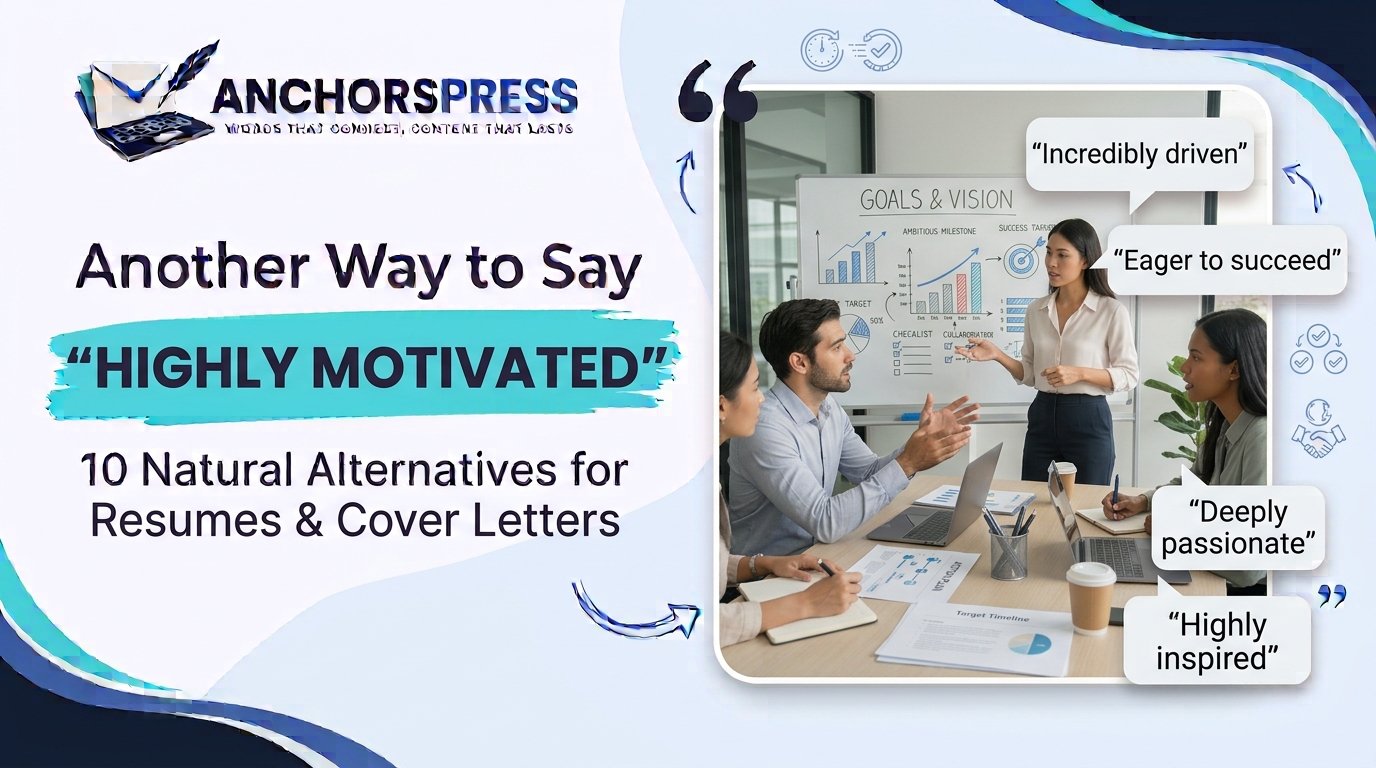
What Does “Another Way to Say Highly Motivated” Mean?

The phrase “highly motivated” describes someone who has a strong desire to achieve something and is willing to put in consistent effort. It can describe a person’s attitude toward work, education, personal goals, sports, or other challenges.
For example, you might call an employee highly motivated because they take initiative and work hard without being pushed. You could also describe a student as highly motivated when they actively work toward academic success.
People often look for another way to say “highly motivated” because the phrase can become repetitive, especially in resumes, cover letters, performance reviews, and professional communication.
Why Use Other Ways to Say “Highly Motivated”?
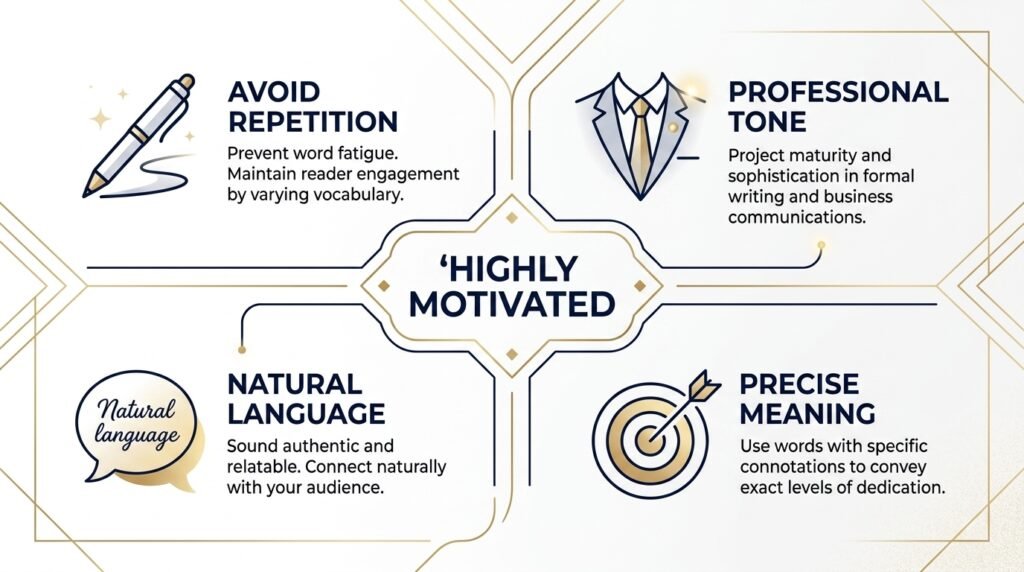
Using different expressions can make your writing more precise and natural. Instead of simply saying someone is highly motivated, you can highlight determination, ambition, enthusiasm, commitment, or independence.
Other benefits include:
- Avoiding repetitive wording
- Making resumes and cover letters more engaging
- Matching the tone to a professional or casual situation
- Describing a specific type of motivation
- Showing stronger and more precise communication
The key is to choose a phrase that explains why or how someone is motivated rather than replacing the original phrase without considering context.
10 Best Other Ways to Say “Highly Motivated”
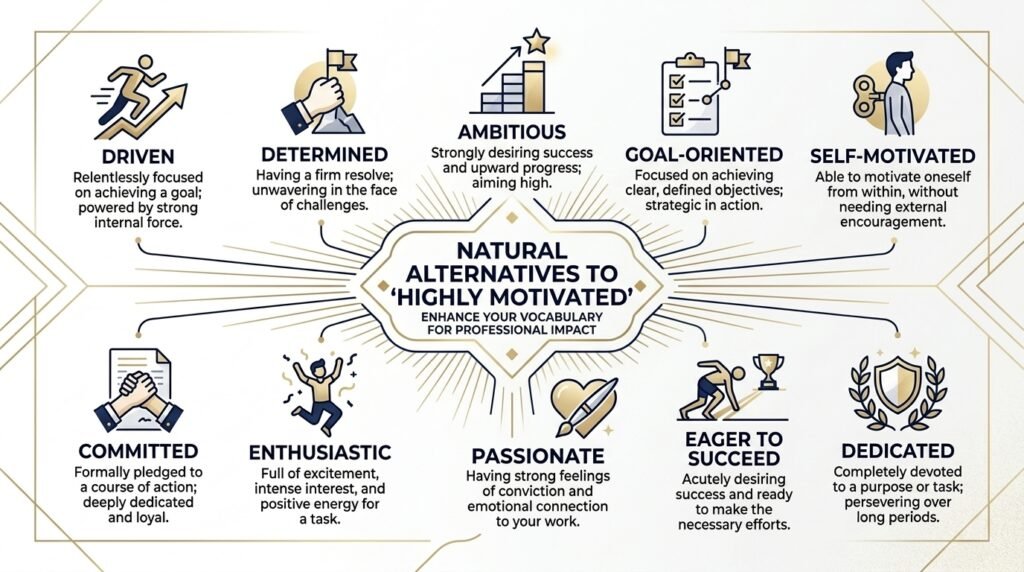
1. Driven
Meaning
Driven describes someone who has a strong internal desire to succeed or accomplish something. It suggests determination, ambition, and consistent effort.
Best For
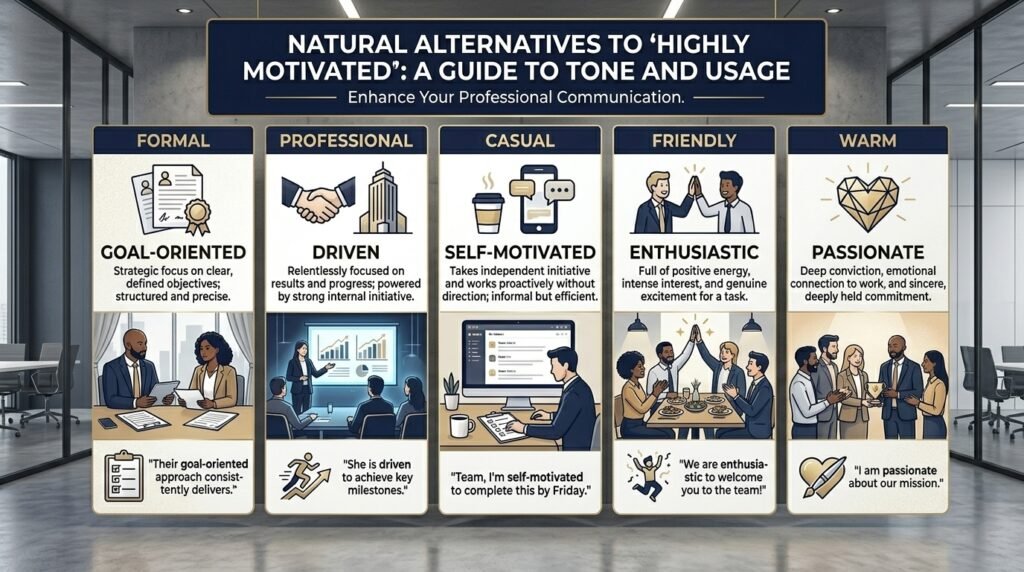
- Professional
- Formal
- Friendly
Example 1
She is a driven marketing professional who consistently looks for ways to improve campaign performance.
Example 2
Our new manager is driven to build a stronger and more collaborative team.
Quick Tip
Use “driven” when you want to emphasize a person’s strong desire to achieve results.
2. Determined
Meaning
Determined describes someone who has firmly decided to achieve a goal and refuses to give up easily. It focuses more on persistence than enthusiasm.
Best For
- Professional
- Formal
- Friendly
- Warm
Example 1
He was determined to finish the certification before the end of the year.
Example 2
Despite several setbacks, Maria remained determined to launch her small business.
Quick Tip
Choose “determined” when persistence and resilience are more important than excitement.
3. Ambitious
Meaning
Ambitious refers to someone who has high goals and wants to achieve significant success. It works particularly well when describing career plans, leadership goals, or long-term aspirations.
Best For
- Professional
- Formal
Example 1
The company is looking for ambitious employees who want to grow into leadership roles.
Example 2
He is an ambitious young professional with clear plans for his career.
Quick Tip
Use “ambitious” when the person’s motivation is connected to challenging or high-level goals.
4. Goal-Oriented
Meaning
Goal-oriented describes someone who focuses on specific objectives and organizes their efforts around achieving them. It sounds clear and professional without being overly emotional.
Best For
- Professional
- Formal
Example 1
We need a goal-oriented project coordinator who can keep the team focused on deadlines.
Example 2
She takes a goal-oriented approach to improving customer satisfaction.
Quick Tip
“Goal-oriented” is an excellent choice for resumes, LinkedIn profiles, job applications, and performance reviews.
5. Self-Motivated
Meaning
Self-motivated describes someone who can take action and maintain effort without needing constant encouragement or supervision. It highlights independence and personal initiative.
Best For
- Professional
- Formal
Example 1
The ideal candidate is self-motivated and comfortable managing multiple projects independently.
Example 2
As a self-motivated student, Daniel creates his own study schedule and follows it consistently.
Quick Tip
Use “self-motivated” when you want to emphasize independence rather than simply strong ambition.
6. Committed
Meaning
Committed describes someone who is dedicated to a person, project, responsibility, or goal. It emphasizes reliability and a willingness to keep working toward an outcome.
Best For
- Professional
- Formal
- Warm
- Polite
Example 1
Our team is committed to providing reliable service to every customer.
Example 2
She remains committed to improving her technical skills throughout the year.
Quick Tip
“Committed” works especially well when motivation involves long-term effort or responsibility.
7. Enthusiastic
Meaning
Enthusiastic describes someone who shows strong interest, excitement, and positive energy toward something. Unlike “determined,” it focuses more on attitude and emotional energy.
Best For
- Casual
- Friendly
- Professional
- Warm
Example 1
The students were enthusiastic about participating in the community project.
Example 2
He is an enthusiastic team member who brings positive energy to every meeting.
Quick Tip
Use “enthusiastic” when you want your description to sound energetic and positive.
8. Passionate
Meaning
Passionate describes someone who has a deep and genuine interest in a subject, activity, or cause. It suggests that motivation comes from personal meaning and strong interest.
Best For
- Friendly
- Warm
- Professional
Example 1
She is passionate about creating accessible educational resources for children.
Example 2
He is passionate about helping small businesses improve their online presence.
Quick Tip
“Passionate” is strongest when you can identify the specific subject or cause that inspires the person.
9. Eager to Succeed
Meaning
Eager to succeed describes someone who strongly wants to achieve a positive result and is ready to make an effort. It has a more conversational feel than “goal-oriented” or “self-motivated.”
Best For
- Casual
- Friendly
- Professional
- Warm
Example 1
The new graduates are eager to succeed and ready to learn from experienced colleagues.
Example 2
She joined the program eager to succeed and make the most of the opportunity.
Quick Tip
Use this phrase when you want to communicate ambition in a straightforward, positive way.
10. Dedicated
Meaning
Dedicated describes someone who gives consistent time, attention, and effort to something important. It suggests loyalty, reliability, and sustained commitment.
Best For
- Professional
- Formal
- Warm
- Polite
Example 1
He is a dedicated employee who consistently supports his coworkers and meets important deadlines.
Example 2
The organization relies on a dedicated group of volunteers to serve the local community.
Quick Tip
Choose “dedicated” when you want to emphasize steady effort and reliability over ambition.
Comparison Table
| Alternative | Best Used In | Tone |
| Driven | Work, careers, leadership | Strong, confident |
| Determined | Goals, challenges, achievements | Persistent |
| Ambitious | Careers, aspirations, leadership | Aspirational |
| Goal-oriented | Resumes, business, performance reviews | Professional |
| Self-motivated | Resumes, interviews, workplaces | Independent |
| Committed | Work, projects, responsibilities | Reliable |
| Enthusiastic | Teams, activities, opportunities | Energetic |
| Passionate | Causes, careers, interests | Warm, emotional |
| Eager to succeed | Work, education, new opportunities | Positive |
| Dedicated | Work, service, long-term efforts | Dependable |
Common Mistakes
1. Using Casual Phrases in Professional Writing
Words such as “pumped” or “fired up” may sound natural in conversation but can feel too informal in a resume or business email. Choose “driven,” “dedicated,” or “goal-oriented” instead.
2. Choosing Overly Formal Language
Not every situation needs sophisticated vocabulary. A simple word like “determined” can sound more natural than an unnecessarily complex expression.
3. Repeating the Same Phrase
Using “highly motivated” several times in one resume or article can make the writing feel repetitive. Vary your language while making sure each alternative adds a slightly different meaning.
4. Forgetting Context
“Passionate” emphasizes strong personal interest, while “self-motivated” emphasizes independence. They are related to motivation but do not communicate exactly the same idea.
5. Sounding Insincere
Avoid describing someone as “passionate” or “exceptionally driven” without supporting evidence. Specific examples, achievements, and behaviors make the description more credible.
Frequently Asked Questions
What is a professional way to say “highly motivated”?
“Driven,” “goal-oriented,” and “self-motivated” are among the best professional alternatives. “Driven” highlights ambition, “goal-oriented” focuses on achieving specific objectives, and “self-motivated” shows that someone can maintain productivity without constant supervision.
What is another word for highly motivated on a resume?
For a resume, consider driven, self-motivated, goal-oriented, dedicated, or ambitious. The best choice depends on the position. For example, “self-motivated” works well for independent roles, while “goal-oriented” is useful when the job involves measurable targets.
How do you describe someone who is highly motivated?
You can describe them as driven, determined, ambitious, dedicated, committed, self-motivated, or goal-oriented. If you want to emphasize excitement and genuine interest, “enthusiastic” or “passionate” may be more appropriate.
Is “driven” the same as “highly motivated”?
“Driven” and “highly motivated” are very similar, but “driven” often sounds stronger and more concise. It usually suggests that a person has a powerful internal desire to achieve results. However, “highly motivated” is broader and can describe motivation without emphasizing ambition as strongly.
What is a positive way to say someone is highly motivated?
Positive alternatives include enthusiastic, passionate, dedicated, committed, driven, and eager to succeed. Each has a slightly different focus. “Enthusiastic” highlights energy, “passionate” suggests genuine interest, and “dedicated” emphasizes consistent effort.
What is the difference between “motivated” and “determined”?
“Motivated” means someone has a reason or desire to take action. “Determined” goes a step further by emphasizing persistence and the willingness to continue despite difficulties. Someone can be motivated to reach a goal but may not always remain determined when challenges appear.
Can I use “passionate” instead of “highly motivated”?
Yes, but only when the person has strong personal interest or enthusiasm for the subject. “Passionate” suggests emotional connection, while “highly motivated” focuses more generally on the desire to accomplish something. For a resume, make sure the surrounding sentence supports the claim.
What is the best alternative to “highly motivated” in a job application?
“Self-motivated” is often one of the strongest choices for a job application because it tells employers that you can take initiative without needing constant direction. “Driven,” “goal-oriented,” and “dedicated” are also effective when they accurately reflect your skills and work style.
Conclusion
Knowing another way to say highly motivated can help you make your writing more precise and engaging. Although “highly motivated” is perfectly natural, alternatives let you emphasize different qualities.
Choose driven when you want to highlight ambition, determined when persistence matters, and goal-oriented when focusing on measurable results. For independent workers, self-motivated is especially useful, while dedicated and committed emphasize reliability and long-term effort.
Sarah Whitfield is the founder and lead editor of Anchors Press. With a background in copyediting and content strategy, she reviews every guide for accuracy, tone, and everyday usefulness before it’s published.