
What Does “To Be Clear” Mean?
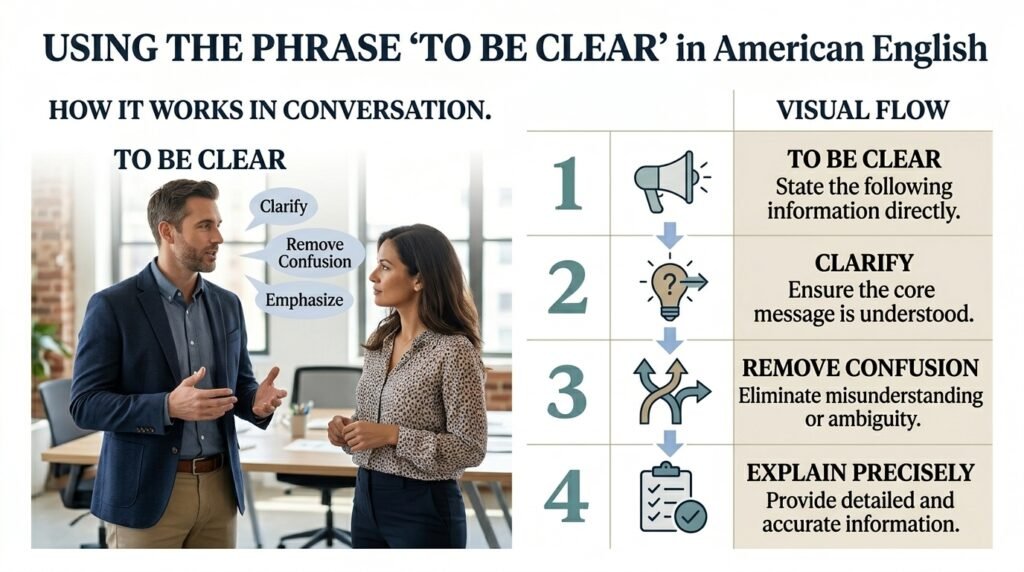
“To be clear” is a phrase used to make a statement easier to understand or to remove possible confusion. It often signals that the speaker wants to explain something more precisely, correct a misunderstanding, or emphasize an important point.
For example, someone might say, “To be clear, the meeting starts at 9 a.m.” This makes the intended information unmistakable.
The phrase is common in everyday conversations, workplace communication, emails, presentations, instructions, and formal discussions. Because it is so useful, however, repeating it too often can make your writing sound predictable.
Why Use Other Ways to Say “To Be Clear”?
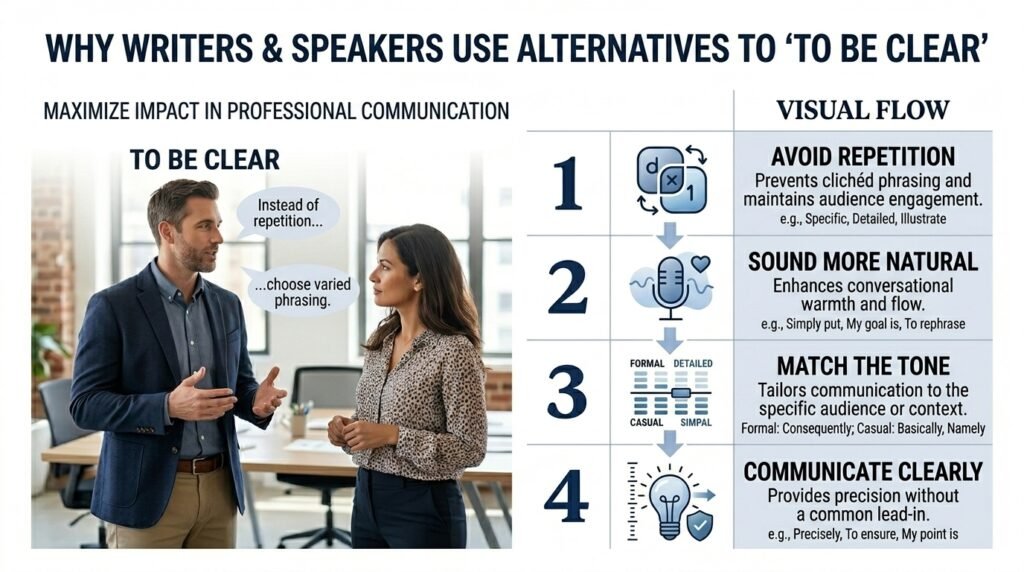
Using alternatives can make your communication more natural and precise. Different expressions also let you match the tone of the situation.
Other ways to say “to be clear” can help you:
- Avoid repeating the same phrase.
- Make your meaning more precise.
- Sound more natural in conversation.
- Communicate professionally at work.
- Clarify instructions or expectations.
- Emphasize an important point without sounding repetitive.
The key is to choose an expression that fits your message rather than replacing “to be clear” mechanically.
10 Best Other Ways to Say “To Be Clear”
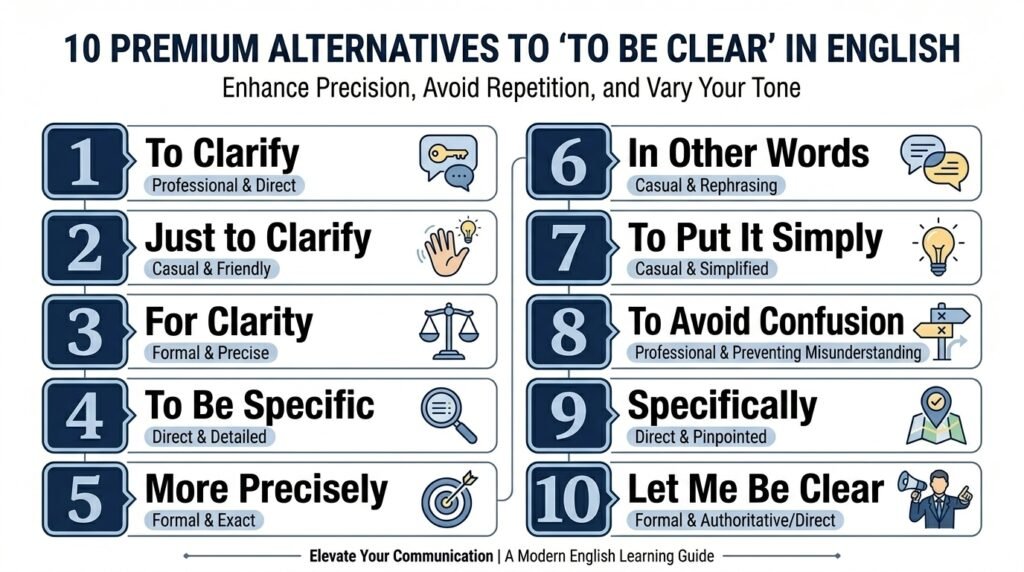
1. To Clarify
Meaning
“To clarify” means to make something easier to understand or remove uncertainty about a particular point. It is a natural and professional replacement for “to be clear.”
Best For
- Professional
- Formal
- Polite
Example 1
To clarify, all applications must be submitted by Friday.
Example 2
I want to clarify that the revised policy applies to new employees only.
Quick Tip
Use “to clarify” when confusion or uncertainty already exists, or when you want to prevent it.
2. Just to Clarify
Meaning
“Just to clarify” is a softer, more conversational version of “to clarify.” It is useful when asking a question, confirming information, or checking that everyone understands the same thing.
Best For
- Casual
- Friendly
- Professional
- Polite
Example 1
Just to clarify, are we meeting at the downtown office tomorrow?
Example 2
Just to clarify, you would like me to send the final report today, correct?
Quick Tip
This phrase works especially well when you want clarification without making your question sound confrontational.
3. For Clarity
Meaning
“For clarity” introduces information that makes a statement, document, or instruction easier to understand. It has a concise and professional tone.
Best For
- Formal
- Professional
- Polite
Example 1
For clarity, employees should submit vacation requests through the online portal.
Example 2
For clarity, the quoted price does not include shipping costs.
Quick Tip
Use “for clarity” in emails, reports, policies, instructions, and other professional writing.
4. To Be Specific
Meaning
“To be specific” signals that you are about to provide exact information rather than a general statement. It is particularly useful when discussing numbers, dates, requirements, or details.
Best For
- Professional
- Casual
- Formal
Example 1
To be specific, we need three volunteers for Saturday’s event.
Example 2
To be specific, the software update will be released on September 5.
Quick Tip
Choose this phrase when the main goal is to give precise details rather than simply resolve confusion.
5. More Precisely
Meaning
“More precisely” is used when you want to refine a statement or express an idea with greater accuracy. It can replace “to be clear” when the distinction between two ideas matters.
Best For
- Formal
- Professional
Example 1
The project should be finished next month, or more precisely, by October 15.
Example 2
She works in marketing, or more precisely, in digital content strategy.
Quick Tip
Use “more precisely” when you are narrowing down or correcting a general statement.
6. In Other Words
Meaning
“In other words” introduces a simpler or different explanation of something that was already stated. It focuses on making an idea easier to understand.
Best For
- Casual
- Friendly
- Professional
Example 1
In other words, we need to finish the first stage before starting the next one.
Example 2
In other words, the customer wants a simpler solution that costs less.
Quick Tip
Use this expression when your audience may benefit from hearing the same idea explained differently.
7. To Put It Simply
Meaning
“To put it simply” tells the reader or listener that you are about to express a complicated idea in straightforward language. It is helpful when simplifying technical or detailed information.
Best For
- Casual
- Friendly
- Professional
Example 1
To put it simply, the new system saves employees time.
Example 2
To put it simply, we need more people working on the customer support team.
Quick Tip
This phrase is especially useful when explaining complex subjects to a general audience.
8. To Avoid Confusion
Meaning
“To avoid confusion” emphasizes that the information that follows is intended to prevent people from misunderstanding a situation. It sounds practical and direct.
Best For
- Professional
- Formal
- Polite
Example 1
To avoid confusion, please use the updated registration form.
Example 2
To avoid confusion, the blue folder contains the final versions of all documents.
Quick Tip
Use this phrase when you are giving instructions or distinguishing between similar options.
9. Specifically
Meaning
“Specifically” points directly to an exact detail or item. It is a compact alternative to “to be clear” when you want to identify something precisely.
Best For
- Professional
- Formal
- Casual
Example 1
We are looking for someone with experience in social media advertising specifically.
Example 2
The budget covers transportation specifically, not accommodation.
Quick Tip
“Specifically” works well when you need to narrow a broad statement to one particular detail.
10. Let Me Be Clear
Meaning
“Let me be clear” strongly emphasizes that the speaker wants to remove doubt about an important point. It can sound confident, but depending on the context, it may also sound firm or forceful.
Best For
- Formal
- Professional
- Direct
Example 1
Let me be clear: customer privacy must remain our top priority.
Example 2
Let me be clear about our expectations: every report must be reviewed before submission.
Quick Tip
Use this phrase carefully. It is effective for emphasis, but a softer option may be better when you want to sound diplomatic.
Comparison Table
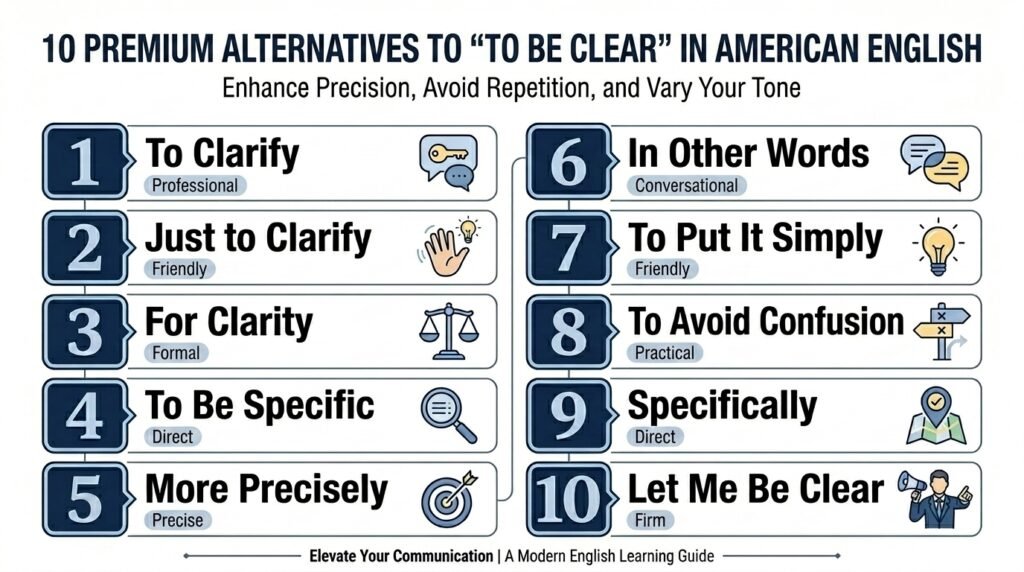
| Alternative | Best Used In | Tone |
| To clarify | Work emails, discussions | Professional |
| Just to clarify | Questions, conversations | Friendly |
| For clarity | Reports, instructions | Formal |
| To be specific | Detailed explanations | Direct |
| More precisely | Corrections, exact details | Precise |
| In other words | Explanations | Conversational |
| To put it simply | Complex ideas | Clear, friendly |
| To avoid confusion | Instructions | Practical |
| Specifically | Detailed statements | Direct |
| Let me be clear | Strong emphasis | Firm |
Common Mistakes
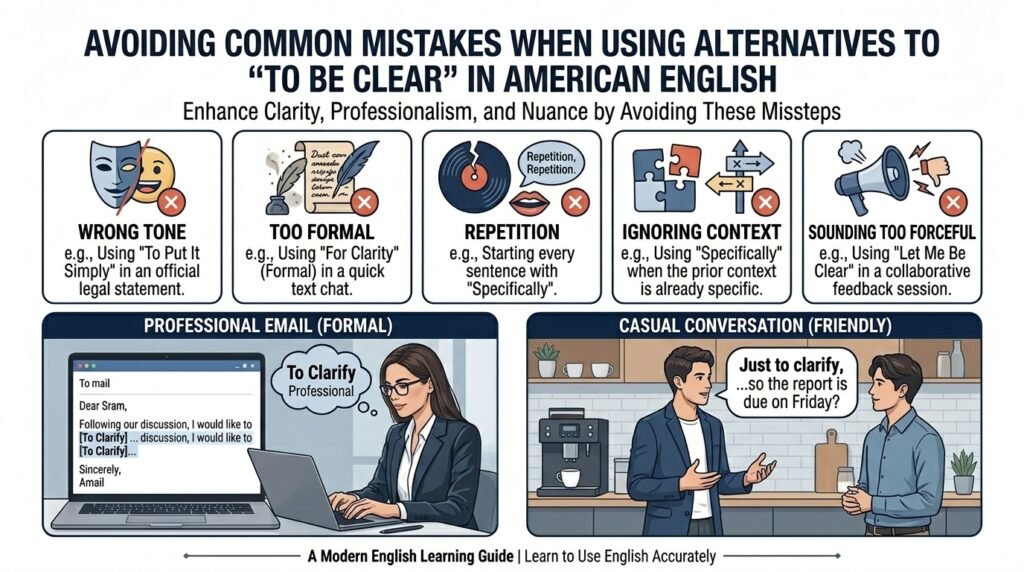
1. Using Casual Phrases in Professional Emails
Phrases such as “just to clarify” can be appropriate at work, but overly casual wording may not suit formal reports or official documents. Consider “for clarity” when you need a more polished tone.
2. Choosing Overly Formal Language
Not every situation requires formal wording. Saying “more precisely” in a relaxed conversation may sound unnecessarily stiff when “just to clarify” would feel more natural.
3. Repeating the Same Phrase
Using “to be clear” in every paragraph can make your writing repetitive. Select alternatives based on what you are actually trying to accomplish.
4. Forgetting Context
An expression that works in an email may not work equally well in a conversation. Always consider your audience, relationship, and purpose before choosing an alternative.
5. Sounding More Aggressive Than Intended
“Let me be clear” can sometimes sound forceful, especially during disagreement. If you want to maintain a warm tone, “just to clarify” or “for clarity” may be a better choice.
Frequently Asked Questions
What is another way to say “to be clear” professionally?
“To clarify” is one of the strongest professional alternatives. Other suitable options include “for clarity,” “to be specific,” and “more precisely.” These expressions work well in business emails, reports, presentations, instructions, and workplace conversations because they communicate your point without sounding unnecessarily informal.
What is a polite way to say “to be clear”?
“Just to clarify” is a polite and natural choice, especially when you are asking a question or confirming information. “For clarity” is another good option for formal communication. Both expressions can help prevent misunderstandings without making your message sound harsh or demanding.
What is a casual way to say “to be clear”?
In casual American English, you can use “just to clarify,” “in other words,” or “to put it simply.” The best choice depends on what you want to do. “Just to clarify” checks information, while “in other words” and “to put it simply” usually introduce a simpler explanation.
Is “to clarify” the same as “to be clear”?
They are very similar, but they are not always interchangeable. “To clarify” usually focuses on removing confusion or explaining something more clearly. “To be clear” can also emphasize a position, expectation, or important point. As a result, “to be clear” may sometimes sound stronger.
What can I say instead of “to be clear” in an email?
For a professional email, consider “to clarify,” “for clarity,” “to be specific,” or “more precisely.” For example, you could write, “To clarify, the revised deadline is Friday.” These alternatives keep your message concise while making the important information easy for the recipient to understand.
What is a formal alternative to “to be clear”?
“For clarity” and “more precisely” are strong formal alternatives. “For clarity” is particularly useful when explaining rules, procedures, or requirements. “More precisely” works better when you are correcting a broad statement or providing a more exact description of something.
Can I use “let me be clear” in professional communication?
Yes, but use it thoughtfully. “Let me be clear” is grammatically correct and common in American English, but it can sound firm or emphatic. It is appropriate when you need to stress an important expectation or position. For routine clarification, “to clarify” usually sounds more neutral.
What is the best replacement for “to be clear”?
There is no single best replacement for every situation. “To clarify” is the most versatile choice, while “just to clarify” works well in conversation. Use “for clarity” in formal writing, “to be specific” for exact details, and “in other words” when simplifying an explanation.
Conclusion
Knowing another way to say “to be clear” gives you more flexibility in both professional and everyday American English. Although “to be clear” is perfectly natural, repeating it too often can make your communication feel predictable.
The best alternative is the one that matches your purpose, audience, and tone. Choose naturally, and your message will sound clearer and more polished.

Amara Reyes has taught English to adult learners for over eight years. She focuses on how phrases are actually used in everyday conversation, not just textbook definitions.