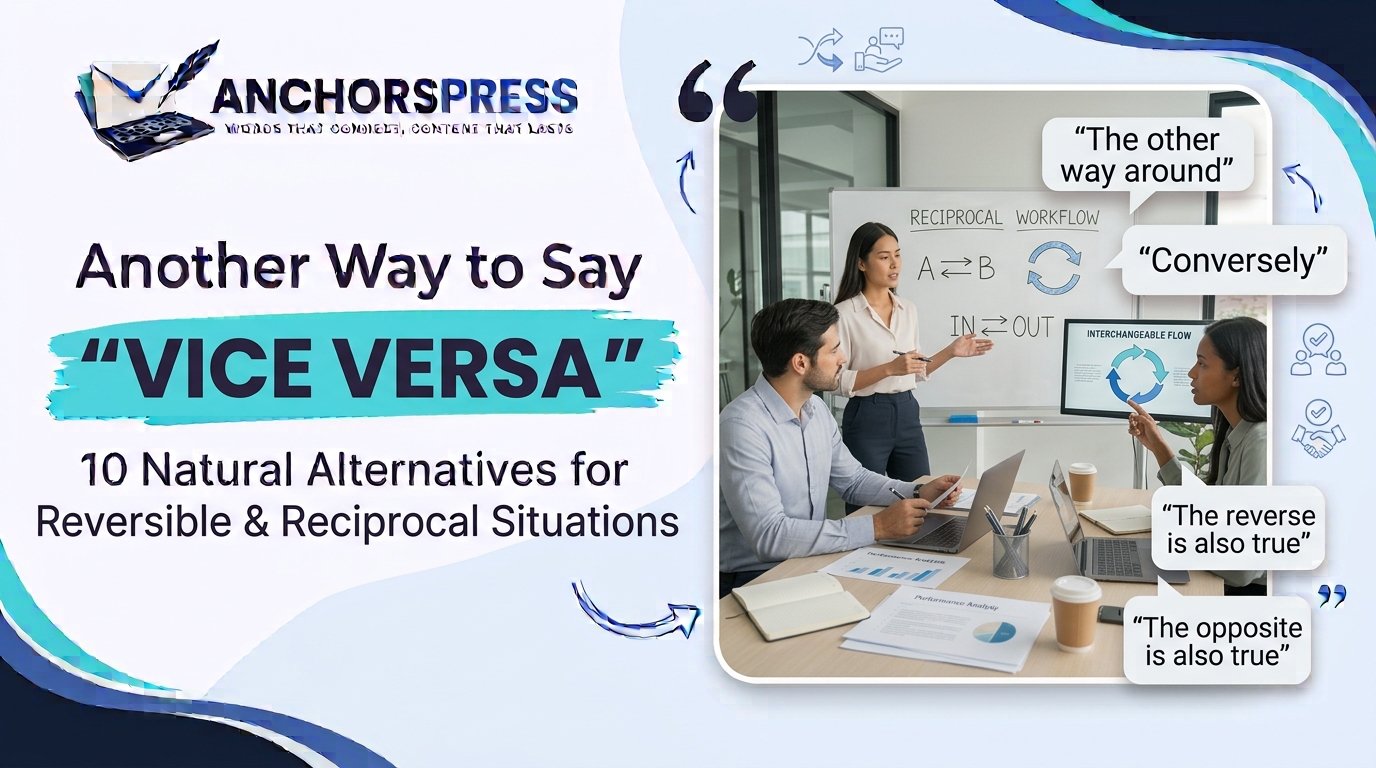
What Does “Another Way to Say Vice Versa” Mean?
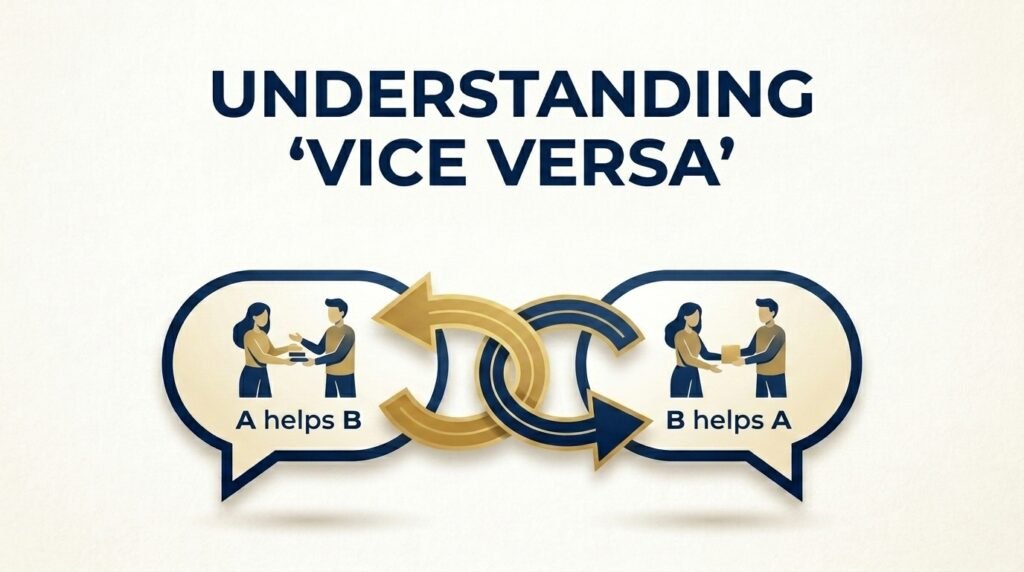
“Vice versa” means that the relationship or statement just mentioned is also true in the opposite direction. For example, “I help her, and vice versa” means “I help her, and she helps me.”
People often search for another way to say “vice versa” because they want clearer, more natural, or more varied wording. While “vice versa” is common in American English, alternatives can make a sentence easier to understand, especially for readers who may not know the Latin expression.
You will see “vice versa” in everyday conversations, emails, academic writing, instructions, business communication, and general explanations.
Why Use Other Ways to Say “Vice Versa”?
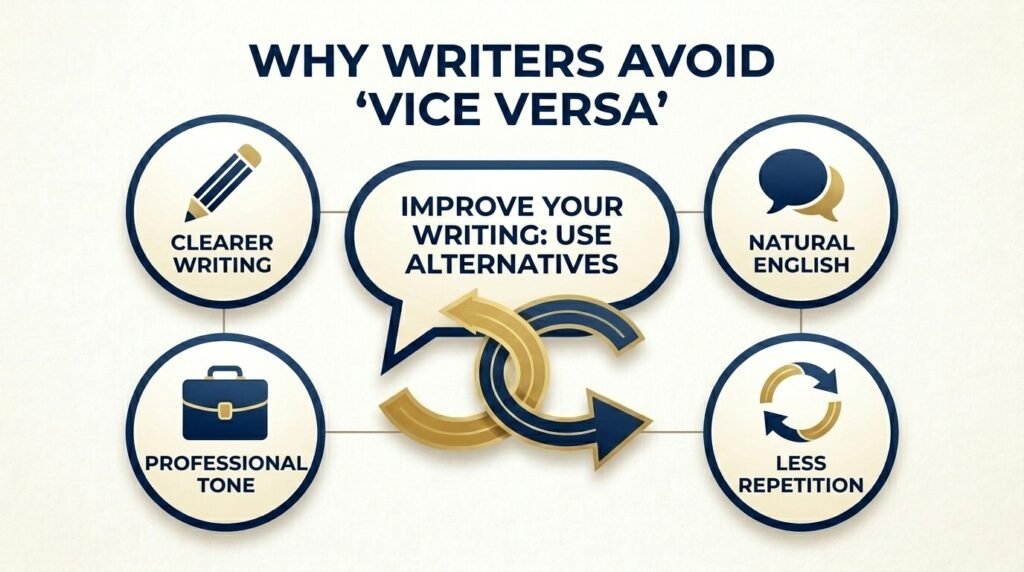
A different expression can make your writing clearer and better suited to the situation. In some cases, replacing “vice versa” also prevents repetition.
Other options can help you:
- Make an idea easier to understand.
- Sound more natural in casual conversation.
- Use clearer language in professional writing.
- Avoid repeating “vice versa” throughout an article.
- Explain a reversed relationship without relying on a Latin phrase.
- Match your wording to your audience and tone.
10 Best Other Ways to Say “Vice Versa”
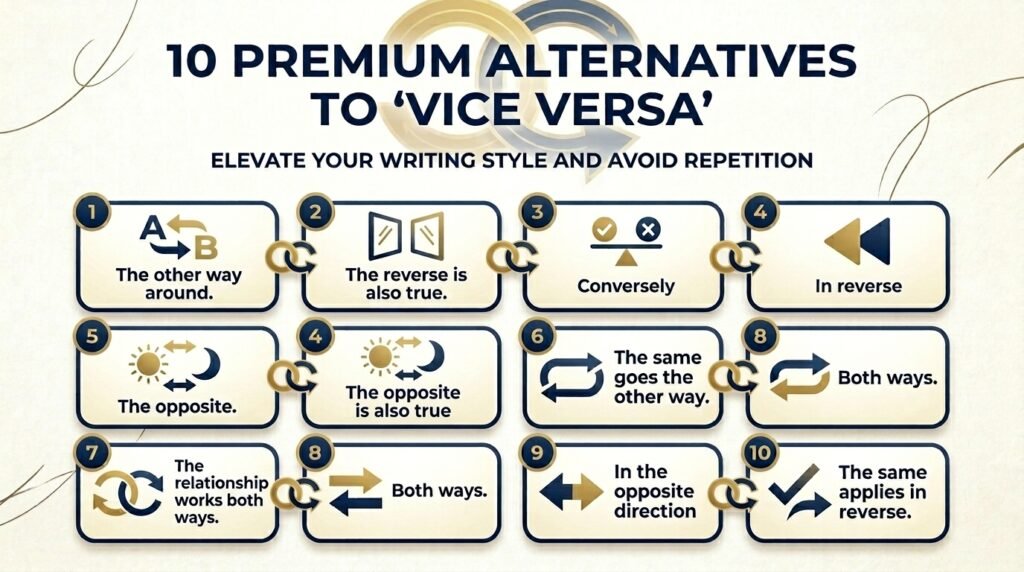
1. The Other Way Around
Meaning
“The other way around” is the closest natural replacement for “vice versa” in everyday American English. It clearly tells the reader that the same relationship applies in the opposite direction.
Best For
- Casual
- Friendly
- Professional
- Polite
Example 1
I thought Sarah was helping Mark, but it was actually the other way around.
Example 2
You can call me whenever you need help, and the other way around.
Quick Tip
Use this phrase when you want simple, conversational wording that most readers will understand immediately.
2. The Reverse Is Also True
Meaning
“The reverse is also true” states directly that the opposite version of a statement is equally valid. It is especially useful when clarity matters more than brevity.
Best For
- Professional
- Formal
Example 1
Employees should respect their managers, and the reverse is also true.
Example 2
A strong economy can increase consumer spending, while the reverse is also true.
Quick Tip
Choose this option when writing for readers who may benefit from an explicit explanation.
3. Conversely
Meaning
“Conversely” introduces a statement that presents the opposite or reversed relationship. It is concise and commonly used in formal, academic, analytical, and professional writing.
Best For
- Formal
- Professional
Example 1
Some customers prefer online shopping. Conversely, others value the experience of visiting a store.
Example 2
Higher prices may reduce demand; conversely, lower prices can encourage more purchases.
Quick Tip
Use “conversely” when the second idea contrasts with or reverses the relationship in the first.
4. In Reverse
Meaning
“In reverse” indicates that something happens in the opposite direction or order. It is especially useful for processes, sequences, instructions, and physical movements.
Best For
- Casual
- Professional
- Formal
Example 1
Follow these steps in reverse if you need to undo the changes.
Example 2
The machine performs the same process in reverse when it returns to its starting position.
Quick Tip
Use “in reverse” when the idea involves an order, direction, sequence, or process.
5. The Opposite Is Also True
Meaning
“The opposite is also true” makes it clear that the reverse of the original statement is valid as well. It is straightforward and easy for almost any audience to understand.
Best For
- Professional
- Formal
- Friendly
Example 1
Good communication builds trust, and the opposite is also true.
Example 2
A lack of preparation can create stress, and the opposite is also true.
Quick Tip
This is a good choice when you want maximum clarity without sounding overly formal.
6. The Same Goes the Other Way
Meaning
“The same goes the other way” communicates that the same condition or relationship applies in the opposite direction. It has a relaxed, natural tone.
Best For
- Casual
- Friendly
Example 1
I expect you to respect my time, and the same goes the other way.
Example 2
Parents should listen to their children, and the same goes the other way.
Quick Tip
Use this phrase in conversations, informal messages, and relaxed writing rather than highly formal documents.
7. The Relationship Works Both Ways
Meaning
“The relationship works both ways” emphasizes that two people, groups, or things affect or benefit one another. It is useful when discussing mutual responsibilities or interactions.
Best For
- Professional
- Friendly
- Polite
Example 1
Trust between a manager and an employee works both ways.
Example 2
Successful partnerships require communication because the relationship works both ways.
Quick Tip
Use this expression when the focus is on mutual interaction rather than simply reversing a sentence.
8. Both Ways
Meaning
“Both ways” is a short and flexible alternative when the surrounding sentence already makes the reversed relationship clear. It works particularly well when describing mutual actions or effects.
Best For
- Casual
- Friendly
- Professional
Example 1
The agreement protects both parties, so the benefits work both ways.
Example 2
We need to be flexible because the arrangement has to work both ways.
Quick Tip
Make sure the context clearly shows what “both ways” refers to; otherwise, the phrase may sound vague.
9. In the Opposite Direction
Meaning
“In the opposite direction” explains that an action, effect, or relationship moves back toward the other side. It is more precise than “vice versa” when direction matters.
Best For
- Formal
- Professional
Example 1
The payment can be transferred from the customer to the company and in the opposite direction.
Example 2
Information travels from the central office to local branches and in the opposite direction.
Quick Tip
Choose this phrase when you are describing movement, communication, transactions, or information flow.
10. The Same Applies in Reverse
Meaning
“The same applies in reverse” means that the original rule, condition, or statement remains valid when the situation is reversed. It is clear and suitably formal.
Best For
- Professional
- Formal
- Polite
Example 1
The policy applies to full-time employees, and the same applies in reverse for certain contractors.
Example 2
If the customer must provide identification, the same applies in reverse when the company requests sensitive information.
Quick Tip
This option works particularly well in policies, instructions, business documents, and explanatory writing.
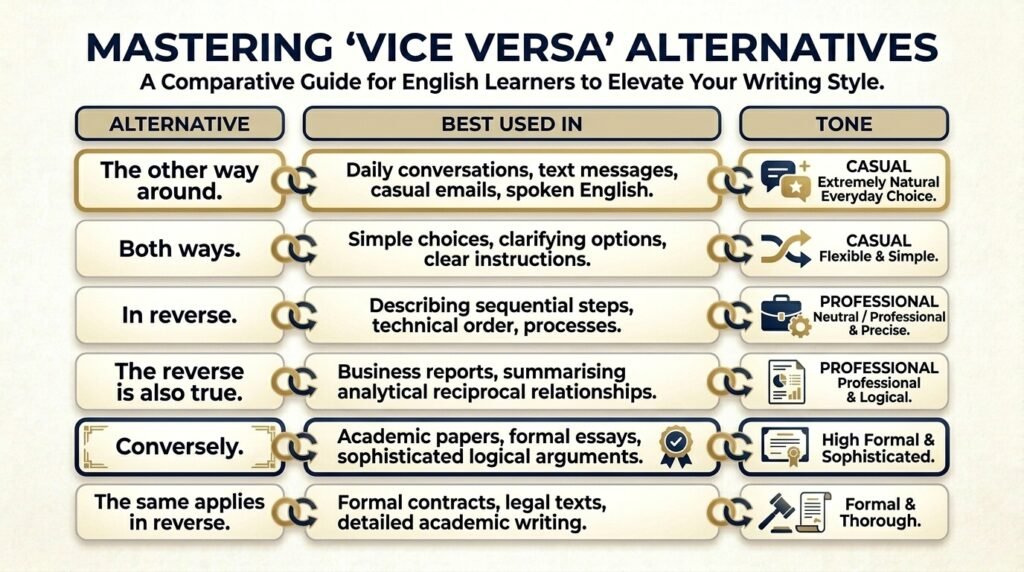
Comparison Table
| Alternative | Best Used In | Tone |
| The other way around | Everyday conversation | Casual, natural |
| The reverse is also true | Business and formal writing | Professional |
| Conversely | Academic and analytical writing | Formal |
| In reverse | Processes and instructions | Neutral |
| The opposite is also true | General explanations | Clear, professional |
| The same goes the other way | Conversations and informal writing | Friendly |
| The relationship works both ways | Relationships and partnerships | Professional, warm |
| Both ways | Short, simple statements | Casual, neutral |
| In the opposite direction | Direction and information flow | Formal, precise |
| The same applies in reverse | Policies and professional writing | Formal, professional |
Common Mistakes
1. Using Casual Phrases in Professional Emails
Phrases such as “the same goes the other way” may sound too relaxed in a formal business email. Choose “the reverse is also true” or “the same applies in reverse” when professionalism is important.
2. Choosing Overly Formal Language
Not every sentence needs “conversely.” In a casual conversation, “the other way around” usually sounds more natural and less stiff.
3. Repeating “Vice Versa” Too Often
Although “vice versa” is correct, using it repeatedly can make writing feel repetitive. Alternating it with clear alternatives can improve readability.
4. Forgetting the Context
Not every alternative has exactly the same use. “In reverse” often describes direction or sequence, while “the relationship works both ways” focuses more on mutual interaction.
5. Making the Meaning Unclear
Short phrases such as “both ways” can be ambiguous if the sentence does not establish the relationship clearly. When clarity is important, use a more explicit phrase such as “the reverse is also true.”
Frequently Asked Questions
What is the most natural way to say “vice versa”?
The most natural everyday alternative is “the other way around.” It sounds conversational, familiar, and clear to American English speakers. For example, “I help her, and the other way around” communicates the same basic idea as “I help her, and vice versa.”
What is a formal alternative to “vice versa”?
“The reverse is also true” is one of the clearest formal alternatives. “Conversely” is another strong choice, especially in academic, analytical, and professional writing. The best option depends on whether you are emphasizing a reversed relationship or presenting a contrasting idea.
Can I use “conversely” instead of “vice versa”?
Yes, but they are not always interchangeable. “Conversely” usually introduces a contrasting or reversed idea between two statements, while “vice versa” means that the preceding relationship applies in the opposite direction. Consider the exact meaning before replacing one with the other.
Is “the other way around” grammatically correct?
Yes. “The other way around” is a standard and natural English expression. It is especially common in American conversation and informal writing. It can replace “vice versa” when the context clearly establishes what is being reversed.
What is another way to say “vice versa” in an email?
For a professional email, try “the reverse is also true,” “the same applies in reverse,” or “the relationship works both ways.” These expressions are clear without sounding unnecessarily complicated. For a friendly email, “the other way around” is usually perfectly appropriate.
Is “both ways” the same as “vice versa”?
“Both ways” can communicate a similar idea, but it is broader and sometimes less precise. “Vice versa” specifically indicates that a previous statement also applies when the roles or directions are reversed. “Both ways” works best when the context already makes that relationship obvious.
Is “the opposite is also true” a good replacement?
Yes. “The opposite is also true” is a clear replacement when you want to emphasize that the reverse statement is valid. It is easy to understand and works well in professional, educational, and general explanatory writing.
What should I use instead of “vice versa” in academic writing?
In academic writing, “conversely,” “the reverse is also true,” or “the same applies in reverse” can work well depending on the sentence. “Conversely” is particularly useful when introducing a contrasting relationship, while the other options are better when you need to state the reversal explicitly.
Conclusion
Knowing another way to say “vice versa” gives you more flexibility when writing and speaking. Although “vice versa” is perfectly correct, alternatives can make your meaning clearer and help you match the tone of the situation.
Knowing another way to say “vice versa” gives you more flexibility when writing and speaking. Although “vice versa” is perfectly correct, alternatives can make your meaning clearer and help you match the tone of the situation. For more context, see the meaning and usage of “vice versa.”

Amara Reyes has taught English to adult learners for over eight years. She focuses on how phrases are actually used in everyday conversation, not just textbook definitions.