

What Does “Another Way to Say Set Up” Mean?
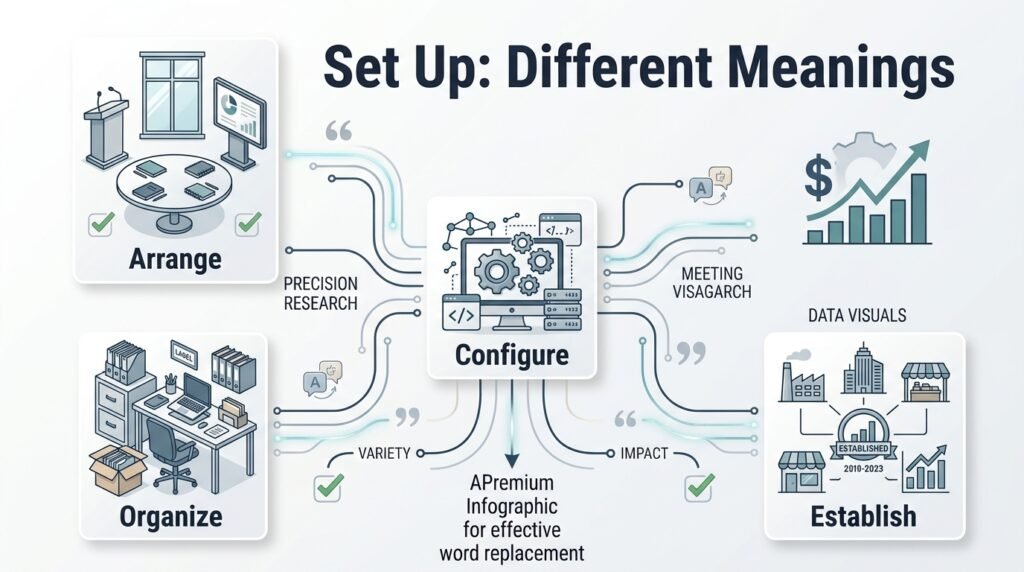
The phrase set up can mean several things. It may describe arranging something, preparing something for use, creating an organization or system, installing equipment, or starting an activity.
For example, you can set up a meeting, set up a computer, set up a business, or set up a new system. Because these situations are different, replacing “set up” with a more precise verb often makes your sentence clearer.
People look for another way to say set up when they want to avoid repetition, improve professional writing, or find a word that better matches a particular situation.
Why Use Other Ways to Say “Set Up”?
Using alternatives to set up can make your communication more precise and natural. Instead of relying on one broad phrase, you can choose a verb that tells readers exactly what happened.
Benefits include:
- Avoiding repetition in articles, emails, and reports.
- Improving clarity by choosing a more specific word.
- Matching the tone of professional, casual, or formal writing.
- Making technical instructions easier to understand.
- Creating stronger sentences with precise vocabulary.
10 Best Other Ways to Say “Set Up”
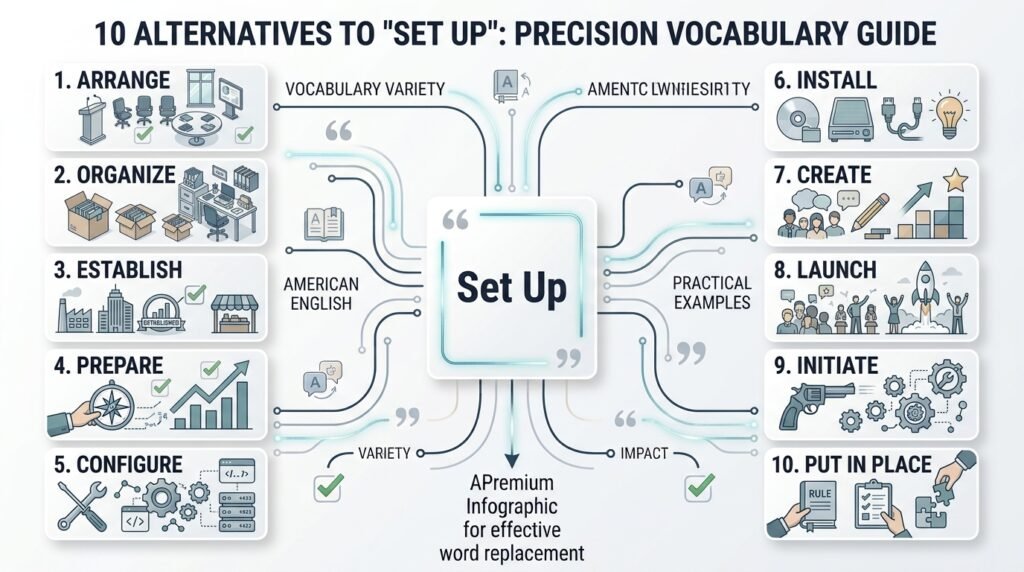
1. Arrange
Meaning
Arrange means to organize people, objects, details, or plans in a particular way. It is one of the most natural alternatives when “set up” refers to preparing something for an event or activity.
Best For
- Professional
- Casual
- Friendly
- Polite
Example 1
I arranged a meeting with the marketing team for Thursday morning.
Example 2
Could you arrange the chairs before the guests arrive?
Quick Tip
Use arrange when you are putting things, people, or plans into an appropriate order.
2. Organize
Meaning
Organize means to plan or arrange something systematically. It works especially well when “set up” refers to an event, project, workspace, or group of information.
Best For
- Professional
- Casual
- Friendly
Example 1
Maria organized a training session for the new employees.
Example 2
He organized the files into separate folders by project.
Quick Tip
Choose organize when the main idea is creating order or managing several parts of something.
3. Establish
Meaning
Establish means to create, start, or formally put something into operation. It sounds more formal than “set up” and works well for businesses, systems, policies, relationships, and procedures.
Best For
- Professional
- Formal
Example 1
The company established a new customer support department.
Example 2
The school established clear guidelines for online learning.
Quick Tip
Use establish when something is being created as a lasting system, rule, organization, or practice.
4. Prepare
Meaning
Prepare means to make something ready for a particular purpose. It is a good alternative when “set up” means getting a person, place, document, or item ready.
Best For
- Professional
- Casual
- Friendly
- Polite
Example 1
The staff prepared the conference room before the presentation.
Example 2
Please prepare the equipment before the training begins.
Quick Tip
Use prepare when the important idea is readiness rather than the physical arrangement itself.
5. Configure
Meaning
Configure means to adjust the settings of a device, program, system, or piece of technology so it works as intended. It is more precise than “set up” in technical contexts.
Best For
- Professional
- Formal
Example 1
The technician configured the router for the office network.
Example 2
You can configure the application to send automatic notifications.
Quick Tip
Use configure for software, computers, networks, devices, accounts, and technical systems.
6. Install
Meaning
Install means to put software, equipment, or a device into a position where it can be used. It is particularly useful when “set up” refers to adding technology to a computer or physical location.
Best For
- Professional
- Formal
- Casual
Example 1
The IT team installed the new security software on every computer.
Example 2
A technician installed the printer beside the reception desk.
Quick Tip
Choose install when something is being added to a device, building, or system for use.
7. Create
Meaning
Create means to make or develop something that did not previously exist. It can replace “set up” when you are establishing an account, system, document, plan, or online presence.
Best For
- Professional
- Casual
- Friendly
Example 1
I created a shared calendar for the entire department.
Example 2
She created an account to access the online training platform.
Quick Tip
Use create when the focus is on making something new rather than simply arranging it.
8. Launch
Meaning
Launch means to officially start or introduce something. It is especially useful for businesses, products, websites, campaigns, services, and major projects.
Best For
- Professional
- Formal
Example 1
The company launched its new website earlier this month.
Example 2
Our team plans to launch the marketing campaign in September.
Quick Tip
Use launch when something is being introduced publicly or officially.
9. Initiate
Meaning
Initiate means to begin a process, action, discussion, or formal procedure. It has a professional and somewhat formal tone.
Best For
- Professional
- Formal
Example 1
The manager initiated a review of the company’s hiring process.
Example 2
The department initiated discussions with several potential partners.
Quick Tip
Use initiate when “set up” means starting a formal process rather than physically arranging something.
10. Put in Place
Meaning
Put in place means to establish or implement something so it can operate or be followed. It is common in business, workplace, policy, and organizational writing.
Best For
- Professional
- Formal
- Polite
Example 1
The company put new safety procedures in place after the inspection.
Example 2
The manager put a backup plan in place before the project started.
Quick Tip
Use put in place when referring to policies, procedures, systems, safeguards, or plans that need to remain active.
Comparison Table
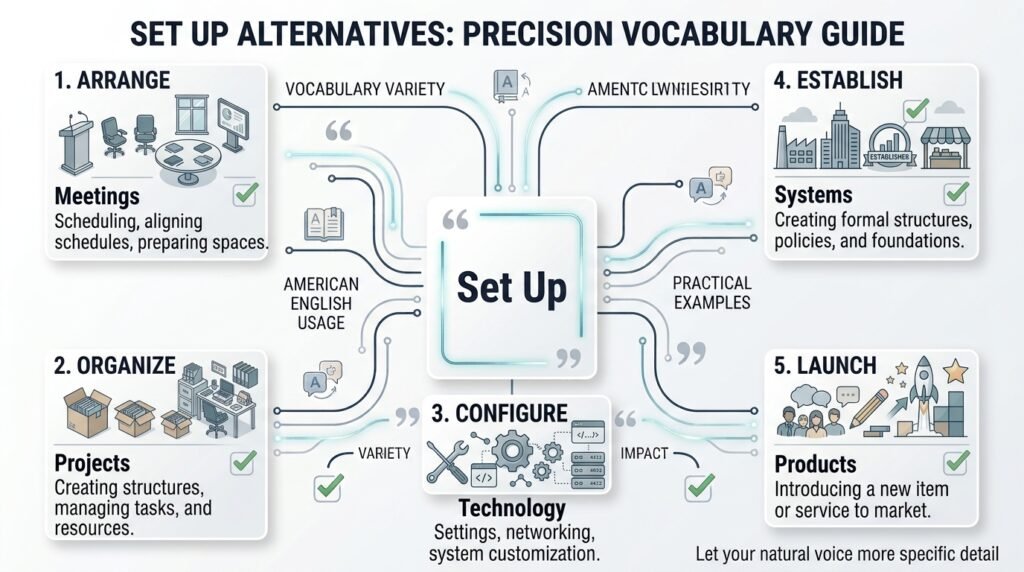
| Alternative | Best Used In | Tone |
| Arrange | Meetings, objects, events | Neutral |
| Organize | Events, projects, files | Neutral |
| Establish | Businesses, systems, policies | Formal |
| Prepare | People, places, equipment | Neutral |
| Configure | Software, devices, technology | Technical |
| Install | Software and equipment | Professional |
| Create | Accounts, plans, systems | Neutral |
| Launch | Products, websites, campaigns | Professional |
| Initiate | Processes, discussions, procedures | Formal |
| Put in Place | Policies, plans, systems | Professional |
Common Mistakes
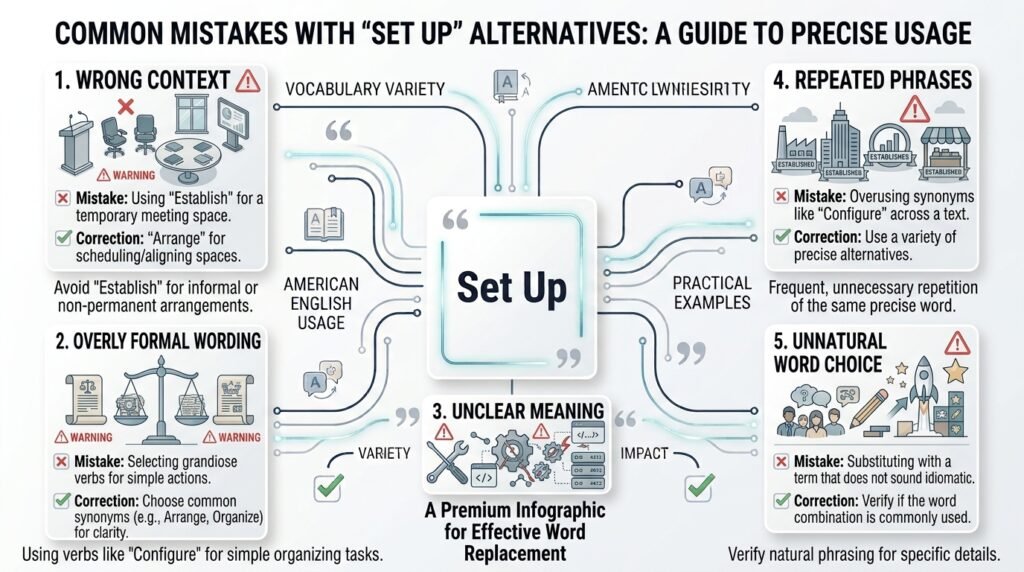
1. Using Casual Phrases in Professional Emails
“Set up” is perfectly acceptable in many emails, but a more precise alternative can sound more professional. For example, establish may be better than “set up” when discussing a formal business system.
2. Choosing an Overly Formal Word
Not every sentence needs sophisticated vocabulary. Saying “I arranged a meeting” often sounds more natural than using an unnecessarily formal expression.
3. Ignoring the Context
Different alternatives have different meanings. Install works for software or equipment, while launch is better for a product or campaign. Swapping them without considering context can change the meaning.
4. Repeating the Same Phrase
Using “set up” several times in a paragraph can make your writing sound repetitive. Look for opportunities to use a more exact verb when the context allows it.
5. Sounding Insincere or Unnatural
A synonym should make the sentence clearer, not simply make it sound more complicated. Choose the word that a natural American English speaker would use in that situation.
Frequently Asked Questions
What is a professional way to say “set up”?
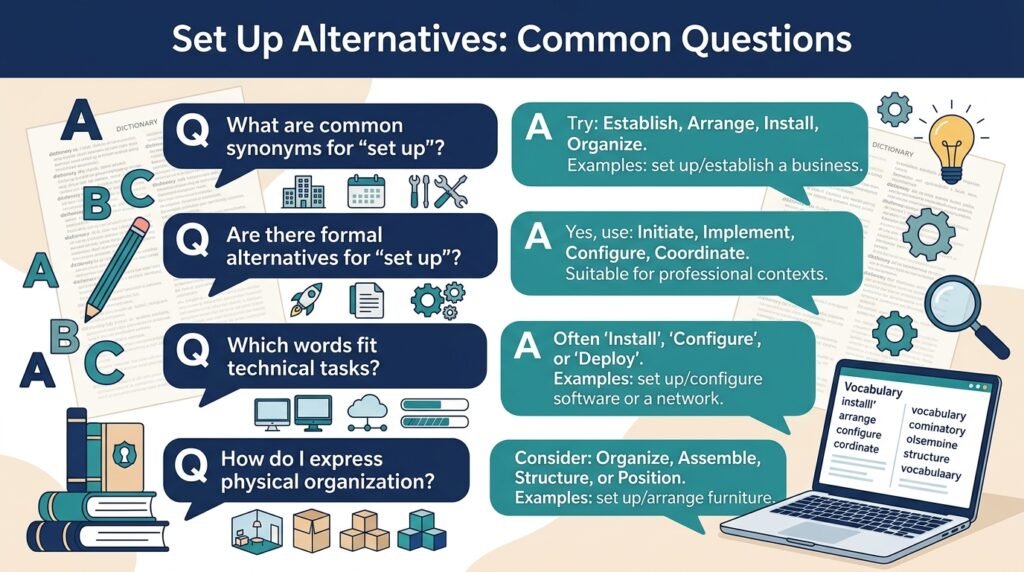
Establish, arrange, organize, configure, and put in place can all work in professional writing. The best choice depends on what you are describing. For example, use “establish a policy,” “arrange a meeting,” “configure a system,” or “put procedures in place.”
What is another word for “set up” a meeting?
Arrange is one of the most natural alternatives for “set up a meeting.” You can also say schedule, although it focuses more specifically on choosing a date and time. For example, “I arranged a meeting with the client” sounds natural and professional.
What is another way to say “set up” a computer?
For computers, configure is often the most precise choice when you mean adjusting settings. Install works when adding software or hardware, while prepare can describe getting the computer ready for use.
What is a formal word for “set up”?
Establish is a strong formal alternative when you mean creating or starting a system, organization, policy, or procedure. Initiate can also work when “set up” means beginning a formal process or activity.
What is another way to say “set up a business”?
You can say establish a business, start a business, or launch a business. “Establish” emphasizes creating the business, while “launch” emphasizes introducing it to the market. “Start” is the simplest and most conversational option.
What is another way to say “set up an account”?
Create an account is usually the most natural alternative. You can also say register for an account when the process involves signing up for a service or platform.
Is “establish” the same as “set up”?
Not always. Establish usually suggests creating something formal, lasting, or recognized, while set up has a much broader meaning. For example, you can set up a chair, but “establish a chair” would not have the same meaning.
Which synonym for “set up” is best for technical writing?
Configure is often the best choice when discussing settings, networks, software, or devices. Install is better when you are adding software or hardware. Selecting the exact technical term makes instructions easier to follow.
Conclusion
Finding another way to say set up can make your writing more precise, natural, and professional. Although “set up” is useful in everyday American English, a specific alternative often communicates your meaning more clearly.
Use arrange for meetings and objects, organize for projects and information, and prepare when something needs to be made ready. For formal situations, establish and initiate are strong choices. In technical writing, configure and install are usually more accurate. Meanwhile, launch works well for products, websites, and campaigns, while put in place fits policies and procedures.

Daniel Cho writes about professional communication, drawing on years spent training teams on clear, confident workplace writing — from emails to performance reviews.