

What Does “Another Way to Say Saying” Mean?

The phrase “another way to say saying” usually means looking for a synonym or alternative expression for the word “saying.” People search for alternatives when they want to avoid repetition, make their writing more precise, or choose a word that better matches a specific context.
“Saying” can refer to speaking words, communicating an idea, expressing an opinion, or even using a particular phrase. Because its meaning changes with context, there is no single replacement that works in every sentence.
For example, “She was saying that she needed help” could become “She was stating that she needed help.” However, “He was saying how grateful he felt” might sound more natural as “He was expressing his gratitude.”
You may need an alternative in essays, emails, business writing, conversations, reports, stories, or everyday communication.
Why Use Other Ways to Say “Saying”?

Using different words instead of repeatedly writing “saying” can make your communication clearer and more natural.
Other alternatives can help you:
- Avoid unnecessary repetition.
- Describe exactly how something was communicated.
- Match formal and informal situations.
- Make professional writing more precise.
- Show whether someone shared a fact, opinion, feeling, or idea.
- Create smoother and more engaging sentences.
The key is to choose a replacement based on meaning, not simply because it looks like a synonym.
10 Best Other Ways to Say “Saying”
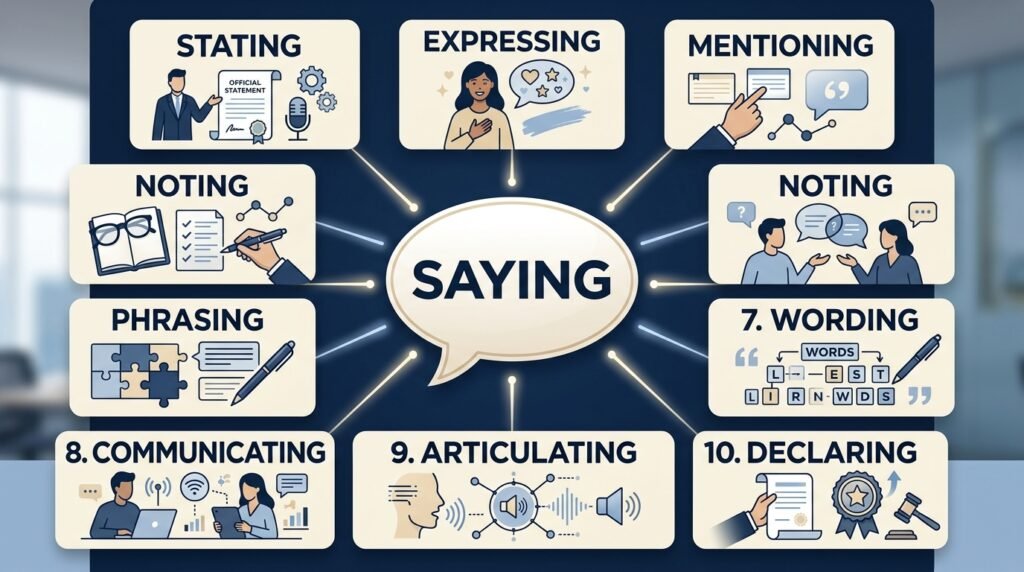
1. Stating
Meaning
Stating means expressing something clearly and directly, especially when presenting information, an opinion, or a fact. It often sounds more precise and professional than “saying.”
Best For
- Professional
- Formal
- Polite
Example 1
The manager was stating the company’s expectations for the new project.
Example 2
She was stating her position clearly during the meeting.
Quick Tip
Use “stating” when the speaker is giving information in a direct and deliberate way.
2. Expressing
Meaning
Expressing means communicating a thought, feeling, opinion, or idea. It is especially useful when the focus is on what someone wants others to understand or feel.
Best For
- Professional
- Friendly
- Warm
- Polite
Example 1
He was expressing his appreciation for everyone who helped.
Example 2
She had trouble expressing how disappointed she felt.
Quick Tip
Choose “expressing” when the sentence involves emotions, opinions, attitudes, or personal thoughts.
3. Mentioning
Meaning
Mentioning means briefly referring to something in conversation or writing. It usually suggests that the topic was brought up without becoming the main focus.
Best For
- Professional
- Casual
- Friendly
Example 1
I remember mentioning the schedule during our last call.
Example 2
She mentioned that the store would close early on Friday.
Quick Tip
Use “mentioning” when someone refers to a subject briefly rather than explaining it in detail.
4. Noting
Meaning
Noting means pointing something out or drawing attention to a particular fact or detail. It is common in professional, academic, and formal writing.
Best For
- Professional
- Formal
- Polite
Example 1
The report is noting several changes in customer behavior.
Example 2
He noted that the deadline had been moved to Monday.
Quick Tip
“Noting” is a good choice when you want your writing to sound concise and professional.
5. Remarking
Meaning
Remarking means making a comment or observation about something. It can describe casual conversation but often has a slightly more polished tone than “saying.”
Best For
- Formal
- Casual
- Friendly
Example 1
She was remarking on how quickly the weather had changed.
Example 2
“That’s quite a view,” he remarked as they reached the overlook.
Quick Tip
Use “remarking” when someone makes an observation or casual comment.
6. Phrasing
Meaning
Phrasing focuses on the particular way an idea is expressed in words. It is useful when discussing someone’s wording rather than simply the fact that they spoke.
Best For
- Professional
- Formal
- Polite
Example 1
I like how you are phrasing the recommendation in this section.
Example 2
She was careful about phrasing her response so nobody felt criticized.
Quick Tip
Choose “phrasing” when the exact language or structure of a statement matters.
7. Wording
Meaning
Wording refers to the specific words used to communicate an idea. It is particularly helpful when discussing written communication, instructions, messages, or statements.
Best For
- Professional
- Formal
- Casual
Example 1
The wording of his email made the request sound more respectful.
Example 2
We should review the wording before sending the announcement.
Quick Tip
Use “wording” when you are talking about the language used rather than the act of speaking itself.
8. Communicating
Meaning
Communicating means sharing information, thoughts, feelings, or ideas with another person or group. It is broader than “saying” because communication can happen through speech, writing, or other methods.
Best For
- Professional
- Formal
- Friendly
Example 1
The team was communicating its concerns to the project leader.
Example 2
He has a clear way of communicating complex ideas to new employees.
Quick Tip
Use “communicating” when you want to emphasize the transfer of information rather than the specific words spoken.
9. Articulating
Meaning
Articulating means expressing an idea clearly and effectively. It is especially useful when someone explains a complex thought in a way that others can understand.
Best For
- Professional
- Formal
Example 1
She did an excellent job articulating the team’s long-term goals.
Example 2
He struggled with articulating his concerns during the presentation.
Quick Tip
“Articulating” works best when clarity and effective explanation are important.
10. Declaring
Meaning
Declaring means making a statement firmly, openly, or officially. It is stronger than “saying” and often suggests confidence, authority, or a formal announcement.
Best For
- Formal
- Professional
Example 1
The coach was declaring that the team was ready for the final match.
Example 2
She declared that the proposal would move forward as planned.
Quick Tip
Use “declaring” when the statement is strong, definite, public, or official.
Comparison Table

| Alternative | Best Used In | Tone |
| Stating | Facts, opinions, professional communication | Clear and direct |
| Expressing | Feelings, thoughts, opinions | Warm and personal |
| Mentioning | Brief references and conversation | Casual and natural |
| Noting | Reports, observations, formal writing | Professional and concise |
| Remarking | Comments and observations | Conversational and polished |
| Phrasing | Specific expression of an idea | Precise and thoughtful |
| Wording | Written statements and messages | Neutral and practical |
| Communicating | Sharing information or ideas | Broad and professional |
| Articulating | Explaining complex ideas | Formal and precise |
| Declaring | Strong or official statements | Firm and authoritative |
Common Mistakes
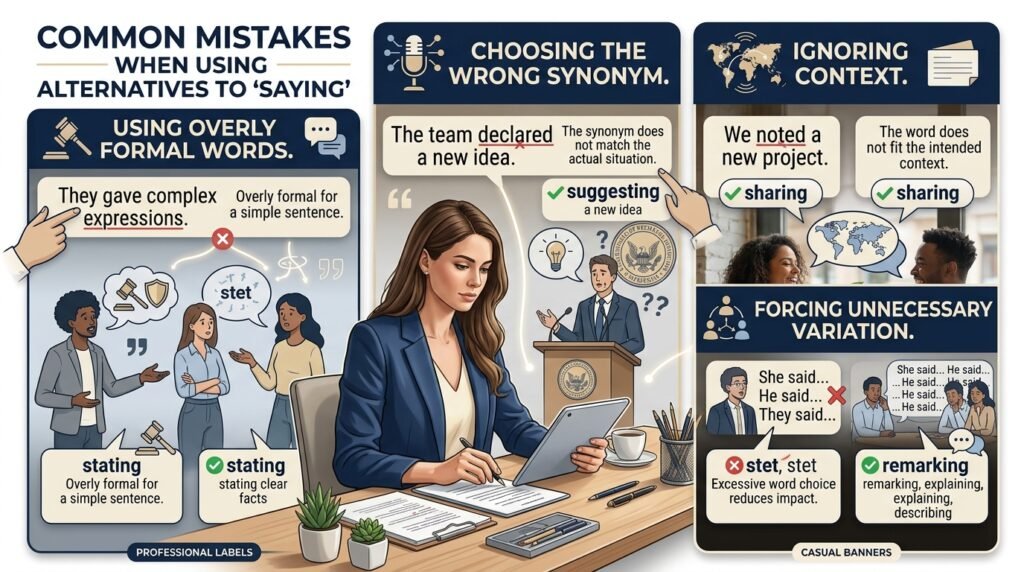
1. Using a casual phrase in professional writing
Words such as “mentioning” may work in an everyday conversation but may not always provide the precision needed in a formal report. Choose a word that reflects the seriousness of the situation.
2. Choosing an overly formal alternative
Not every sentence needs sophisticated vocabulary. Replacing a simple “saying” with “articulating” can sound unnatural when the context is an ordinary conversation.
3. Treating every synonym as interchangeable
These alternatives have different meanings. “Mentioning” suggests a brief reference, while “declaring” suggests a strong or official statement.
4. Ignoring the surrounding context
Look at what the speaker is actually communicating. If the person is sharing an emotion, “expressing” may be better than “stating.”
5. Trying too hard to avoid repetition
Sometimes “saying” is the best word. Replacing a natural word simply to sound different can make your writing less clear rather than more effective.
Frequently Asked Questions
What is another word for saying?
Common alternatives for “saying” include stating, expressing, mentioning, noting, remarking, communicating, articulating, and declaring. The best option depends on the sentence. For example, “stating” works well for facts, “expressing” fits emotions, and “mentioning” is appropriate when someone briefly refers to a topic.
What is a professional way to say “saying”?
For professional writing, stating, noting, communicating, and articulating are useful choices. “Stating” is especially effective when someone gives a clear fact or position. “Articulating” works better when the person explains a complex idea clearly. Always select the word that matches the exact meaning.
What is another way to say “he is saying”?
You could say “he is stating,” “he is expressing,” “he is mentioning,” “he is explaining,” or “he is communicating.” The correct choice depends on what he is doing. If he gives a fact, use “stating.” If he shares a feeling, “expressing” is usually more natural.
What is another way to say “she said”?
Depending on context, alternatives include “she stated,” “she mentioned,” “she remarked,” “she noted,” and “she explained.” These words add information about how she communicated. For instance, “she remarked” suggests a comment, while “she stated” suggests a clear and direct statement.
What is a formal synonym for “saying”?
Formal alternatives include stating, noting, articulating, declaring, and asserting. “Stating” is one of the most versatile choices for formal writing. “Declaring” is stronger and may suggest an official announcement, while “articulating” emphasizes clear expression of an idea.
What is a synonym for “saying” when expressing feelings?
When someone communicates an emotion, expressing is often the strongest alternative. You can say someone is “expressing concern,” “expressing gratitude,” or “expressing disappointment.” This wording makes it clear that the person is communicating an internal feeling rather than simply providing information.
Can “mentioning” replace “saying”?
Sometimes, but not always. Mentioning means briefly referring to something, so it does not carry exactly the same meaning as “saying.” For example, “She mentioned the meeting” suggests a short reference, while “She explained the meeting” suggests that she provided more information.
Which alternative to “saying” is best for essays?
For essays, stating, noting, explaining, expressing, and arguing can work depending on the context. Academic writing benefits from precise verbs because they tell readers what the writer or source is actually doing. Instead of replacing “saying” automatically, choose a verb that accurately describes the purpose of the statement.
Conclusion
Knowing another way to say saying can make your writing more precise, natural, and engaging. Although “saying” is a perfectly useful word, alternatives can show exactly how an idea was communicated.
The most important rule is to consider the context before choosing a synonym. A good alternative should improve the meaning of your sentence, not simply make it sound more complicated. For more guidance on word choice and usage, Merriam-Webster provides helpful definitions and usage information. When in doubt, use the clearest word that accurately describes what the speaker is doing.

Sarah Whitfield is the founder and lead editor of Anchors Press. With a background in copyediting and content strategy, she reviews every guide for accuracy, tone, and everyday usefulness before it’s published.