
What Does “Another Way to Say Quickly” Mean?

The phrase “another way to say quickly” refers to finding a synonym or alternative expression for the word quickly. The word usually means doing something at a fast speed or with little delay.
People look for alternatives to avoid repetition, improve word choice, or make their writing sound more natural. You may need a different expression in an email, essay, conversation, business document, or creative piece.
For example, instead of saying, “She quickly finished the report,” you could write, “She promptly finished the report” or “She finished the report without delay.”
Why Use Other Ways to Say “Quickly”?
Using different expressions can make your English more precise and interesting. Although quickly is correct in almost every situation, another word may communicate a slightly different meaning.
Other alternatives can help you:
- Avoid repeating the same word.
- Sound more natural in conversation.
- Choose a tone that fits your audience.
- Make professional writing more precise.
- Show urgency, speed, or efficiency more clearly.
- Improve variety in essays, emails, and articles.
The key is to choose an alternative based on meaning and context, rather than replacing “quickly” automatically.
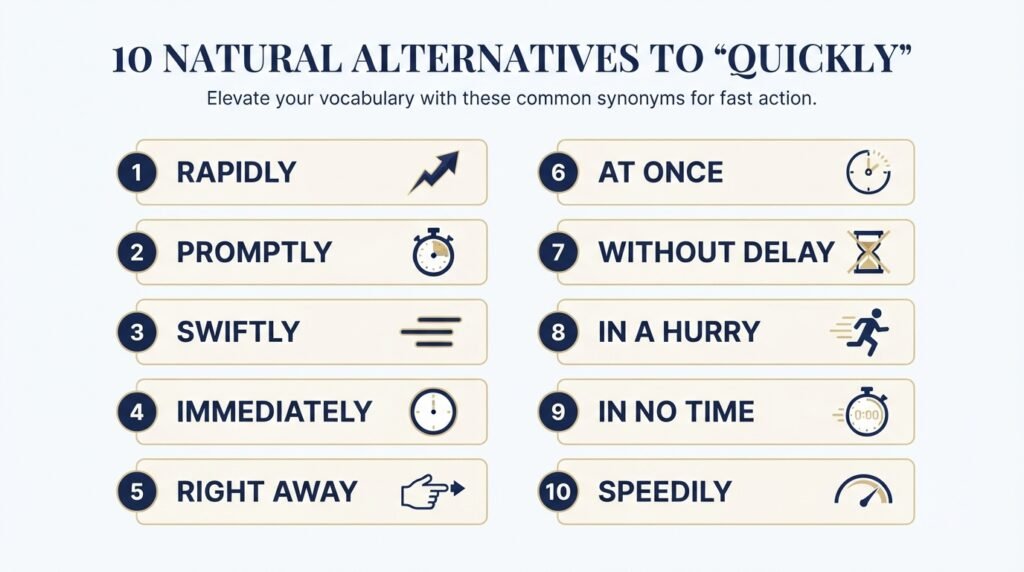
10 Best Other Ways to Say “Quickly”
1. Rapidly
Meaning
Rapidly means at a fast rate or with great speed. It often describes changes, growth, movement, or processes and tends to sound more formal than “quickly.”
Best For
- Professional
- Formal
Example 1
The company is rapidly expanding into new markets.
Example 2
Technology is changing rapidly, so businesses must adapt.
Quick Tip
Use rapidly when you are describing a noticeable rate of change or development.
2. Promptly
Meaning
Promptly means without unnecessary delay or at the expected time. It focuses more on timely action than physical speed.
Best For
- Professional
- Formal
- Polite
Example 1
Please respond to the customer promptly.
Example 2
The support team promptly addressed my concern.
Quick Tip
Choose promptly when the important idea is responding or acting on time.
3. Swiftly
Meaning
Swiftly means very quickly or with little hesitation. It can describe physical movement, decisions, reactions, or actions.
Best For
- Formal
- Professional
Example 1
The manager swiftly approved the revised proposal.
Example 2
The rescue team swiftly moved the hikers to safety.
Quick Tip
Use swiftly when you want to emphasize fast, decisive action.
4. Immediately
Meaning
Immediately means at once, with no waiting period. It is stronger than simply saying “quickly” because it stresses that something happens right after another event.
Best For
- Professional
- Formal
- Polite
Example 1
Please contact the office immediately if you notice an error.
Example 2
The technician arrived immediately after receiving the emergency call.
Quick Tip
Use immediately when there should be little or no delay.
5. Right Away
Meaning
Right away is a natural American English expression meaning immediately or very soon. It sounds friendly and conversational.
Best For
- Casual
- Friendly
- Warm
Example 1
I’ll send you the updated file right away.
Example 2
She called her parents right away after hearing the news.
Quick Tip
Use right away in everyday conversations, texts, and friendly emails.
6. At Once
Meaning
At once can mean immediately or all at the same time, depending on the sentence. When it means immediately, it expresses a sense of urgency.
Best For
- Formal
- Professional
- Polite
Example 1
The supervisor asked the staff to leave the building at once.
Example 2
I understood at once that something was wrong.
Quick Tip
Check the context because at once can also mean “simultaneously.”
7. Without Delay
Meaning
Without delay means taking action immediately rather than waiting. It is especially useful when writing instructions, policies, notices, or professional communication.
Best For
- Professional
- Formal
Example 1
The company must investigate the complaint without delay.
Example 2
Employees should report safety concerns without delay.
Quick Tip
Use this expression when you want to sound clear, serious, and authoritative.
8. In a Hurry
Meaning
In a hurry describes doing something quickly because you have limited time or need to get somewhere or finish something soon. Unlike “rapidly,” it often suggests pressure or urgency.
Best For
- Casual
- Friendly
Example 1
I was in a hurry and forgot my keys on the kitchen counter.
Example 2
Don’t make an important decision just because you’re in a hurry.
Quick Tip
Use in a hurry when the reason for speed is limited time or urgency.
9. In No Time
Meaning
In no time is an informal expression meaning very soon or after only a short amount of time. It often suggests that something will be completed faster than expected.
Best For
- Casual
- Friendly
- Warm
Example 1
We’ll have the room ready in no time.
Example 2
Once you learn the basic steps, you’ll be using the software in no time.
Quick Tip
This expression works especially well when reassuring someone that something will happen soon.
10. Speedily
Meaning
Speedily means quickly or at a fast pace. It is grammatically correct but less common in everyday American English than words such as “quickly,” “promptly,” or “rapidly.”
Best For
- Formal
- Professional
Example 1
The application was processed speedily by the review team.
Example 2
The issue was resolved speedily after the necessary information was provided.
Quick Tip
Use speedily sparingly because it can sound more formal or old-fashioned than other alternatives.
Comparison Table
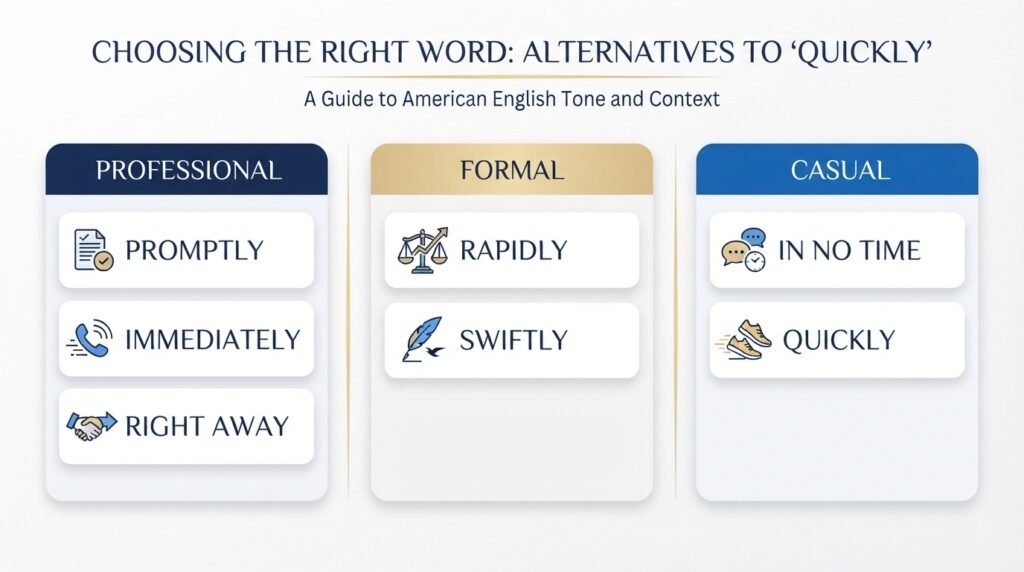
| Alternative | Best Used In | Tone |
| Rapidly | Reports, business writing | Professional, formal |
| Promptly | Emails, customer service | Professional, polite |
| Swiftly | Decisions, actions, formal writing | Formal, confident |
| Immediately | Urgent instructions | Direct, serious |
| Right away | Conversations, casual emails | Friendly, casual |
| At once | Instructions, urgent situations | Formal, urgent |
| Without delay | Policies, business communication | Professional, authoritative |
| In a hurry | Everyday situations | Casual, conversational |
| In no time | Conversations, reassurance | Friendly, casual |
| Speedily | Formal descriptions | Formal, professional |
Common Mistakes
- Using casual phrases in professional writing
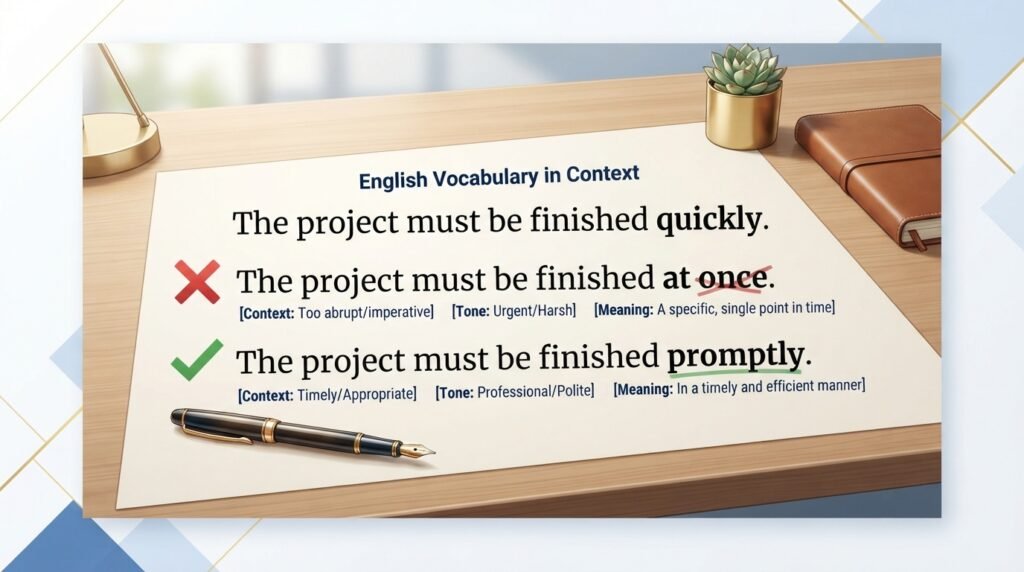
Expressions such as “right away” can work in friendly business emails, but “promptly” or “without delay” may be better for formal communication. - Choosing a synonym without checking its meaning
Not every alternative means exactly the same thing. “Promptly” emphasizes timely action, while “rapidly” usually emphasizes speed or rate. - Using overly formal language
Words such as “speedily” may sound unnatural in casual American English. A simple phrase like “quickly” or “right away” may be more appropriate. - Ignoring context
“In a hurry” suggests pressure or limited time, while “rapidly” can describe a process that is moving at a high rate. Consider what you actually want to communicate. - Repeating the same alternative too often
Replacing “quickly” with “rapidly” throughout an entire article does not create real variety. Choose different expressions based on their specific meanings.
Frequently Asked Questions
What is a professional way to say quickly?
Promptly, rapidly, and without delay are strong professional alternatives to “quickly.” Use “promptly” when you mean responding or acting on time, “rapidly” when describing a fast rate of change, and “without delay” when emphasizing that an action should happen immediately.
What is a formal word for quickly?
Rapidly and swiftly are common formal alternatives to “quickly.” Promptly is also appropriate when discussing timely action. The best option depends on the sentence because these words emphasize slightly different ideas, such as speed, decisiveness, or a lack of delay.
What is a casual way to say quickly?
In everyday American English, right away and in no time are natural alternatives. In a hurry also works when someone is moving quickly because they have limited time. These expressions generally sound more conversational than formal words such as “rapidly” or “promptly.”
Is “right away” another way to say quickly?
Yes, but “right away” more specifically means immediately or without waiting. For example, “I’ll call you right away” means the speaker intends to call very soon. It is common in conversations, texts, and informal emails and sounds natural in American English.
Is “promptly” the same as “quickly”?
Not exactly. Promptly focuses on acting without unnecessary delay, while quickly can refer to the speed at which an action happens. For example, someone can respond promptly but take a long time to complete a complicated task.
What is another way to say “do it quickly”?
Depending on the situation, you can say “do it promptly,” “do it right away,” “do it without delay,” or “do it immediately.” “Right away” sounds conversational, while “promptly” and “without delay” are more suitable for professional or formal instructions.
What is a stronger word for quickly?
Immediately can be stronger than “quickly” when you want to stress that there should be no delay. Swiftly can also emphasize fast and decisive action. Choose “immediately” for urgency and “swiftly” when you want to highlight efficient movement or action.
Which synonym for quickly is best for an essay?
For an academic or formal essay, rapidly, swiftly, or promptly may work depending on the context. However, do not choose a complicated word simply to sound sophisticated. The clearest synonym is usually the strongest choice when it accurately expresses your meaning.
Conclusion
Knowing another way to say quickly gives you more control over your American English. The best alternative depends on what you want to emphasize. Choose rapidly for fast changes or development, promptly for timely action, and swiftly for quick and decisive movement.
The most important rule is to consider context before replacing “quickly.” A good synonym should not only avoid repetition—it should express the exact meaning and tone you intend. For more guidance on choosing between fast, quick, or quickly, understanding how these words function in a sentence can help you write more naturally. When in doubt, choose the simplest phrase that sounds natural and communicates your idea clearly.

Daniel Cho writes about professional communication, drawing on years spent training teams on clear, confident workplace writing — from emails to performance reviews.