
What Does “Another Way to Say For Sure” Mean?

The phrase “for sure” means something is certain, definite, or true. It is common in everyday American English when someone wants to express confidence or agreement.
For example, you might say, “I’ll be there for sure,” meaning you are certain that you will attend. You can also use it to agree with someone: “For sure, that was the best part of the movie.”
Because “for sure” is informal and conversational, you may want another expression in professional emails, academic writing, or situations where you want to sound more polished.
Why Use Other Ways to Say “For Sure”?
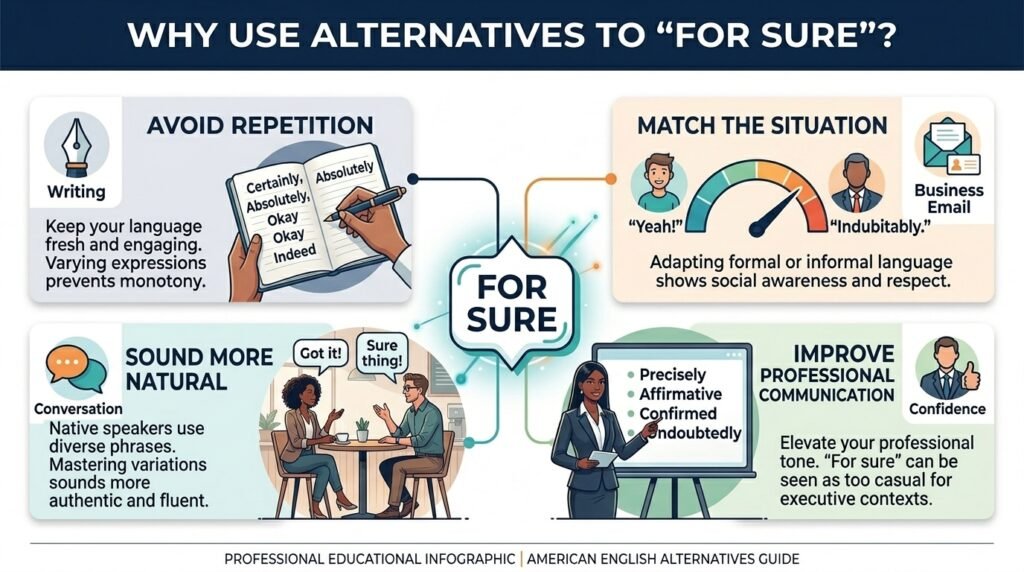
Using alternatives to “for sure” can make your communication more precise and natural. Different expressions can show confidence, agreement, certainty, or strong emphasis.
Other benefits include:
- Avoiding repetition in your writing
- Sounding more professional when needed
- Matching the tone to your audience
- Showing a stronger or softer level of certainty
- Making emails and formal writing sound more polished
- Expressing agreement in a more natural way
The key is not to replace “for sure” every time. It is perfectly natural in casual American conversation. Instead, choose an alternative when it better fits the situation.
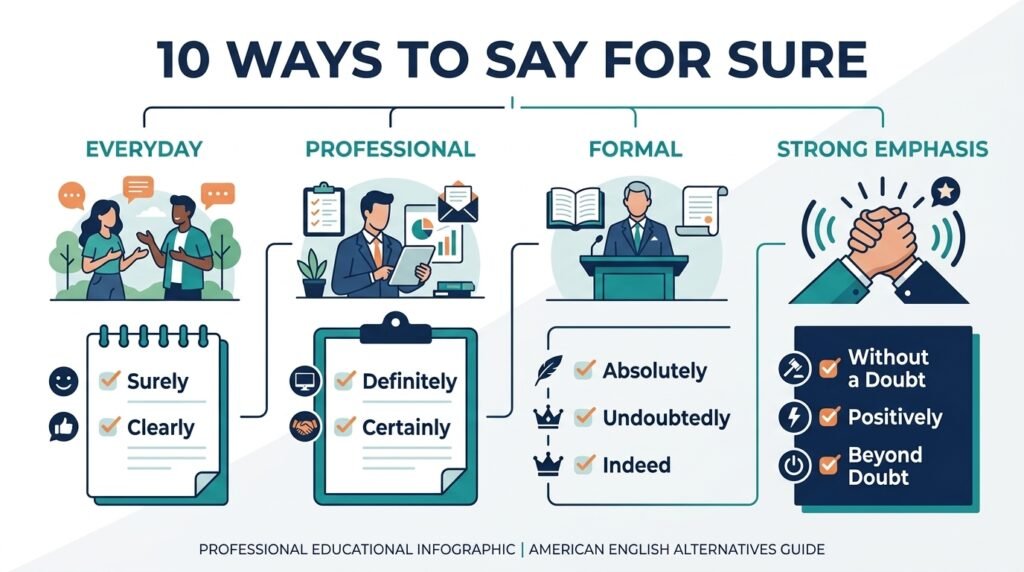
10 Best Other Ways to Say “For Sure”
1. Definitely
Meaning
Definitely means something is certain or will happen without question. It is one of the closest and most versatile alternatives to “for sure.”
It sounds natural in both casual conversations and many professional situations.
Best For
- Casual
- Friendly
- Professional
- Polite
Example 1
“I’ll definitely send you the updated file before Friday.”
Example 2
“She definitely deserves recognition for all the work she did.”
Quick Tip
Use definitely when you want to express clear confidence without sounding overly formal.
2. Certainly
Meaning
Certainly expresses strong agreement or confidence that something is true. It has a more polished tone than “for sure.”
It is especially useful when responding politely or writing professionally.
Best For
- Professional
- Formal
- Polite
- Friendly
Example 1
“Certainly, I can review the proposal this afternoon.”
Example 2
“This change will certainly improve the customer experience.”
Quick Tip
Choose certainly when you want to sound confident but courteous.
3. Absolutely
Meaning
Absolutely shows very strong agreement or certainty. It can also express enthusiasm when responding to a request or suggestion.
Unlike some formal alternatives, it sounds natural in everyday American speech.
Best For
- Casual
- Friendly
- Warm
- Professional
Example 1
“Absolutely, I’d be happy to help with the presentation.”
Example 2
“That restaurant is absolutely worth visiting if you enjoy Italian food.”
Quick Tip
Use absolutely when you want your answer to sound especially confident or enthusiastic.
4. Without a Doubt
Meaning
Without a doubt means there is no uncertainty about something. It strongly emphasizes your belief that a statement is true.
This phrase can add emphasis without sounding unnatural.
Best For
- Formal
- Professional
- Warm
- Friendly
Example 1
“Without a doubt, she was the strongest candidate for the position.”
Example 2
“He is, without a doubt, one of the most reliable people on our team.”
Quick Tip
Use this expression when you want to emphasize certainty rather than simply state it.
5. Undoubtedly
Meaning
Undoubtedly means something is clearly true or certain. It is more formal than “for sure” and often appears in professional, academic, or polished writing.
It can make a statement sound authoritative when used appropriately.
Best For
- Formal
- Professional
Example 1
“Undoubtedly, the new policy will affect how the department operates.”
Example 2
“She is undoubtedly one of the company’s most experienced managers.”
Quick Tip
Save undoubtedly for situations where a formal tone is appropriate; it may sound too serious in casual conversation.
6. Surely
Meaning
Surely can express confidence that something is true or likely to happen. Depending on context, it can also sound like a request for agreement or confirmation.
Its meaning is slightly more context-dependent than “definitely.”
Best For
- Casual
- Friendly
- Warm
- Formal
Example 1
“Surely, we can find a solution that works for everyone.”
Example 2
“You surely remember the restaurant we visited last summer.”
Quick Tip
Be careful with surely because questions such as “Surely you agree?” can sometimes sound challenging or presumptive.
7. Clearly
Meaning
Clearly indicates that something appears obvious or easy to understand. It communicates confidence based on visible facts, evidence, or circumstances.
It is often stronger when you have a reason for making the claim.
Best For
- Professional
- Formal
- Casual
Example 1
“The results clearly show that customers prefer the new design.”
Example 2
“She clearly understood the instructions before starting the project.”
Quick Tip
Use clearly when the evidence supports your statement rather than simply expressing personal confidence.
8. Indeed
Meaning
Indeed is used to emphasize that something is true or to strongly confirm a previous statement. It has a polished tone and can make writing sound more deliberate.
It is less common than “definitely” in everyday conversation.
Best For
- Formal
- Professional
- Warm
Example 1
“The training was indeed helpful for our new employees.”
Example 2
“Indeed, the team’s preparation played a major role in the successful launch.”
Quick Tip
Use indeed sparingly because frequent use can make casual writing sound overly formal.
9. Positively
Meaning
Positively can mean certainly or unquestionably. It is often used when someone wants to give a firm answer or confirm something with confidence.
It can sound more emphatic than ordinary conversational alternatives.
Best For
- Formal
- Professional
- Polite
Example 1
“I can positively confirm that the payment was received.”
Example 2
“She positively identified the correct document during the review.”
Quick Tip
Use positively when you want to stress that your information or confirmation is definite.
10. Beyond Doubt
Meaning
Beyond doubt means something is so certain that there is no reasonable reason to question it. It is a strong expression of certainty.
The phrase works best in formal or persuasive writing rather than casual conversation.
Best For
- Formal
- Professional
Example 1
“Her dedication to the project is beyond doubt.”
Example 2
“The evidence proves beyond doubt that the system needs an update.”
Quick Tip
Choose beyond doubt when you want to make a particularly strong statement about certainty.
Comparison Table
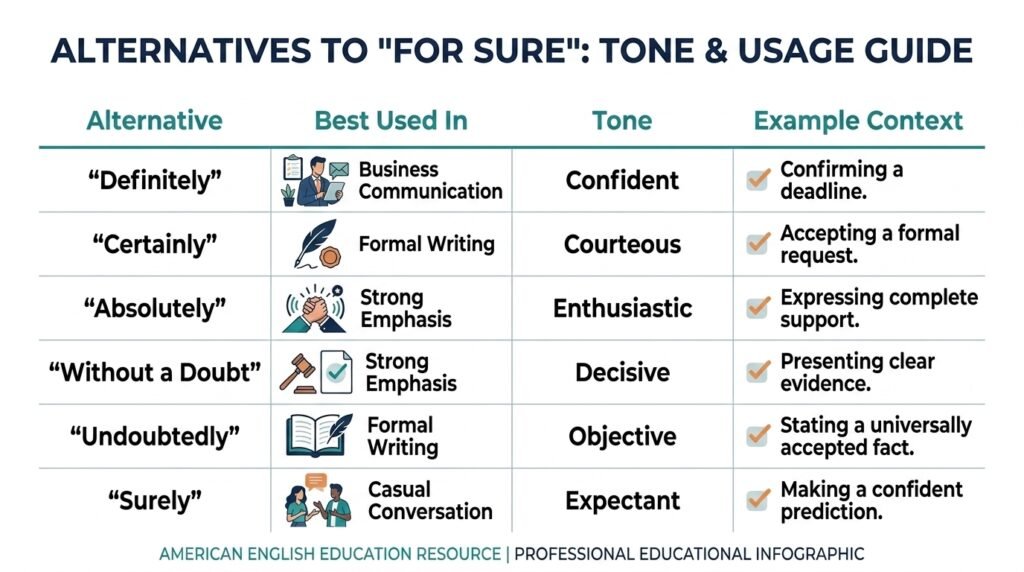
| Alternative | Best Used In | Tone |
| Definitely | Everyday and professional communication | Confident |
| Certainly | Emails and professional writing | Polite, polished |
| Absolutely | Conversations and enthusiastic responses | Strong, positive |
| Without a doubt | Emphatic statements | Confident |
| Undoubtedly | Formal and professional writing | Formal, authoritative |
| Surely | Conversations and persuasive statements | Confident, sometimes questioning |
| Clearly | Evidence-based statements | Direct, confident |
| Indeed | Formal and polished writing | Formal, emphatic |
| Positively | Firm confirmations | Strong, definite |
| Beyond doubt | Formal or persuasive writing | Very strong, authoritative |
Common Mistakes
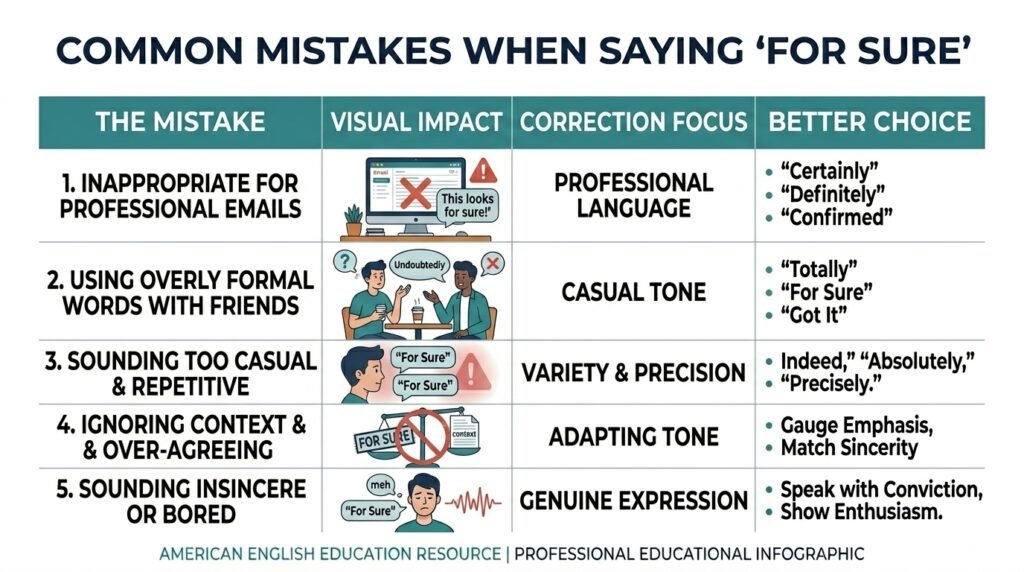
1. Using Casual Phrases in Professional Emails
“For sure” is acceptable in casual communication, but it may sound too informal in a business email. Certainly or definitely is usually a safer choice.
2. Choosing Overly Formal Language
Not every conversation needs words such as undoubtedly or beyond doubt. Using formal expressions with friends can make a simple statement sound unnecessarily serious.
3. Repeating the Same Phrase
Using “for sure” several times in one paragraph can make your writing repetitive. Vary your wording when the context allows it.
4. Forgetting Context
Not every synonym has exactly the same meaning. For example, clearly often suggests evidence, while absolutely can express strong enthusiasm or agreement.
5. Sounding Insincere
Very strong words can feel exaggerated when the situation does not justify them. If you are only reasonably confident, avoid choosing an expression that suggests complete certainty.
Frequently Asked Questions
What is the most common alternative to “for sure”?
Definitely is one of the most natural alternatives to “for sure.” It works well in everyday conversations, texts, emails, and many professional situations. For example, “I’ll definitely be there” communicates the same basic certainty as “I’ll be there for sure,” while sounding slightly more polished.
What is a professional way to say “for sure”?
Certainly is an excellent professional alternative to “for sure.” It sounds confident and polite without being overly formal. You can use it in workplace conversations, customer service responses, business emails, and professional correspondence when you want to confirm something clearly.
What is another way to say “for sure” in an email?
Depending on your sentence, use definitely, certainly, or absolutely. “I will definitely attend the meeting” sounds natural and professional. “Certainly” is a little more polished, while “absolutely” works well when you want to show strong agreement or enthusiasm.
Is “absolutely” the same as “for sure”?
They can have similar meanings, but they are not always interchangeable. Absolutely often adds stronger emphasis or enthusiasm, especially when agreeing with someone. “For sure” usually sounds more casual. For example, “Absolutely, I agree” expresses stronger enthusiasm than simply saying “For sure.”
What is a formal way to say “for sure”?
For formal writing, consider certainly, undoubtedly, without a doubt, or beyond doubt. The best choice depends on your sentence. “Certainly” is generally the most versatile formal option, while “beyond doubt” makes a much stronger claim.
Can I use “for sure” in professional writing?
Yes, but context matters. “For sure” is common in conversational American English, so it may work in informal workplace messages or friendly communication. However, definitely or certainly is usually a better choice for formal emails, reports, proposals, and business documents.
What is a friendly way to say “for sure”?
Absolutely, definitely, and certainly can all work in friendly conversations. “Absolutely!” is particularly natural when agreeing with a friend or enthusiastically accepting an invitation. For example, “Absolutely! I’d love to come to dinner” sounds warm and positive.
What is the strongest way to say “for sure”?
Expressions such as beyond doubt, without a doubt, and absolutely can communicate very strong certainty. However, the strongest option depends on context. Use “beyond doubt” for formal claims and “absolutely” for enthusiastic agreement or confident everyday speech.
Conclusion
Knowing another way to say for sure gives you more control over your tone and helps you communicate with greater precision. While “for sure” is perfectly natural in casual American English, another expression may work better depending on your audience and purpose.
Use definitely for a versatile everyday option, certainly for professional communication, and absolutely when you want to show strong agreement or enthusiasm. For greater emphasis, choose without a doubt or beyond doubt. In formal writing, undoubtedly and indeed can also work well.

Amara Reyes has taught English to adult learners for over eight years. She focuses on how phrases are actually used in everyday conversation, not just textbook definitions.