
What Does “Another Way to Say It’s My Pleasure” Mean?
“It’s my pleasure” is a polite response to someone who thanks you. It shows that you were happy to help and did not consider the favor a burden.
People commonly use it after receiving a “thank you,” especially in customer service, professional conversations, emails, and polite everyday interactions. However, using the same response repeatedly can make your communication feel predictable.
Choosing a suitable alternative lets you match your tone to the situation while still expressing kindness and appreciation.
Why Use Other Ways to Say “It’s My Pleasure”?
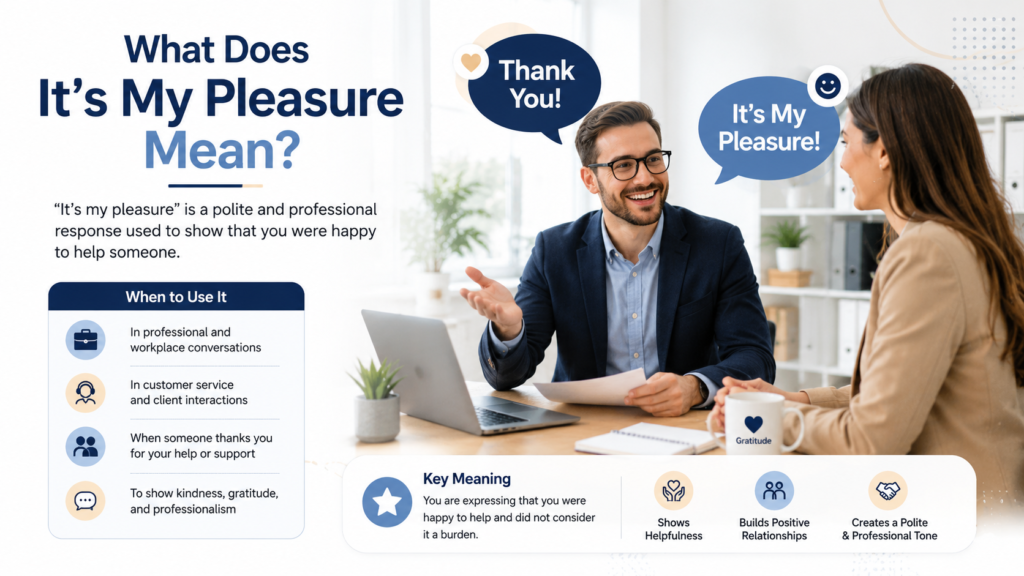
Using different expressions can make your conversations sound more natural and thoughtful. The best phrase can also communicate a slightly different level of warmth or formality.
Other expressions can help you:
- Avoid repeating the same response.
- Sound more natural in everyday conversations.
- Maintain a professional tone with customers or coworkers.
- Show genuine warmth and appreciation.
- Match your response to the relationship and setting.
- Make emails and messages feel less repetitive.
10 Best Other Ways to Say “It’s My Pleasure”
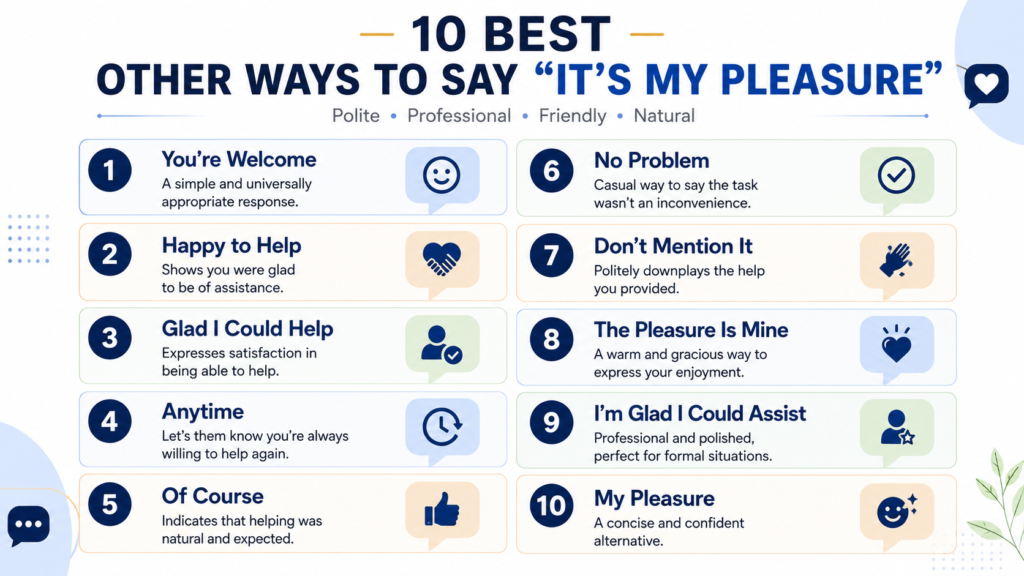
1. You’re Welcome
Meaning
“You’re welcome” is one of the most common responses to “thank you.” It is polite, natural, and appropriate in almost any everyday situation.
Best For
- Professional
- Casual
- Friendly
- Polite
Example 1
“You’re welcome! I’m glad I could help you find the right information.”
Example 2
“Thanks for staying late to finish this.”
“You’re welcome. We got it done together.”
Quick Tip
Use “you’re welcome” when you want a simple, universally appropriate response.
2. Happy to Help
Meaning
“Happy to help” shows that you genuinely enjoyed assisting someone. It sounds friendly without becoming too casual, making it especially useful in professional communication.
Best For
- Professional
- Friendly
- Warm
- Polite
Example 1
“Thanks for walking me through the new software.”
“Happy to help.”
Example 2
“Thank you for answering all my questions.”
“Happy to help anytime.”
Quick Tip
Choose this phrase when you want your response to sound positive and approachable.
3. Glad I Could Help
Meaning
“Glad I could help” emphasizes satisfaction with being useful. It works particularly well when someone thanks you for solving a problem or providing useful information.
Best For
- Friendly
- Professional
- Warm
- Casual
Example 1
“Thanks for helping me fix the spreadsheet.”
“Glad I could help.”
Example 2
“Your advice made the presentation much easier.”
“I’m glad I could help.”
Quick Tip
Use this expression after completing a specific task or solving a problem.
4. Anytime
Meaning
“Anytime” suggests that you would be willing to help again in the future. It creates a relaxed and welcoming tone.
Best For
- Casual
- Friendly
- Warm
Example 1
“Thanks for picking me up from the airport.”
“Anytime!”
Example 2
“I really appreciate your advice.”
“Anytime. Just let me know if you need anything else.”
Quick Tip
Save “anytime” for relaxed conversations where a friendly tone feels appropriate.
5. Of Course
Meaning
“Of course” makes helping someone sound natural and expected. It can communicate that the favor was easy or that you were happy to do it.
Best For
- Casual
- Friendly
- Polite
- Professional
Example 1
“Thanks for sending me the report.”
“Of course.”
Example 2
“Thank you for making time for the meeting.”
“Of course. I was happy to join.”
Quick Tip
A warm tone of voice helps “of course” sound sincere rather than dismissive.
6. No Problem
Meaning
“No problem” tells someone that their request did not cause you difficulty or inconvenience. It is common in casual American English.
Best For
- Casual
- Friendly
- Polite
Example 1
“Thanks for helping me carry those boxes.”
“No problem.”
Example 2
“Sorry for asking you to resend the document.”
“No problem. I’ll send it again.”
Quick Tip
Use it with friends, coworkers, or familiar contacts rather than in highly formal situations.
7. Don’t Mention It
Meaning
“Don’t mention it” is a traditional polite expression that means the favor was not important enough to require thanks. It conveys modesty and friendliness.
Best For
- Friendly
- Warm
- Polite
- Formal
Example 1
“Thank you for taking care of the arrangements.”
“Don’t mention it. I was happy to do it.”
Example 2
“I really appreciate you checking on the details.”
“Don’t mention it.”
Quick Tip
This phrase works best when you want to downplay the effort you made.
8. The Pleasure Is Mine
Meaning
“The pleasure is mine” is a warm and gracious response to appreciation. It suggests that you personally enjoyed helping or meeting the other person.
Best For
- Formal
- Professional
- Warm
- Polite
Example 1
“Thank you for joining us at the event.”
“The pleasure is mine.”
Example 2
“It was wonderful speaking with you today.”
“The pleasure is mine. I enjoyed our conversation.”
Quick Tip
Use this when you want to sound especially gracious without being overly casual.
9. I’m Glad I Could Assist
Meaning
“I’m glad I could assist” is a polished alternative that focuses on being useful. It fits customer service, workplace emails, and other professional settings.
Best For
- Professional
- Formal
- Polite
Example 1
“Thank you for helping me resolve this account issue.”
“I’m glad I could assist.”
Example 2
“I appreciate your help with the application process.”
“I’m glad I could assist you.”
Quick Tip
Choose this option when communicating with customers, clients, or professional contacts.
10. My Pleasure
Meaning
“My pleasure” is a shorter version of “it’s my pleasure.” It sounds courteous and confident while expressing that you were happy to help.
Best For
- Professional
- Formal
- Friendly
- Polite
Example 1
“Thank you for organizing everything.”
“My pleasure.”
Example 2
“Thanks for taking the time to explain that.”
“My pleasure. I’m glad it was useful.”
Quick Tip
Use “my pleasure” when you want a concise but polished response.
Comparison Table
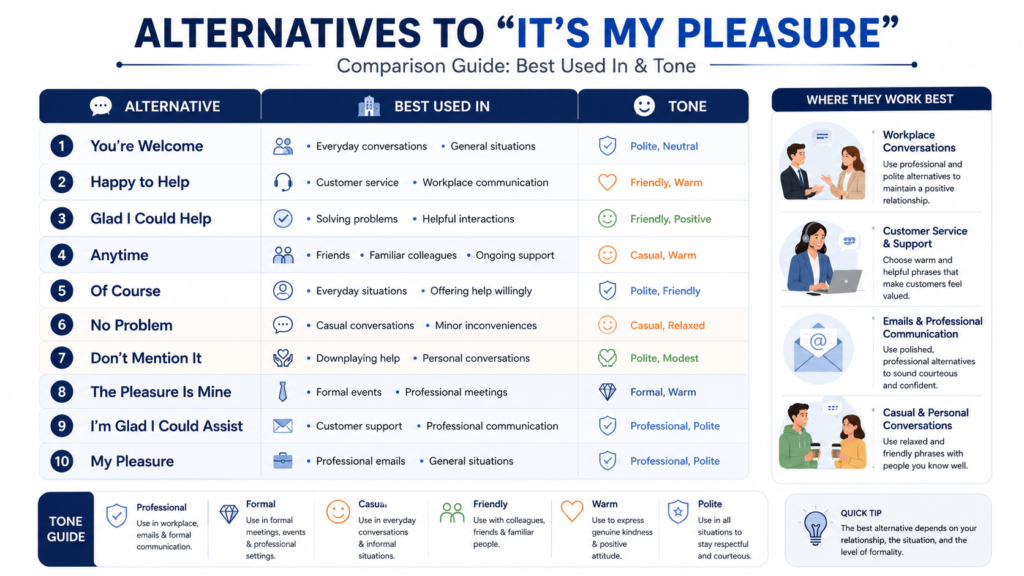
| Alternative | Best Used In | Tone |
| You’re welcome | Everyday conversations | Polite, neutral |
| Happy to help | Work and customer service | Warm, professional |
| Glad I could help | Helpful conversations | Friendly, positive |
| Anytime | Informal conversations | Casual, warm |
| Of course | Everyday and workplace conversations | Friendly, natural |
| No problem | Casual situations | Relaxed, friendly |
| Don’t mention it | Personal and polite conversations | Warm, modest |
| The pleasure is mine | Formal and social situations | Gracious, warm |
| I’m glad I could assist | Professional communication | Formal, polished |
| My pleasure | Professional and everyday situations | Courteous, confident |
Common Mistakes
1. Using Casual Phrases in Professional Emails
Expressions such as “no problem” or “anytime” can sound too relaxed in some formal settings. When communicating with clients or senior professionals, “happy to help” or “I’m glad I could assist” may be safer.
2. Choosing Overly Formal Language
Not every situation needs a polished expression such as “the pleasure is mine.” With close friends, a simple “you’re welcome” may sound more natural.
3. Repeating the Same Phrase
Using “you’re welcome” after every thank-you can make conversations feel repetitive. Having several natural alternatives gives your communication more variety.
4. Forgetting the Context
The relationship, setting, and reason for the thank-you all matter. A phrase that sounds perfect in a casual conversation may feel awkward in a business email.
5. Sounding Insincere
Even a polite phrase can feel cold if it does not match your tone. Choose wording that genuinely reflects how you feel rather than using formal language simply to sound impressive.
Frequently Asked Questions
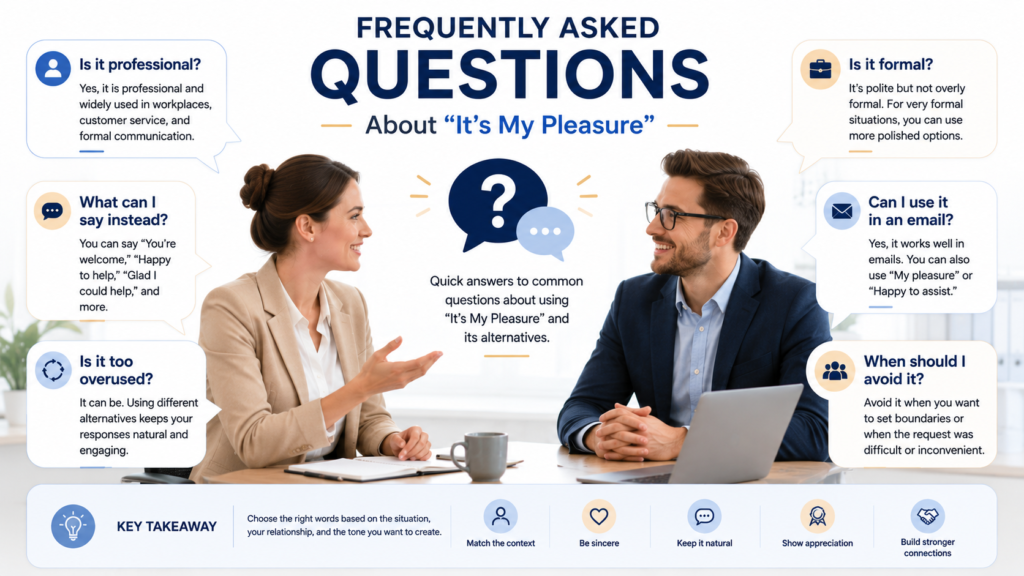
What is the best alternative to “it’s my pleasure”?
“You’re welcome” is the safest general alternative because it works in most everyday situations. If you want to sound warmer, “happy to help” or “glad I could help” are excellent choices. For formal or especially gracious situations, “the pleasure is mine” can work well.
Is “happy to help” professional?
Yes. “Happy to help” is a professional and friendly expression commonly used with coworkers, customers, clients, and business contacts. It shows that you were willing to assist and creates a positive tone without sounding overly formal.
What can I say instead of “it’s my pleasure” in an email?
For a professional email, you can say “happy to help,” “glad I could assist,” “you’re welcome,” or “my pleasure.” The best choice depends on your relationship with the recipient and how formal the email needs to be.
Is “no problem” a good response to thank you?
“No problem” is perfectly natural in casual American English. However, some people prefer more positive expressions in professional settings because “no problem” can sometimes sound as though the favor was an inconvenience.
What is a warm way to say “it’s my pleasure”?
“Happy to help,” “glad I could help,” and “the pleasure is mine” are warm alternatives. “Happy to help” feels friendly and approachable, while “the pleasure is mine” sounds more gracious and formal.
What is a formal way to say “it’s my pleasure”?
“I’m glad I could assist” is a strong formal option, especially in professional or customer-service communication. “The pleasure is mine” is another polished choice when you want to express warmth and courtesy.
Can I say “anytime” instead of “it’s my pleasure”?
Yes. “Anytime” works well when you want to tell someone that you would gladly help again. It has a relaxed, friendly tone, so it is generally better suited to casual conversations than highly formal business correspondence.
What should I say after someone thanks me for helping?
Choose your response based on the situation. “You’re welcome” is universally appropriate, while “happy to help” sounds warmer and more professional. With friends, “anytime” or “no problem” feels natural. For formal situations, “my pleasure” or “I’m glad I could assist” works well.
Conclusion
Finding another way to say “it’s my pleasure” can make your conversations sound more natural, varied, and appropriate for the situation. The best alternative depends on the tone you want to create.
Finding another way to say “it’s my pleasure” can make your conversations sound more natural, varied, and appropriate for the situation. The best alternative depends on the tone you want to create and the polite expressions in English you choose.

Amara Reyes has taught English to adult learners for over eight years. She focuses on how phrases are actually used in everyday conversation, not just textbook definitions.