What Does “Another Way to Say I Would” Mean?

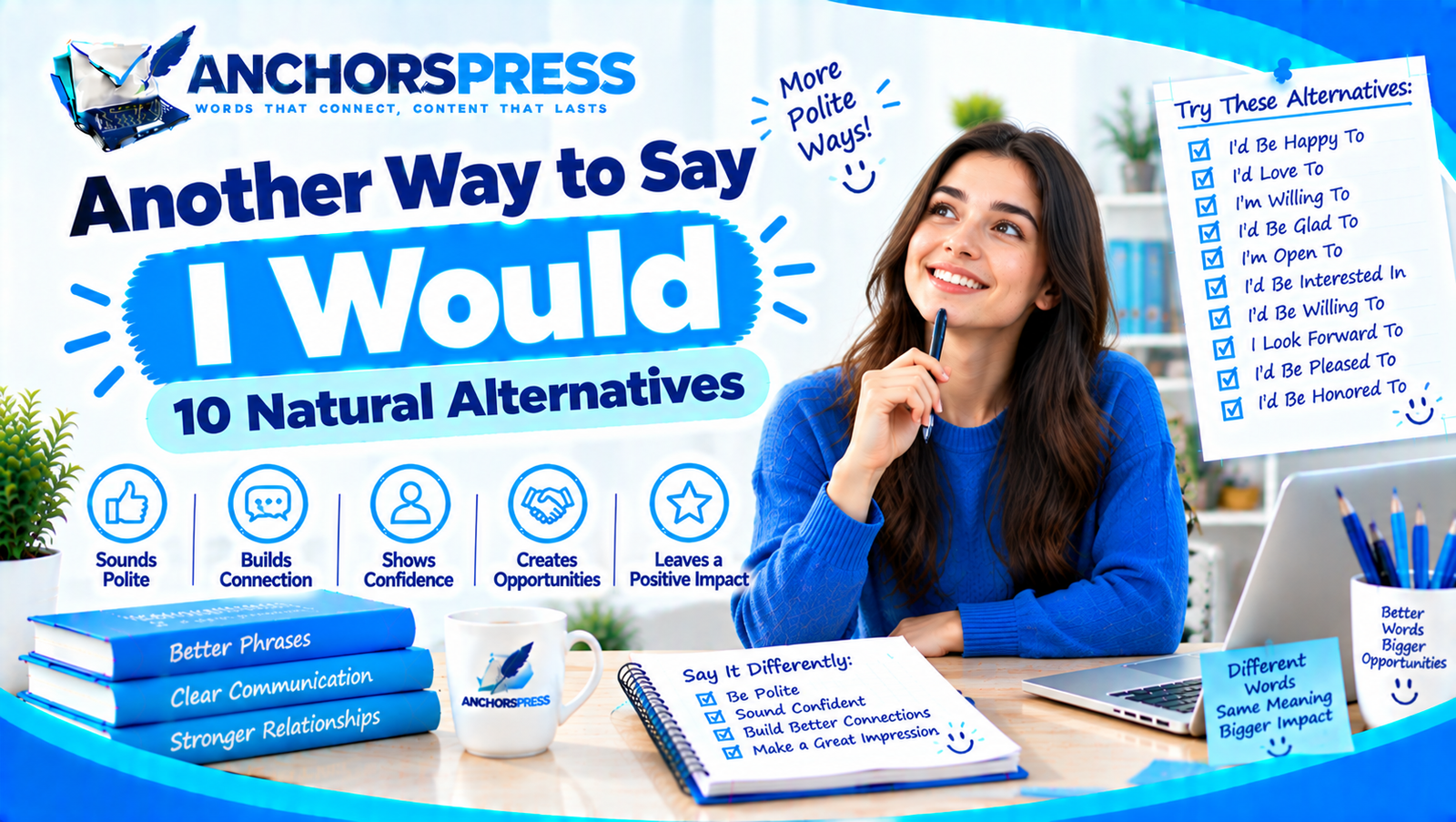
The phrase “another way to say I would” refers to different expressions that can replace “I would” while keeping the same general idea. The right choice depends on what you mean in the sentence.
“I would” can express a preference, willingness, polite request, future intention, or hypothetical situation. For example, “I would be happy to help” shows willingness, while “I would choose the first option” can express a preference.
People often search for alternatives to avoid repetition, make their writing sound more natural, or adjust their tone for professional and personal situations.
Why Use Other Ways to Say “I Would”?
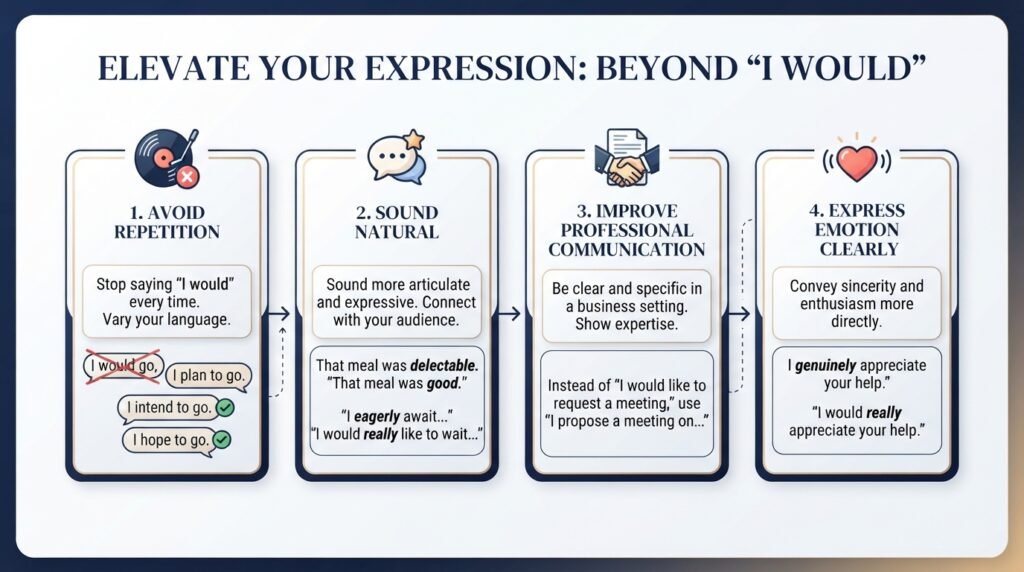
Using different expressions can make your communication clearer and more natural. While “I would” is correct and versatile, repeating it too often can make writing feel predictable.
Other expressions can also show exactly what you mean.
- Avoid repeating the same phrase.
- Make professional emails sound smoother.
- Express preferences more clearly.
- Show willingness or enthusiasm.
- Adjust your tone for formal or casual situations.
- Make requests sound more polite.
10 Best Other Ways to Say “I Would”
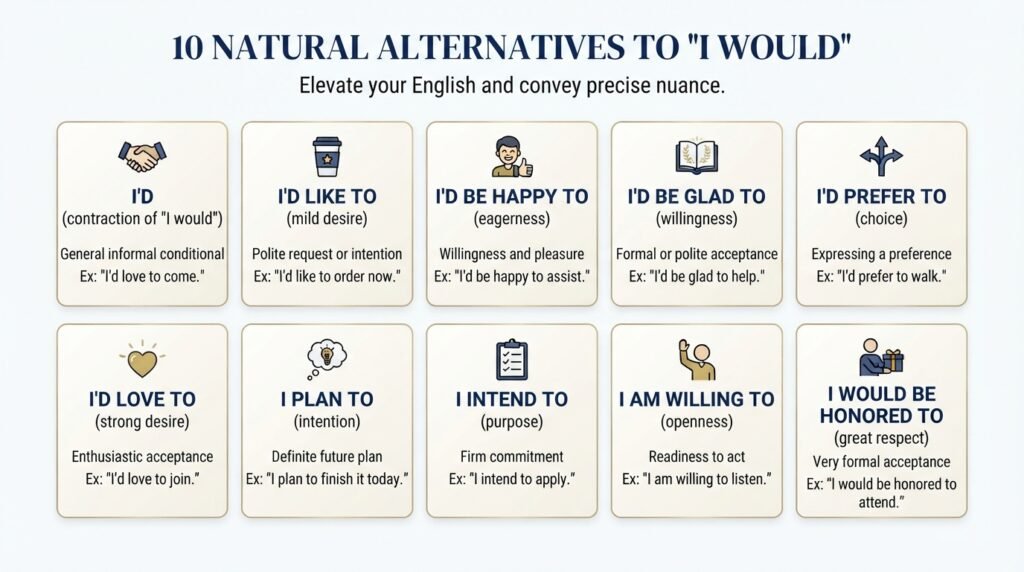
1. I’d
Meaning
“I’d” is the contracted form of “I would.” It is one of the most natural choices in everyday American English and works well when the context already makes the meaning clear.
Best For
- Casual
- Friendly
- Polite
- Professional
Example 1
I’d be happy to review the document before the meeting.
Example 2
I’d choose the second option if we want to keep the design simple.
Quick Tip
Use “I’d” in conversational writing, emails, and everyday speech. In highly formal documents, spelling out “I would” may be preferable.
2. I’d Be Happy To
Meaning
“I’d be happy to” expresses willingness in a warm and positive way. It is especially useful when you want to show that you are pleased to help or accept a request.
Best For
- Professional
- Polite
- Friendly
- Warm
Example 1
I’d be happy to send you the updated proposal this afternoon.
Example 2
I’d be happy to answer any questions you have about the project.
Quick Tip
This phrase is excellent for professional emails because it sounds cooperative without being overly formal.
3. I’d Like To
Meaning
“I’d like to” is a polite way to express a desire, intention, or request. It is more courteous than simply saying “I want to” in many situations.
Best For
- Professional
- Formal
- Polite
- Casual
Example 1
I’d like to schedule a meeting for next Tuesday.
Example 2
I’d like to learn more about your services before making a decision.
Quick Tip
Use “I’d like to” when you want to sound polite while clearly stating what you want to do.
4. I’d Be Glad To
Meaning
“I’d be glad to” communicates willingness and a positive attitude. It is similar to “I’d be happy to,” but it can sound slightly more formal or deliberate.
Best For
- Professional
- Formal
- Polite
- Warm
Example 1
I’d be glad to provide additional information about the proposal.
Example 2
I’d be glad to discuss the next steps whenever you are available.
Quick Tip
Choose this phrase when you want to sound helpful and respectful, particularly in workplace communication.
5. I’d Prefer To
Meaning
“I’d prefer to” clearly expresses a preference between two or more options. It is useful when you want to communicate your choice without sounding demanding.
Best For
- Professional
- Formal
- Polite
Example 1
I’d prefer to meet in the morning so we have enough time to discuss everything.
Example 2
I’d prefer to keep the original layout because it is easier to navigate.
Quick Tip
Use “I’d prefer to” when you need to state a preference tactfully rather than giving a blunt command.
6. I’d Love To
Meaning
“I’d love to” expresses strong interest or enthusiasm. It is warmer and more energetic than a simple “I would like to.”
Best For
- Casual
- Friendly
- Warm
- Polite
Example 1
I’d love to join you for dinner this weekend.
Example 2
I’d love to hear your thoughts on the new website design.
Quick Tip
This phrase works particularly well in friendly conversations and informal professional communication, but it may be too enthusiastic for some formal documents.
7. I’m Willing To
Meaning
“I’m willing to” emphasizes readiness or acceptance rather than excitement. It tells the reader that you are prepared to do something under the circumstances.
Best For
- Professional
- Formal
- Polite
Example 1
I’m willing to make the requested changes before the final review.
Example 2
I’m willing to consider another approach if it improves the overall result.
Quick Tip
Use this expression when you want to emphasize cooperation or readiness without suggesting strong enthusiasm.
8. I’m Planning To
Meaning
“I’m planning to” focuses on an intended future action. Unlike “I would,” it usually describes a real plan rather than a hypothetical possibility.
Best For
- Professional
- Casual
- Friendly
Example 1
I’m planning to update the website before the end of the month.
Example 2
I’m planning to contact the client after I finish the report.
Quick Tip
Do not use this phrase when discussing an imaginary or conditional situation. It works best when you genuinely expect to take the action.
9. I’m Open To
Meaning
“I’m open to” shows that you are willing to consider an idea, suggestion, or alternative. It does not mean that you have already agreed.
Best For
- Professional
- Formal
- Polite
- Friendly
Example 1
I’m open to discussing a different deadline if necessary.
Example 2
I’m open to trying a new strategy if the current approach does not work.
Quick Tip
Use “I’m open to” when you want to show flexibility without making a firm commitment.
10. I Intend To
Meaning
“I intend to” expresses a clear purpose or plan. It sounds more direct and formal than “I’m planning to,” making it useful when you want to emphasize your intention.
Best For
- Professional
- Formal
- Polite
Example 1
I intend to complete the project before the agreed deadline.
Example 2
I intend to follow up with the team once I receive their feedback.
Quick Tip
Use this phrase when your writing needs a more deliberate or formal tone, especially in professional communication.
Comparison Table
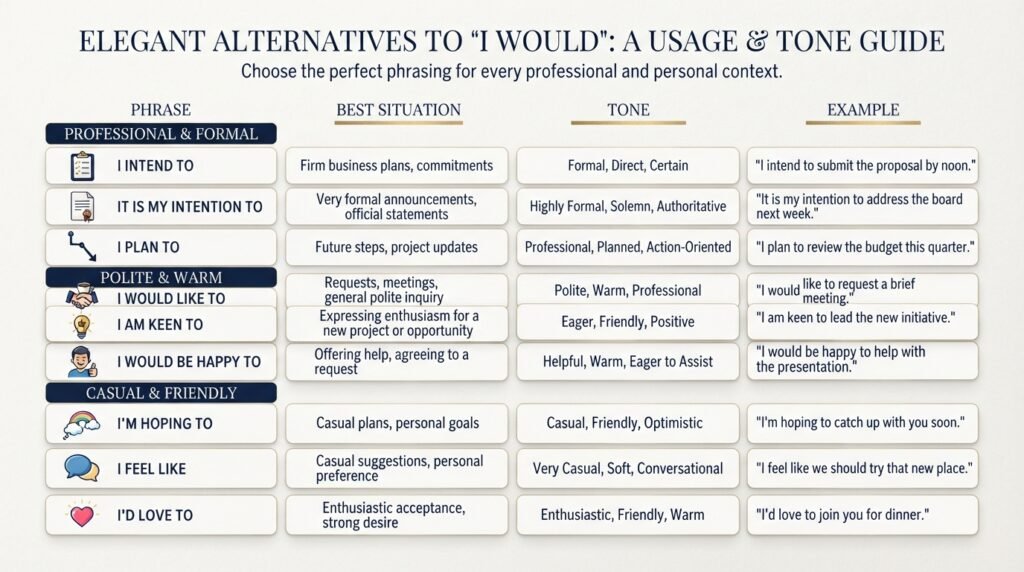
| Alternative | Best Used In | Tone |
| I’d | Everyday conversation and emails | Natural |
| I’d be happy to | Helpful responses and emails | Warm, professional |
| I’d like to | Requests and intentions | Polite |
| I’d be glad to | Professional assistance | Warm, formal |
| I’d prefer to | Expressing preferences | Polite, direct |
| I’d love to | Friendly invitations and interest | Warm, enthusiastic |
| I’m willing to | Cooperation and readiness | Professional |
| I’m planning to | Future plans | Natural, direct |
| I’m open to | Suggestions and possibilities | Flexible |
| I intend to | Clear plans and formal writing | Formal, confident |
Common Mistakes
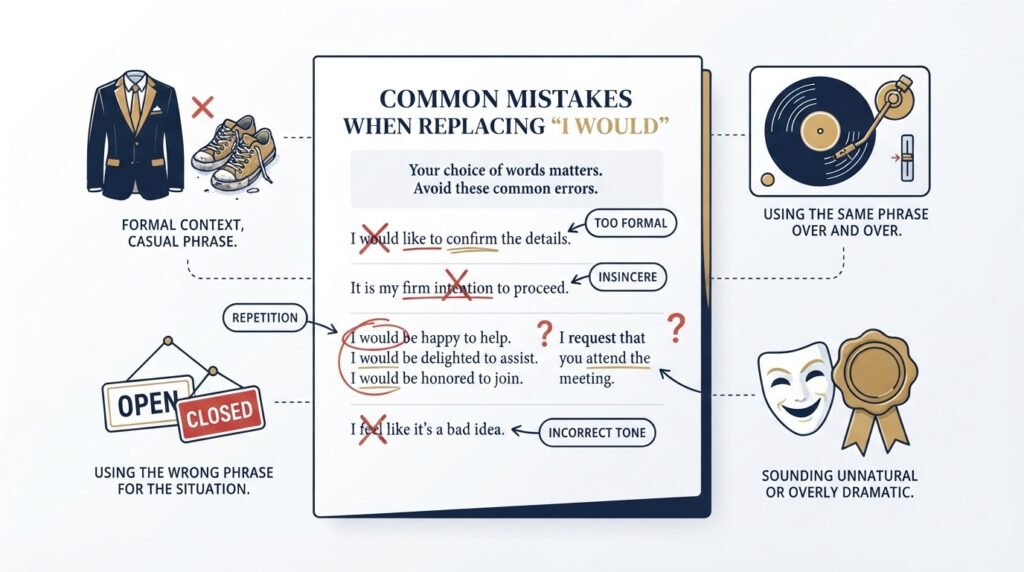
1. Using Casual Phrases in Professional Emails
Phrases such as “I’d love to” can sound too enthusiastic in certain formal situations. Choose a more neutral option when communicating with clients, managers, or official organizations.
2. Choosing an Alternative That Changes the Meaning
“I’m planning to” describes a real future plan, while “I would” can describe a hypothetical situation. Replacing one with the other can change the meaning of your sentence.
3. Overusing “I’d Be Happy To”
Although this phrase sounds friendly, repeating it throughout an email can become predictable. Mix it with alternatives such as “I’d be glad to” or “I’m willing to.”
4. Ignoring the Context
The best alternative depends on what you are trying to communicate. A preference, request, hypothetical idea, and willingness may each require a different expression.
5. Sounding More Formal Than Necessary
Words such as “I intend to” can sound serious in casual conversations. Match your phrase to the relationship, situation, and purpose of your communication.
Frequently Asked Questions
What is another way to say “I would”?
Common alternatives include “I’d,” “I’d like to,” “I’d be happy to,” “I’d be glad to,” “I’d prefer to,” and “I’d love to.” The best option depends on the meaning. For example, “I’d like to” expresses a desire, while “I’d be happy to” shows willingness to help.
What is a professional way to say “I would”?
A professional alternative depends on the sentence. “I’d be glad to,” “I’d be happy to,” “I’m willing to,” and “I intend to” can work well in workplace communication. Choose the phrase that matches your intended meaning instead of simply replacing “I would” word for word.
Is “I’d” the same as “I would”?
Yes. “I’d” is the standard contraction of “I would.” It is extremely common in American English, especially in conversation and informal or semi-formal writing. However, “I’d” can also mean “I had,” so the surrounding sentence determines which meaning applies.
What is a polite way to say “I would like”?
“I’d like to” is already one of the most polite and natural ways to express a desire or request. Depending on context, you can also say “I’d be interested in,” “I’d appreciate,” or “I’d be glad to.” Each option creates a slightly different tone.
How can I say “I would be happy to” differently?
You can use “I’d be glad to,” “I’d be pleased to,” or “I’d be happy to.” In less formal situations, “I’d love to” can work when you want to show enthusiasm. The choice should reflect how formal and warm you want the message to sound.
What is a formal alternative to “I would”?
There is no single formal replacement for “I would.” Depending on the meaning, you could use “I intend to,” “I am willing to,” “I would prefer to,” or “I would be pleased to.” Avoid changing the phrase simply to sound formal because the replacement may alter the original meaning.
Can I use “I’d” in a professional email?
Yes. “I’d” is completely natural in most professional emails, especially in American English. For example, “I’d be happy to discuss the proposal” sounds professional and friendly. In highly formal legal, academic, or official documents, writing “I would” in full may be more appropriate.
How do I choose the right alternative to “I would”?
First, identify what “I would” means in your sentence. Use “I’d like to” for a desire, “I’d be happy to” for willingness, “I’d prefer to” for a preference, and “I’m planning to” for a real future plan. Matching the meaning is more important than simply changing the wording.
Conclusion
Knowing another way to say “I would” can help you make your American English more natural, precise, and appropriate for different situations. The best alternative depends on the meaning you want to express.
Always consider the context before choosing a replacement. The goal is not simply to avoid “I would,” but to communicate your exact meaning in the most natural way. For a deeper understanding of how “would” is used in English, the British Council’s grammar guide provides useful examples and explanations.
Amara Reyes has taught English to adult learners for over eight years. She focuses on how phrases are actually used in everyday conversation, not just textbook definitions.