
What Does “Another Way to Say Good Fit” Mean?

The phrase “good fit” means that something or someone is well matched to a particular person, role, situation, need, or environment. For example, a candidate may be a good fit for a job, or a product may be a good fit for a customer’s needs.
People commonly use the expression when discussing jobs, relationships, teams, products, services, schools, and opportunities. It is especially common in American English because it sounds natural, positive, and flexible.
For example, a hiring manager might say, “She seems like a good fit for the position.” This means her skills, experience, personality, or goals match what the employer wants.
Why Use Other Ways to Say “Good Fit”?
Using different expressions can make your communication more precise and natural. The best alternative can also help you match the tone of a conversation or explain why something works well.
- Avoid repeating the same phrase.
- Sound more natural in everyday conversations.
- Make professional communication more polished.
- Emphasize compatibility, qualifications, or suitability.
- Express approval without sounding repetitive.
- Choose language that better matches the situation.
10 Best Other Ways to Say “Good Fit”

1. Great Match
Meaning
“Great match” means two people, things, or ideas work especially well together. It has a positive and conversational tone, making it useful when you want to show enthusiasm.
Best For
- Casual
- Friendly
- Warm
Example 1
“Those running shoes look like a great match for your training routine.”
Example 2
“I think you two would be a great match for this project.”
Quick Tip
Use “great match” when you want to sound positive without being overly formal.
2. Well Suited
Meaning
“Well suited” means something or someone has the qualities needed for a particular purpose. It sounds more polished than “good fit” and works particularly well in professional writing.
Best For
- Professional
- Formal
- Polite
Example 1
“Her background in customer service makes her well suited for the position.”
Example 2
“This software is well suited for small businesses with limited budgets.”
Quick Tip
Choose “well suited” when you want to emphasize qualifications or practical suitability.
3. Strong Match
Meaning
“Strong match” describes a person, product, or option that closely meets specific requirements. It is common when comparing qualifications, skills, needs, or expectations.
Best For
- Professional
- Formal
Example 1
“Your experience with data analysis makes you a strong match for the role.”
Example 2
“This apartment is a strong match for our budget and location preferences.”
Quick Tip
Use “strong match” when you want to explain that several important requirements line up.
4. Ideal Match
Meaning
“Ideal match” suggests that something is especially appropriate or nearly perfect for a particular purpose. It is stronger than simply saying “good fit.”
Best For
- Professional
- Formal
- Warm
Example 1
“Her leadership experience makes her an ideal match for the department.”
Example 2
“This lightweight laptop is an ideal match for frequent travelers.”
Quick Tip
Reserve “ideal match” for situations where the compatibility is especially strong.
5. Right Choice
Meaning
“Right choice” focuses on suitability and good judgment. Instead of simply saying something fits, it suggests that selecting it would be a sensible decision.
Best For
- Professional
- Friendly
- Polite
Example 1
“After reviewing the options, we believe this plan is the right choice.”
Example 2
“If you want flexibility and low maintenance, this car may be the right choice.”
Quick Tip
Use “right choice” when discussing a decision rather than compatibility alone.
6. Perfect Match
Meaning
“Perfect match” describes an exceptionally strong connection between two things or people. It is enthusiastic and more absolute than “good fit.”
Best For
- Casual
- Friendly
- Warm
Example 1
“The blue sofa is a perfect match for the room.”
Example 2
“Her creative skills and the team’s goals seem like a perfect match.”
Quick Tip
Because “perfect” sounds very strong, use this phrase when the compatibility is genuinely excellent.
7. Highly Suitable
Meaning
“Highly suitable” means someone or something is particularly appropriate for a specific purpose. It has a formal tone and is useful when you want to sound objective.
Best For
- Professional
- Formal
Example 1
“His technical background makes him highly suitable for the engineering position.”
Example 2
“The material is highly suitable for outdoor applications.”
Quick Tip
This phrase works best in reports, evaluations, applications, and other formal contexts.
8. A Strong Fit
Meaning
“A strong fit” is a close variation of “good fit” that suggests particularly strong compatibility. It is common in hiring, business, education, and team discussions.
Best For
- Professional
- Friendly
- Polite
Example 1
“Your project management experience makes you a strong fit for our team.”
Example 2
“The program could be a strong fit for students interested in technology.”
Quick Tip
Use “a strong fit” when you want to keep the original meaning while making the statement more confident.
9. A Natural Match
Meaning
“A natural match” suggests that two things work together easily without requiring much adjustment. It can describe people, skills, products, ideas, or opportunities.
Best For
- Casual
- Friendly
- Warm
Example 1
“Her writing skills and marketing experience are a natural match.”
Example 2
“Fresh vegetables are a natural match for this simple pasta dish.”
Quick Tip
Choose this phrase when the connection seems obvious or effortless.
10. Well Matched
Meaning
“Well matched” means that two or more things have compatible qualities, requirements, or characteristics. It is flexible enough for both everyday and professional communication.
Best For
- Professional
- Formal
- Polite
Example 1
“The candidates are well matched to the responsibilities of the position.”
Example 2
“The two colors are well matched and create a balanced design.”
Quick Tip
Use “well matched” when you want to emphasize compatibility without sounding overly enthusiastic.
Comparison Table
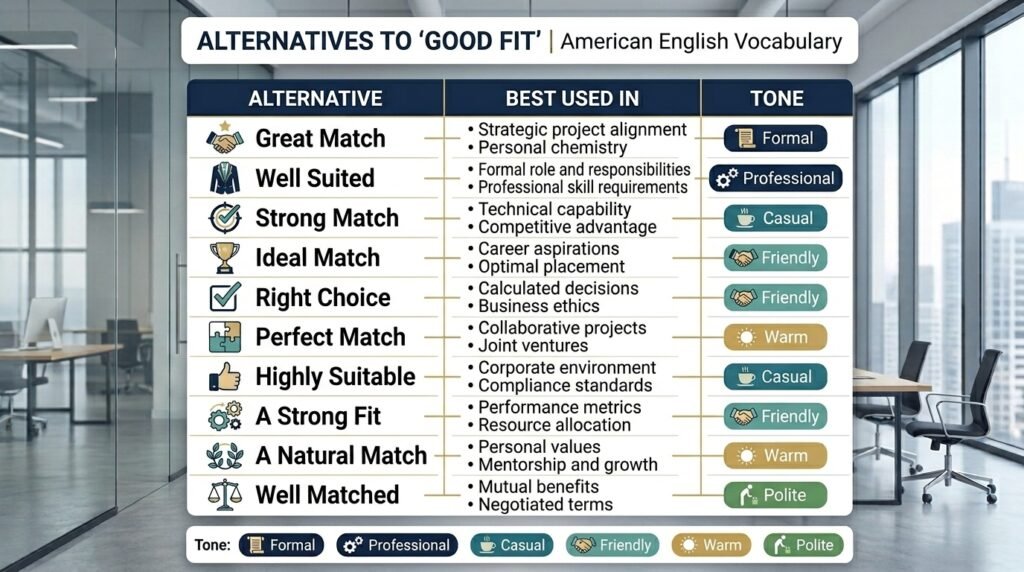
| Alternative | Best Used In | Tone |
| Great match | Everyday conversations | Friendly, positive |
| Well suited | Professional writing | Polished, formal |
| Strong match | Hiring and evaluations | Professional, confident |
| Ideal match | Professional and general use | Positive, confident |
| Right choice | Decisions and recommendations | Practical, reassuring |
| Perfect match | Personal and casual situations | Enthusiastic, warm |
| Highly suitable | Formal writing | Objective, professional |
| A strong fit | Work and education | Professional, positive |
| A natural match | Everyday and creative contexts | Warm, conversational |
| Well matched | Professional and general use | Neutral, polished |
Common Mistakes
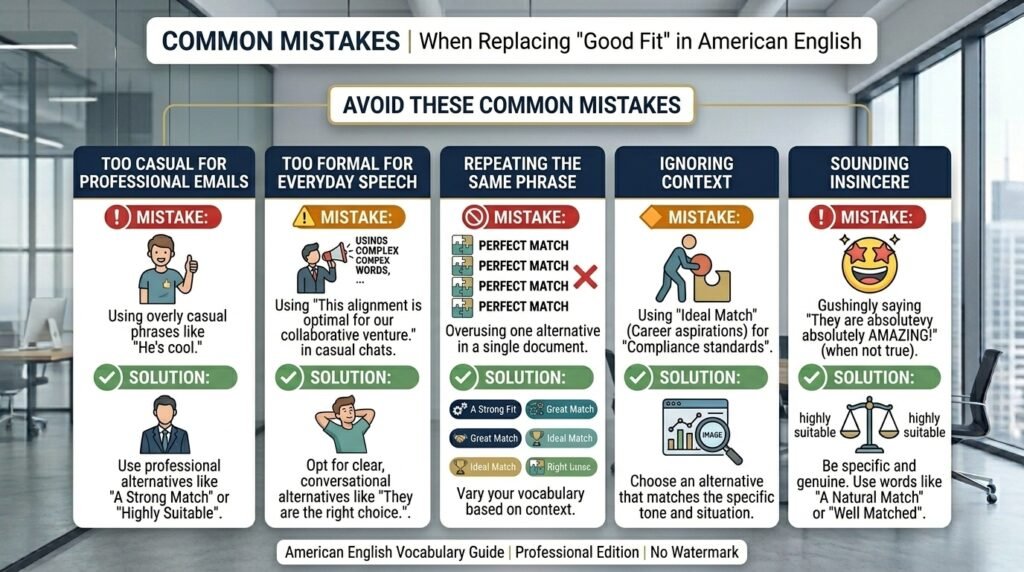
1. Using Casual Phrases in Professional Emails
Phrases such as “perfect match” can sometimes sound too enthusiastic in formal communication. In a business email, “well suited” or “strong match” may sound more appropriate.
2. Choosing Overly Formal Language
Not every situation requires sophisticated wording. Saying “highly suitable” to a friend may sound stiff when “great match” would feel more natural.
3. Repeating the Same Phrase
Using “good fit” several times in the same paragraph can make your writing feel repetitive. Replace it with a context-specific alternative when the meaning remains clear.
4. Forgetting the Context
A job candidate, a romantic relationship, and a software product do not necessarily need the same expression. Consider what is being matched before choosing your wording.
5. Sounding Insincere
Avoid stronger phrases such as “perfect match” when the evidence does not support them. If the compatibility is simply positive, “well suited” or “strong fit” may be more accurate.
Frequently Asked Questions

What is another way to say “good fit” professionally?
Professional alternatives include “well suited,” “strong match,” “highly suitable,” “ideal match,” and “a strong fit.” “Well suited” is especially useful when discussing qualifications, while “strong match” works well when comparing someone’s skills or experience with specific requirements.
What is a better word for “good fit”?
The best replacement depends on your meaning. “Suitable” is a concise formal alternative, while “well suited” sounds more natural in many professional sentences. If you want to emphasize compatibility, “strong match” or “ideal match” may work better.
How do you say “good fit” in a job interview?
In a job interview, you can say “I believe my experience aligns well with this role” or “I think my skills are a strong match for this position.” These alternatives sound confident and professional without making the statement feel exaggerated.
Is “great match” the same as “good fit”?
The two phrases have similar meanings, but their tone differs slightly. “Great match” often sounds more enthusiastic and conversational, while “good fit” is neutral and widely used in professional settings. “Great match” is particularly useful when you want to express stronger approval.
What is another way to say someone is a good fit for a job?
You can say someone is “well suited for the role,” “a strong candidate,” “a strong match for the position,” or “well matched to the role.” These phrases highlight qualifications and compatibility without relying on the exact expression “good fit.”
Can I use “perfect match” instead of “good fit”?
Yes, but “perfect match” is stronger. It suggests exceptionally close compatibility, so it should be used when you genuinely believe the match is excellent. In professional settings, “ideal match” or “strong fit” can sound more measured.
What is a formal way to say “good fit”?
“Well suited” and “highly suitable” are among the most formal alternatives. For example, instead of saying “She is a good fit for the position,” you could write, “She is well suited to the position based on her experience and qualifications.”
How can I avoid repeating “good fit” in writing?
Replace it with an expression that reflects the specific meaning you want. Use “well suited” for suitability, “strong match” for qualifications, “right choice” for decisions, and “great match” for an enthusiastic or conversational tone.
Conclusion
Knowing another way to say “good fit” gives you more flexibility in American English. Although “good fit” is natural and useful, alternatives such as “well suited,” “strong match,” and “ideal match” can make your writing more precise.
The key is to match your wording to the context. Choose the phrase that accurately reflects the level of compatibility and the tone you want to convey.

Daniel Cho writes about professional communication, drawing on years spent training teams on clear, confident workplace writing — from emails to performance reviews.