
The word bad is one of the most common adjectives in American English. It can describe poor quality, negative results, unpleasant experiences, harmful behavior, or something that fails to meet expectations.
Because “bad” covers so many meanings, choosing a more specific word can make your writing clearer. For example, a poor decision is different from a harmful decision, while an unpleasant experience is not necessarily a terrible experience.
What Does “Another Way to Say Bad” Mean?

“Another way to say bad” means looking for a synonym or alternative expression that communicates a similar negative meaning.
The best word depends on what you are describing. You might use poor for quality, disappointing for results, unpleasant for experiences, or harmful when something causes damage.
People often search for alternatives to “bad” because they want their writing to sound more precise and natural. This is especially useful in essays, professional emails, reviews, conversations, and everyday American English.
Why Use Other Ways to Say “Bad”?
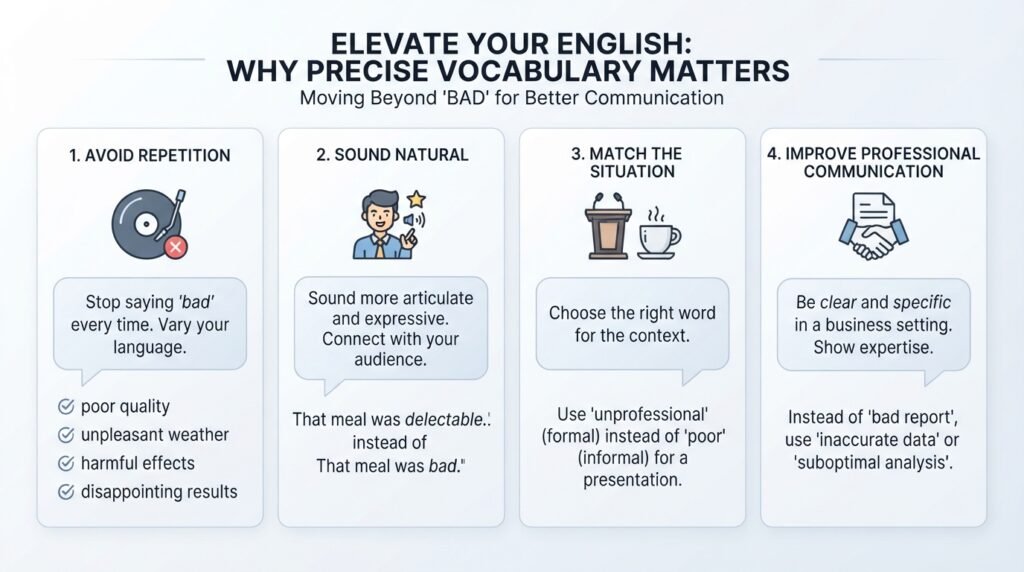
Using a more specific alternative can make your message stronger and easier to understand.
- Avoid repetition: Prevent the same adjective from appearing too often.
- Sound more natural: Choose a word that fits the situation better.
- Improve precision: Explain exactly what makes something negative.
- Match the tone: Sound casual, professional, polite, or firm.
- Communicate clearly: Help readers understand the specific problem.
For example, saying “The service was bad” gives little information. Saying “The service was disappointing” tells the reader that the experience failed to meet expectations.
10 Best Other Ways to Say “Bad”
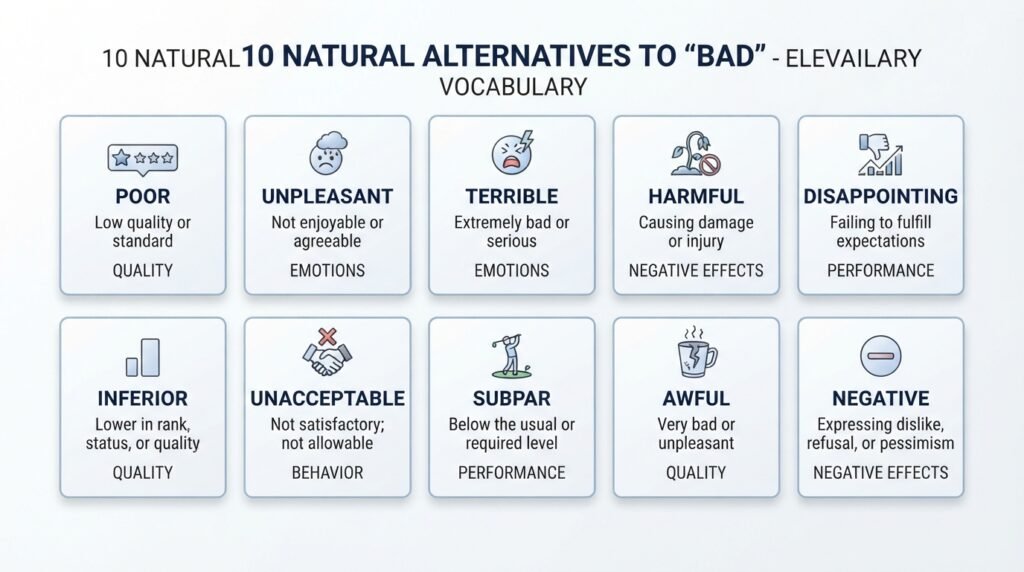
1. Poor
Meaning
Poor is one of the most useful alternatives to “bad.” It usually describes something that has low quality, weak performance, or an unsatisfactory standard.
Best For
- Professional
- Formal
- Polite
Example 1
The company received several complaints about its poor customer service.
Example 2
The report was rejected because it contained poor-quality data.
Quick Tip
Use poor when you want to criticize something without sounding unnecessarily harsh.
2. Unpleasant
Meaning
Unpleasant describes something that causes discomfort, annoyance, or an unwanted feeling. It is often softer and more polite than simply calling something “bad.”
Best For
- Professional
- Polite
- Friendly
Example 1
We had an unpleasant experience at the restaurant last night.
Example 2
The conversation became unpleasant after the disagreement.
Quick Tip
Choose unpleasant when you are describing an experience, atmosphere, smell, conversation, or situation that you did not enjoy.
3. Terrible
Meaning
Terrible is a strong alternative to “bad.” It suggests that something is extremely poor, unpleasant, or disappointing.
Best For
- Casual
- Friendly
- Warm
Example 1
I had a terrible headache after the long flight.
Example 2
The traffic was terrible during the evening commute.
Quick Tip
Because terrible is strong, use it when “bad” does not fully express the seriousness of the situation.
4. Harmful
Meaning
Harmful means something causes damage, injury, or negative effects. Unlike the general word “bad,” it clearly explains that something may have damaging consequences.
Best For
- Professional
- Formal
Example 1
Too much exposure to the chemical can be harmful to the environment.
Example 2
The article warns readers about harmful online habits.
Quick Tip
Use harmful when the issue involves physical, emotional, environmental, financial, or other forms of damage.
5. Disappointing
Meaning
Disappointing describes something that fails to meet your hopes, expectations, or standards. It is particularly useful when the result is not as good as you expected.
Best For
- Professional
- Polite
- Friendly
- Warm
Example 1
The team’s performance was disappointing despite months of preparation.
Example 2
The movie had an interesting premise but a disappointing ending.
Quick Tip
Use disappointing when the main issue is that something did not live up to expectations.
6. Inferior
Meaning
Inferior means lower in quality, value, or standard compared with something else. It usually involves a direct or implied comparison.
Best For
- Professional
- Formal
Example 1
The cheaper material was noticeably inferior to the original product.
Example 2
Customers complained that the replacement parts were inferior in quality.
Quick Tip
Use inferior when comparing two products, services, methods, materials, or results.
7. Unacceptable
Meaning
Unacceptable means something does not meet an expected or required standard. It is stronger than “poor” and clearly communicates disapproval.
Best For
- Professional
- Formal
- Polite
Example 1
The manager explained that repeated lateness was unacceptable.
Example 2
The school considers bullying and harassment unacceptable behavior.
Quick Tip
Use unacceptable when you need to set a clear boundary or state that something fails an important standard.
8. Subpar
Meaning
Subpar means below an expected or acceptable level. It is common in American English and works particularly well when discussing performance, quality, service, or results.
Best For
- Professional
- Casual
- Friendly
Example 1
The contractor delivered subpar work that needed several corrections.
Example 2
Customers were unhappy with the restaurant’s subpar service.
Quick Tip
Subpar is a useful choice when you want to criticize quality without using a very emotional word such as “terrible.”
9. Awful
Meaning
Awful is a strong, informal alternative to “bad.” It can describe something extremely unpleasant, poor, or disappointing.
Best For
- Casual
- Friendly
Example 1
The weather was awful during our entire weekend trip.
Example 2
I felt awful after realizing that I had missed the appointment.
Quick Tip
Use awful mainly in casual conversations and informal writing because it can sound too emotional for some professional situations.
10. Negative
Meaning
Negative describes something unfavorable, harmful, pessimistic, or likely to produce an undesirable result. It is broader and more neutral than words such as “terrible” or “awful.”
Best For
- Professional
- Formal
- Polite
Example 1
The new policy could have negative effects on small businesses.
Example 2
Try to focus on solutions instead of negative comments about the project.
Quick Tip
Choose negative when you want a neutral, professional word for an unfavorable result, effect, opinion, or attitude.
Comparison Table

| Alternative | Best Used In | Tone |
| Poor | Quality, performance, service | Neutral |
| Unpleasant | Experiences, situations, conversations | Polite |
| Terrible | Very negative situations | Strong |
| Harmful | Damage, health, effects, consequences | Serious |
| Disappointing | Results, experiences, expectations | Polite |
| Inferior | Comparisons and quality | Formal |
| Unacceptable | Standards, behavior, performance | Firm |
| Subpar | Quality and performance | Neutral |
| Awful | Experiences and situations | Strong, casual |
| Negative | Effects, opinions, attitudes, results | Neutral |
Common Mistakes

1. Using casual phrases in professional writing
Words such as awful and terrible can sound overly emotional in a business setting. Choose poor, subpar, or disappointing when you need a more measured tone.
2. Choosing an overly formal word
Inferior or unacceptable may sound too serious in a casual conversation. Match the word to the relationship and situation.
3. Repeating “bad” too often
Using “bad” throughout an article or essay can make the writing feel basic and repetitive. Replace it with a more precise word when the context allows.
4. Forgetting the context
Not every synonym has the same meaning. For example, harmful suggests damage, while disappointing suggests that expectations were not met.
5. Sounding unnecessarily harsh
Calling something “terrible” or “awful” can make criticism sound stronger than intended. If you want to remain respectful, poor, unpleasant, or disappointing may be better choices.
Frequently Asked Questions
What is another way to say bad in professional English?
In professional English, good alternatives include poor, subpar, disappointing, unacceptable, and negative. The best choice depends on the situation. For example, “poor performance” sounds professional, while “unacceptable behavior” communicates a more serious concern or failure to meet a standard.
What is a polite way to say bad?
A polite way to say “bad” is unpleasant, disappointing, or less than ideal. These expressions communicate a negative opinion without sounding unnecessarily harsh. For example, instead of saying “The experience was bad,” you could say, “The experience was disappointing.”
What is a stronger word for bad?
Stronger alternatives include terrible, awful, unacceptable, and harmful, depending on the meaning. “Terrible” and “awful” express strong negative feelings, while “harmful” focuses on damage and “unacceptable” indicates that something fails an important standard.
What is another word for bad quality?
Common alternatives for “bad quality” include poor-quality, subpar, inferior, and low-quality. “Subpar” is especially useful in everyday American English, while “inferior” works well when you are comparing one product or service with another.
What is another way to say bad behavior?
Depending on the situation, you can say inappropriate behavior, unacceptable behavior, harmful behavior, or negative behavior. “Unacceptable behavior” is especially useful when discussing conduct that clearly violates rules, expectations, or social standards.
What is another word for bad experience?
Unpleasant, disappointing, negative, and terrible can all describe a bad experience. “Unpleasant experience” is more polite and neutral, while “terrible experience” is much stronger and usually communicates significant frustration or dissatisfaction.
Can I use “poor” instead of “bad”?
Yes. Poor is one of the most natural replacements for “bad,” especially when discussing quality, performance, service, or results. For example, “bad communication” can become “poor communication,” and “bad performance” can become “poor performance.”
Which synonym for bad is best for an essay?
For an essay, choose a precise word based on what you mean. Poor works for quality or performance, harmful works for damaging effects, negative works for unfavorable results, and disappointing works when something fails to meet expectations.
Conclusion
Knowing another way to say bad can help you make your American English more precise, natural, and effective. While “bad” is perfectly acceptable in everyday conversation, a more specific synonym can tell readers exactly what you mean.
The more precise your word choice, the clearer and more natural your writing becomes.
Amara Reyes has taught English to adult learners for over eight years. She focuses on how phrases are actually used in everyday conversation, not just textbook definitions.