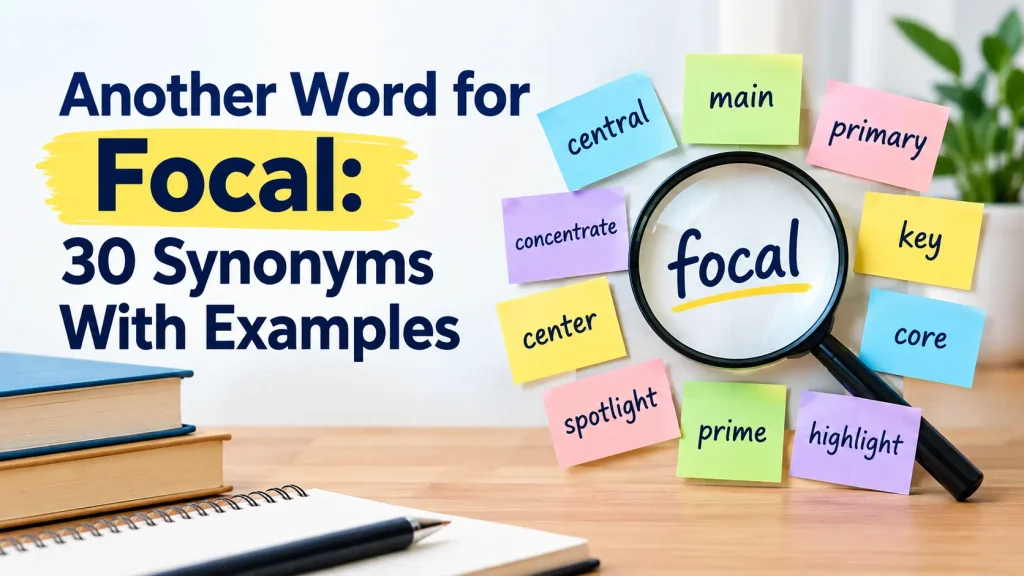
The best everyday alternatives for focal are central, main, key, and primary. These words describe something important or at the center of attention. The best choice depends on the meaning and context.
Focal can refer to the main point of interest, a key part of a plan, or a point where light rays meet. In science and medicine, it can have more specific meanings.
Oxford Learner’s Dictionaries+2
Quick list: Central, main, key, primary, principal, chief, major, leading, pivotal, and important.
This guide explores 30 alternatives with meanings, IPA, usage notes, and examples. It also explains common word pairs, useful expressions, and ways to choose the right word.
At a Glance: Focal Synonyms and Related Alternatives
| Alternative | Part of Speech | Meaning | Register / Tone | Ideal Context |
| Central | Adjective | At the center or most important | Neutral | Ideas and places |
| Main | Adjective | The most important | Everyday | General writing |
| Key | Adjective | Very important | Neutral | Plans and problems |
| Primary | Adjective | First in rank or importance | Formal | Goals and needs |
| Principal | Adjective | Chief or most important | Formal | Reasons and parts |
| Chief | Adjective | Highest in rank or importance | Neutral | Causes and concerns |
| Major | Adjective | Great in size or importance | Neutral | Events and issues |
| Leading | Adjective | At the front or in first place | Neutral | Roles and causes |
| Pivotal | Adjective | Having a strong effect on events | Formal | Turning points |
| Important | Adjective | Having great value or meaning | Everyday | General use |
Which Word Should You Use?
| If you want to… | Use | Why |
| Name the center of attention | Central | It points to the main focus. |
| Use a simple everyday word | Main | It is clear and widely understood. |
| Stress the value of something | Key | It highlights importance. |
| Show the first priority | Primary | It ranks one thing above others. |
| Sound more formal | Principal | It suits reports and formal writing. |
| Stress a major effect | Pivotal | It shows that something can change events. |
| Point to a leading role | Leading | It suggests a front or top position. |
| Describe the center of a lens | Focal | It keeps the exact technical meaning. |
Exploring the Multiple Meanings of “Focal”
1. The Main Point of Interest
- Meaning: The place or thing that draws the most attention.
- Explanation: This sense often applies to art, rooms, events, and public spaces. It also helps name the main feature in a scene.
- Example: The bright red sofa became the focal point of the room.
2. The Most Important Part
- Meaning: Something that plays a central role in a plan or issue.
- Explanation: Writers use focal to stress importance. It also points to the part that matters most.
- Example: Safety remained the focal concern during the whole trip.
3. The Center of Light or Rays
- Meaning: A point linked to where light rays meet or appear to meet.
- Explanation: This sense appears in optics and lens design. It also relates to terms such as focal length and focal plane.
- Example: The lens brought the light rays toward a focal point.
4. A Limited Area in Medicine
- Meaning: Related to a specific, limited area of the body or a process.
- Explanation: Medical staff may use focal to show that a problem affects one area. It also contrasts with terms for wider effects.
- Example: The scan showed a focal change in one small area.
5. The Starting Point of an Event
- Meaning: A place or point where an activity or process begins.
- Explanation: This sense appears in science and the study of natural events. It also links focal to the source of a process.
- Example: Researchers studied the focal area of the small quake.
Sources: Oxford University Press, Collins, and Cambridge University Press & Assessment.
Oxford Learner’s Dictionaries+2
Analyzing 30 Focal Alternatives in Detail
Some words are direct alternatives for focal, while others fit only certain contexts. Choose the word that best matches your meaning.
Core Synonyms
1. Central
IPA: US /ˈsɛntrəl/ · UK /ˈsentrəl/
Definition: Central means at the center of something. It also means very important to a plan or idea.
- Usage: This is one of the closest everyday synonyms. However, it may refer to a physical center or an important role.
- Example: Trust plays a central role in a strong friendship.
2. Main
IPA: US /meɪn/ · UK /meɪn/
Definition: Main means more important than other parts. It also names the chief thing in a group.
- Usage: This is a simple choice for general writing. Also, it fits many cases where focal means most important.
- Example: Our main goal is to finish the project on time.
3. Key
IPA: US /kiː/ · UK /kiː/
Definition: Key means very important to success or understanding. It also points to something that helps explain a result.
- Usage: Use it to stress importance. For example, a key issue may shape a whole plan.
- Example: Good planning is key to a smooth family trip.
4. Primary
IPA: US /ˈpraɪˌmɛri/ · UK /ˈpraɪməri/
Definition: Primary means first in rank or importance. It also refers to the main need or goal.
- Usage: This word often suits formal writing. However, it can suggest order or rank rather than a point of attention.
- Example: Our primary concern is keeping every child safe.
5. Principal
IPA: US /ˈprɪnsəpəl/ · UK /ˈprɪnsɪpəl/
Definition: Principal means the most important among several things. It also names the chief reason or part.
- Usage: This word sounds more formal than main. For example, it fits reports, plans, and lists of causes.
- Example: The principal reason for the delay was bad weather.
6. Chief
IPA: US /tʃiːf/ · UK /tʃiːf/
Definition: Chief means highest in rank or importance. It also points to the leading cause or concern.
- Usage: Use it to stress the top concern. However, it may sound formal in some phrases.
- Example: Her chief aim was to help the whole team.
Words That Stress Importance
7. Major
IPA: US /ˈmeɪdʒər/ · UK /ˈmeɪdʒə/
Definition: Major means very important or large in scale. It also marks something with a strong effect.
- Usage: This word fits big issues and events. Still, major does not always mean the center of attention.
- Example: The team made a major change to its plans.
8. Important
IPA: US /ɪmˈpɔrtənt/ · UK /ɪmˈpɔːtənt/
Definition: Important means having great value or meaning. It also shows that something needs care or attention.
- Usage: This is a broad, simple choice. However, it does not always mean central or at the center.
- Example: It is important to check the door before leaving.
9. Significant
IPA: US /sɪɡˈnɪfɪkənt/ · UK /sɪɡˈnɪfɪkənt/
Definition: Significant means having special value or meaning. It also points to a change or fact worth noting.
- Usage: This word suits reports and careful analysis. For example, a significant event may affect many people.
- Example: The new rule brought a significant change to school life.
10. Essential
IPA: US /ɪˈsɛnʃəl/ · UK /ɪˈsenʃəl/
Definition: Essential means needed for a purpose. It also marks something that cannot be left out without loss.
- Usage: Use it when something is vital, not just central. However, essential stresses need more than attention.
- Example: Clean water is essential for every home.
11. Fundamental
IPA: US /ˌfʌndəˈmɛntəl/ · UK /ˌfʌndəˈmentəl/
Definition: Fundamental means forming the base of something. It also points to a core rule or idea.
- Usage: This word fits basic ideas and key rules. In fact, it often stresses a deeper role than focal.
- Example: Respect is a fundamental part of a healthy friendship.
12. Paramount
IPA: US /ˈpærəˌmaʊnt/ · UK /ˈpærəmaʊnt/
Definition: Paramount means more important than anything else. It also stresses the highest level of concern.
- Usage: This is a strong and formal choice. However, it stresses rank rather than physical position.
- Example: The safety of all guests is paramount during the event.
Words That Show a Leading Role
13. Leading
IPA: US /ˈliːdɪŋ/ · UK /ˈliːdɪŋ/
Definition: Leading means ahead of others or in a top role. It also points to a strong influence.
- Usage: Use it for people, groups, causes, or ideas. Still, it may mean first in rank rather than central.
- Example: She played a leading role in the school play.
14. Foremost
IPA: US /ˈfɔrˌmoʊst/ · UK /ˈfɔːməʊst/
Definition: Foremost means first in rank or importance. It also marks someone or something as a top choice.
- Usage: This word sounds formal or literary. For example, it fits a person at the top of a field.
- Example: He is one of the foremost experts in the field.
15. Dominant
IPA: US /ˈdɑmɪnənt/ · UK /ˈdɒmɪnənt/
Definition: Dominant means stronger or more noticeable than others. It also points to the part with the greatest influence.
- Usage: This word suits a strong presence or force. However, it may suggest control rather than simple importance.
- Example: Blue was the dominant color in the room.
16. Predominant
IPA: US /prɪˈdɑmɪnənt/ · UK /prɪˈdɒmɪnənt/
Definition: Predominant means most common or strongest in a group. It also points to the leading feature of something.
- Usage: Use it for trends, colors, views, or traits. In fact, it often stresses what is most widespread.
- Example: Warm colors were predominant throughout the small cafe.
17. Foreground
IPA: US /ˈfɔrˌɡraʊnd/ · UK /ˈfɔːɡraʊnd/
Definition: Foreground means the front part of a scene. It also refers to something given special attention.
- Usage: This is a related term, not a direct synonym in every case. Use it when a person or thing comes to the front.
- Example: The artist placed a small bird in the foreground.
18. Prominent
IPA: US /ˈprɑmɪnənt/ · UK /ˈprɒmɪnənt/
Definition: Prominent means easy to notice or important. It also refers to someone well known in a field.
- Usage: This word suits visible features and public figures. However, something prominent may not be the main focus.
- Example: A prominent clock stood above the town square.
Words for a Central Point or Role
19. Pivotal
IPA: US /ˈpɪvətəl/ · UK /ˈpɪvətəl/
Definition: Pivotal means very important to what happens next. It also marks a point that may change events.
- Usage: Use it for key choices and turning points. For example, it often suggests a major effect on later events.
- Example: Her advice played a pivotal role in our final choice.
20. Prime
IPA: US /praɪm/ · UK /praɪm/
Definition: Prime means first in rank or quality. It also marks something as a main example or reason.
- Usage: This word suits leading aims and causes. However, it may also mean the best stage of life.
- Example: Cost was the prime reason we chose that house.
21. Core
IPA: US /kɔr/ · UK /kɔː/
Definition: Core means the central part of something. It also refers to the main idea or value.
- Usage: Use it for the heart of an issue or plan. Still, core may stress the inner base more than visibility.
- Example: Kindness lies at the core of her teaching style.
22. Heart
IPA: US /hɑrt/ · UK /hɑːt/
Definition: Heart means the center or most vital part. It also points to the main meaning of an idea.
- Usage: This is a common figurative choice. For example, it often adds a warm or human tone.
- Example: Family sits at the heart of their daily life.
23. Focused
IPA: US /ˈfoʊkəst/ · UK /ˈfəʊkəst/
Definition: Focused means giving close attention to one thing. It also suggests a clear goal or aim.
- Usage: This is related to focal, but it describes attention rather than central importance. Use it for people, work, or plans.
- Example: She stayed focused on her work despite the noise.
24. Concentrated
IPA: US /ˈkɑnsənˌtreɪtɪd/ · UK /ˈkɒnsəntreɪtɪd/
Definition: Concentrated means gathered into one place or kept on one task. It also refers to a strong amount in a small area.
- Usage: This is a related alternative in certain contexts. For example, it fits effort, force, or material gathered in one spot.
- Example: Most of the rain fell in a concentrated burst.
Context-Specific and Technical Alternatives
25. Localized
IPA: US /ˈloʊkəˌlaɪzd/ · UK /ˈləʊkəlaɪzd/
Definition: Localized means limited to a certain place or area. It also applies to problems that do not spread widely.
- Usage: This is not a general synonym for focal. However, it can fit medical or technical cases where focal means limited to one area.
- Example: The doctor found a localized patch of skin redness.
26. Specific
IPA: US /spəˈsɪfɪk/ · UK /spəˈsɪfɪk/
Definition: Specific means exact or clearly defined. It also points to one particular thing rather than a broad group.
- Usage: Use it when focal refers to a particular point or issue. Still, specific does not always imply importance.
- Example: Please name the specific problem you want us to solve.
27. Targeted
IPA: US /ˈtɑrɡɪtɪd/ · UK /ˈtɑːɡɪtɪd/
Definition: Targeted means aimed at a certain person or goal. It also refers to work meant for a clear need.
- Usage: This is a related choice for focused efforts. However, it suggests a planned aim rather than a central position.
- Example: The school offered targeted help to pupils who needed extra support.
28. Specialized
IPA: US /ˈspɛʃəˌlaɪzd/ · UK /ˈspeʃəlaɪzd/
Definition: Specialized means made for one task or field. It also refers to skills or tools for a narrow purpose.
- Usage: This is not a direct synonym for focal. For example, it may fit a narrow field or a specific kind of care.
- Example: The lab uses specialized tools to study tiny cells.
29. Optical
IPA: US /ˈɑptɪkəl/ · UK /ˈɒptɪkəl/
Definition: Optical means related to sight or the way light works. It also refers to lenses and other tools for vision.
- Usage: This is a technical alternative only in light-related contexts. However, it does not mean central or important.
- Example: The camera shop repaired an optical lens on my old camera.
30. Keynote
IPA: US /ˈkiːˌnoʊt/ · UK /ˈkiːnəʊt/
Definition: Keynote means the main idea or theme of a speech or event. It also names a talk that sets the theme of a meeting.
- Usage: This is a related term, not a general synonym for focal. Use it when discussing a main theme or a formal talk.
- Example: Her speech set the keynote for the whole meeting.
Sources: Cambridge Dictionary and Collins English Dictionary.
Cambridge English+2
Focal vs. Central vs. Focused
These three words are close in meaning, but they do different jobs.
| Word | Main Meaning | Example |
| Focal | Related to the main point of attention or a technical focus | The fountain became the focal point of the garden. |
| Central | At the center or most important | Trust is central to their friendship. |
| Focused | Giving close attention to a task or goal | She stayed focused during the lesson. |
Use focal for a point of attention or a technical term. Choose central to stress importance or position. Use focused to talk about attention or effort.
Sources:
Oxford Learner’s Dictionaries+2
Focal and Opposite/Paired Word Pairs
| Word | Paired Word | Note |
| Central | Peripheral | Main or central versus near the outer edge |
| Primary | Secondary | First in importance versus lower in rank |
| Major | Minor | Great in size or importance versus less important |
| Main | Supporting | Chief part versus a part that helps |
| Focused | Unfocused | Clear attention versus scattered attention |
| Localized | Widespread | Limited to one area versus spread across many areas |
| Dominant | Subordinate | Strongest or most influential versus lower in rank |
| Essential | Optional | Needed versus not required |
These pairs help show different shades of meaning. However, the best opposite depends on the sense of focal. In optics, for example, technical terms may not have a simple everyday opposite.
Sources:
Cambridge English+2
Common Word Partners of “Focal”
| Pattern | Common Partners | Example |
| Focal + point | point of interest, point of attention | The statue became the focal point of the square. |
| Focal + lens term | length, plane, distance | The camera has a short focal length. |
| Focal + role or issue | role, issue, concern | Safety became the focal concern of the meeting. |
| Focal + area | area, region, zone | The team studied the focal area on the map. |
| Focal + medical term | lesion, seizure, change | The report noted a focal change in the scan. |
| Focal + group term | species, group, person | The study tracked each focal species. |
These word partners appear in everyday, academic, and technical English. Choose them based on the field and the meaning you need.
Sources:
Collins English Dictionary+2
Idiomatic Phrases Featuring “Focal”
The word focal appears in several established expressions. Most are set phrases rather than true idioms.
1. Focal Point
- Meaning: The main place or thing that draws attention.
- Example: The fireplace became the focal point of the living room.
2. Focal Length
- Meaning: A measure of how a lens bends light toward a focus.
- Example: The photographer chose a lens with a longer focal length.
3. Focal Plane
- Meaning: A plane where an optical system brings light into focus.
- Example: The camera sensor sat at the correct focal plane.
4. Focal Area
- Meaning: A specific area that receives attention or study.
- Example: The team marked the focal area on the site map.
Sources:
Collins English Dictionary+2
Word Formation of “Focal”
Etymology and Structure
The adjective focal comes from New Latin focalis, linked to Latin focus, meaning “hearth” or “fireplace.” English later used the word for a point of focus.
Etymology, Origin & Meaning+1
The word has two main parts:
- Focus: The base word, meaning a center of attention or a point where rays meet.
- -al: A suffix that forms adjectives related to a noun.
Date and History
English records of focal date to the late 1600s. The word first related to a focus and later gained wider uses in science and everyday speech.
Etymology, Origin & Meaning+1
Word Class Variations
| Word | Part of Speech | Meaning |
| Focus | Noun or verb | A center of attention or to direct attention |
| Focal | Adjective | Related to a focus |
| Focally | Adverb | In a way related to a focus |
| Focality | Noun | The state or quality of being focal |
| Focused | Adjective or verb form | Giving attention to a goal |
| Focusing | Verb form or noun | Directing attention or bringing into focus |
Sources: Online Etymology Dictionary and Dictionary.com.
Etymology, Origin & Meaning+1
Common Word-Choice Mistakes
- Wrong pairing: The focal person of the group. Correction: The central figure in the group.
- Wrong pairing: A focused point of the room. Correction: The focal point of the room.
- Wrong pairing: The primary point of a camera lens. Correction: The focal point of a camera lens.
- Wrong pairing: A focal goal for next year. Correction: A primary goal for next year.
- Wrong pairing: A localized role in a team. Correction: A central role in a team.
- Wrong pairing: A pivotal color in the painting. Correction: A dominant color in the painting.
- Wrong pairing: A focal effort to help students. Correction: A focused effort to help students.
Frequently Asked Questions
1. What is the closest synonym for focal?
Central is one of the closest synonyms. Main and key also fit when focal means important.
2. What is another simple word for focal?
Use main in everyday writing. It is short and easy to understand.
3. What is a formal alternative to focal?
Principal or primary often works in formal writing. However, the best choice depends on the sentence.
4. What is the difference between focal and central?
Focal often points to a center of attention or a technical focus. Central means at the center or very important.
5. Is focal the same as focused?
No. Focal relates to a point of focus, while focused often describes attention or effort.
6. What is the opposite of focal?
There is no single opposite for every use. Peripheral, secondary, and nonfocal fit different contexts.
7. Can focal describe a person?
Yes. A person can be a focal point of attention. However, central figure may sound more natural in some sentences.
8. What does focal mean in science?
It often relates to a focus where light rays meet or to measurements from that point. The exact meaning depends on the field.
9. What does focal mean in medicine?
It often means limited to a particular area. Medical staff use it in terms such as focal seizure or focal lesion.
10. Is pivotal a good substitute for focal?
Sometimes. Pivotal stresses the power to affect events, while focal often means central or related to a focus.
Conclusion
The closest alternatives for focal include central, main, key, primary, and principal. Each word offers a slightly different shade of meaning.
However, not every alternative works in every sentence.
Pivotal stresses impact, focused refers to attention, and localized points to a limited area.Choose the word that fits your meaning. Use main for simple writing, central for a key role, and focal for points of attention or technical terms.

I’m Iqra, the creator behind MediaPostHub, a platform dedicated to sharing useful, engaging, and trustworthy content. I explore trending topics, helpful guides, lifestyle ideas, and informative insights, making everyday information simple, valuable, and enjoyable for readers worldwide.