
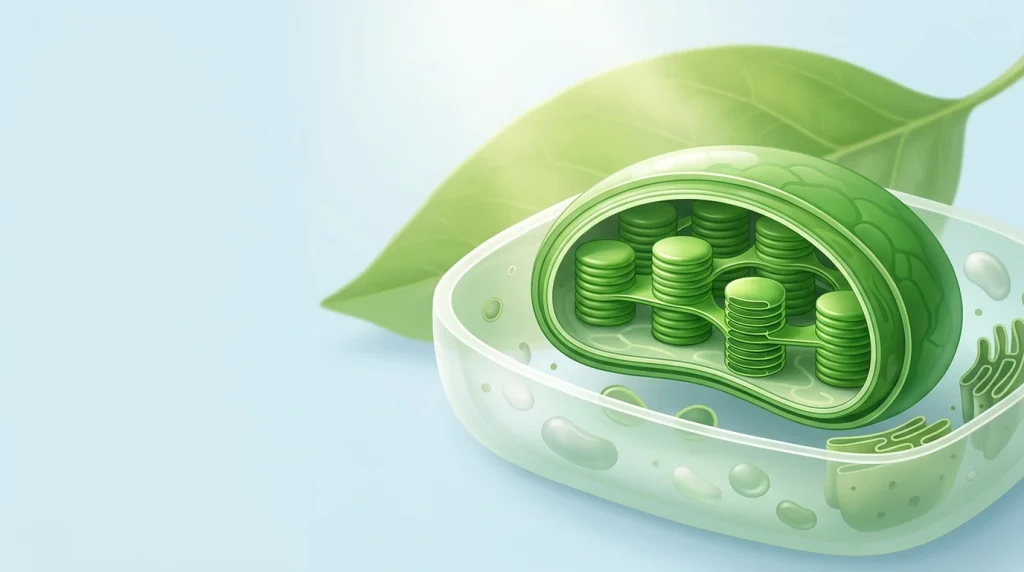
A chloroplast is a part of a plant cell where photosynthesis takes place. The closest scientific alternative is photosynthetic organelle, while plastid is a broader term for a related cell structure. However, these terms do not all mean exactly the same thing.
Words related to chloroplasts include chlorophyll, thylakoid, granum, and photosynthesis. Each term refers to a different part, substance, or process in plant biology. So, the best word depends on If you mean the cell structure, its green pigment, or its role in making food.
Quick list: photosynthetic organelle, plastid, chlorophyll-containing organelle, plant cell organelle, photosynthesis site, chlorophyll-bearing plastid, photosynthetic cell structure, chloroplastid, chloroplastic structure, and green plastid.
This guide explores 30 alternatives and related terms with meanings, IPA, usage notes, and examples. It also explains key scientific differences so you can choose the right term.
At a Glance: Chloroplast Synonyms and Related Alternatives
| Alternative | Part of Speech | Meaning | Register / Tone | Ideal Context |
| Photosynthetic organelle | Noun phrase | Cell structure that carries out photosynthesis | Scientific | Biology writing |
| Plastid | Noun | Cell structure found in plants and algae | Scientific | Cell biology |
| Chlorophyll-containing organelle | Noun phrase | Cell structure that holds chlorophyll | Descriptive | Basic science |
| Plant cell organelle | Noun phrase | A small structure inside a plant cell | General science | Schoolwork |
| Photosynthesis site | Noun phrase | Place where photosynthesis occurs | Informal science | Simple explanations |
| Chlorophyll-bearing plastid | Noun phrase | Plastid that contains chlorophyll | Scientific | Botany |
| Photosynthetic cell structure | Noun phrase | Cell part involved in photosynthesis | Descriptive | Biology lessons |
| Chloroplastid | Noun | Older or less common term related to chloroplast | Rare / historical | Older scientific texts |
| Chloroplastic structure | Noun phrase | Structure linked to a chloroplast | Technical | Research writing |
| Green plastid | Noun phrase | Plastid with green pigment | Descriptive | Basic biology |
Note: Chloroplast has very few true synonyms. Most terms in this guide are scientific descriptions or related concepts, not exact replacements.
Which Word Should You Use?
| If you want to… | Use | Why |
| Name a chloroplast in scientific writing | Chloroplast | It is the standard, precise term. |
| Explain its main role | Photosynthetic organelle | It highlights the process it carries out. |
| Use a broader cell biology term | Plastid | This term covers several types of plant cell structures. |
| Explain it to a young learner | Photosynthesis site | It makes the main role easy to grasp. |
| Focus on its green pigment | Chlorophyll-containing organelle | It points to the pigment inside the structure. |
| Discuss plant cell parts | Plant cell organelle | It gives a broad and clear description. |
| Refer to older scientific wording | Chloroplastid | This rare term may appear in older sources. |
| Discuss a chloroplast’s internal parts | Thylakoid or granum | These terms name parts inside a chloroplast, not the whole structure. |
Exploring the Multiple Meanings of “Chloroplast”
Chloroplast has one main scientific meaning. Related terms help explain its structure, role, and place in a plant cell.
1. A Cell Structure in Plants
- Meaning: A chloroplast is a structure inside many plant cells that carries out photosynthesis.
- Explanation: It holds chlorophyll and other pigments. It also contains internal membranes needed for photosynthesis.
- Example: The leaf cells contain chloroplasts that help the plant make food.
2. A Site of Photosynthesis
- Meaning: A chloroplast is the main site of photosynthesis in plants and many algae.
- Explanation: It captures light energy and helps turn water and carbon dioxide into sugars. The process also releases oxygen.
- Example: Sunlight reaches the leaf, and the chloroplast helps make sugar.
3. A Type of Plastid
- Meaning: A chloroplast is one type of plastid, a group of structures in plant cells.
- Explanation: Other plastids store food or hold pigments of different colors. However, chloroplasts specialize in photosynthesis.
- Example: The biology class compared chloroplasts with other plastids in plant cells.
4. A Structure That Holds Chlorophyll
- Meaning: A chloroplast contains chlorophyll, the green pigment that absorbs light.
- Explanation: Chlorophyll helps capture light energy for photosynthesis. However, chlorophyll and chloroplast mean different things.
- Example: Chlorophyll inside the chloroplast helps the leaf absorb sunlight.
5. A Structure With Internal Membranes
- Meaning: A chloroplast has inner parts, including thylakoids and stacks called grana.
- Explanation: These membranes help carry out light-driven steps of photosynthesis. The surrounding fluid is called the stroma.
- Example: The diagram showed stacks of grana inside the chloroplast.
Analyzing 30 Chloroplast Alternatives in Detail
Some entries below are descriptions of a chloroplast. Others name related structures, pigments, or processes. Use them with care because they are not all exact synonyms.
Core Terms and Scientific Descriptions
1. Photosynthetic Organelle
IPA: photosynthetic /ˌfoʊtoʊsɪnˈθɛtɪk/ · organelle /ˌɔːrɡəˈnɛl/
Definition: A cell structure that carries out photosynthesis. It also helps plants turn light energy into stored chemical energy.
- Usage: This is a clear scientific description of a chloroplast. However, some other organisms have different photosynthetic structures.
- Example: The teacher called the chloroplast a photosynthetic organelle in the lesson.
2. Plastid
IPA: US /ˈplæstɪd/ · UK /ˈplæstɪd/
Definition: A structure found in plant cells and many algae. It also includes forms that store food or pigments.
- Usage: Plastid is a broader term than chloroplast. For example, chromoplasts and leucoplasts are other types of plastids.
- Example: The student learned that a chloroplast is one kind of plastid.
3. Chlorophyll-Containing Organelle
IPA: chlorophyll /ˈklɔːrəfɪl/ · organelle /ˌɔːrɡəˈnɛl/
Definition: A cell structure that contains chlorophyll. It also helps capture light for photosynthesis.
- Usage: This phrase gives a clear description of a chloroplast. However, it is not a standard one-word synonym.
- Example: The book showed a chlorophyll-containing organelle inside a leaf cell.
4. Plant Cell Organelle
IPA: organelle /ˌɔːrɡəˈnɛl/
Definition: A small structure inside a plant cell that has a specific role. It also helps the cell carry out life tasks.
- Usage: This phrase is broad and includes many cell parts. Use it when the exact structure is clear from context.
- Example: The diagram marked the chloroplast as a plant cell organelle.
5. Photosynthesis Site
IPA: photosynthesis /ˌfoʊtoʊˈsɪnθəsɪs/
Definition: A place where photosynthesis takes place. It also points to the main role of chloroplasts in plant cells.
- Usage: This is a plain-language description, not a formal synonym. In plants, chloroplasts are the main site of photosynthesis.
- Example: The worksheet asked students to name the photosynthesis site in a leaf cell.
Pigment and Plant Cell Terms
6. Chlorophyll-Bearing Plastid
IPA: chlorophyll /ˈklɔːrəfɪl/ · plastid /ˈplæstɪd/
Definition: A plastid that holds chlorophyll. It also refers to the green plastids that support photosynthesis.
- Usage: This phrase can describe a chloroplast. However, chloroplast remains the clearer and more common term.
- Example: The student drew a chlorophyll-bearing plastid in the plant cell.
7. Green Plastid
IPA: plastid /ˈplæstɪd/
Definition: A plastid that appears green due to its pigments. It also gives a simple visual clue to a chloroplast’s identity.
- Usage: This is a descriptive phrase rather than an exact scientific synonym. Use chloroplast in formal biology work.
- Example: The green plastid stood out in the cell diagram.
8. Photosynthetic Cell Structure
IPA: photosynthetic /ˌfoʊtoʊsɪnˈθɛtɪk/
Definition: A cell structure involved in photosynthesis. It also helps explain the role of a chloroplast without naming it directly.
- Usage: This phrase is broad and descriptive. In plants, it commonly points to the chloroplast.
- Example: The student labeled the photosynthetic cell structure on the worksheet.
9. Chloroplastid
IPA: /ˈklɔːrəˌplæstɪd/
Definition: A rare term linked to the chloroplast. It also appears in some older or specialized sources.
- Usage: This is not the usual modern word. Use chloroplast unless a source specifically calls for chloroplastid.
- Example: The researcher checked an old text that used the term chloroplastid.
10. Chloroplastic Structure
IPA: chloroplastic /ˌklɔːrəˈplæstɪk/
Definition: A structure related to a chloroplast. It also may refer to features found within or linked to chloroplasts.
- Usage: This phrase is technical and context-dependent. It does not work as a direct replacement for chloroplast in every sentence.
- Example: The paper examined a chloroplastic structure in the leaf tissue.
Related Cell Structures
11. Thylakoid
IPA: US /ˈθaɪləˌkɔɪd/ · UK /ˈθaɪləˌkɔɪd/
Definition: A flat membrane sac inside a chloroplast. It also holds chlorophyll and supports light-driven steps of photosynthesis.
- Usage: A thylakoid is part of a chloroplast, not another name for the whole organelle. Use it when discussing internal membranes.
- Example: The science book showed a thylakoid inside the chloroplast.
12. Granum
IPA: US /ˈɡreɪnəm/ · UK /ˈɡreɪnəm/
Definition: A stack of thylakoids inside a chloroplast. It also helps organize membranes used in photosynthesis.
- Usage: Granum names one internal feature. The plural form is grana.
- Example: The teacher pointed to one granum in the chloroplast model.
13. Grana
IPA: /ˈɡreɪnə/
Definition: Stacks of thylakoids inside chloroplasts. They also help form the internal membrane system for photosynthesis.
- Usage: Grana is plural, while granum is singular. Neither word means chloroplast itself.
- Example: The diagram showed several grana within the chloroplast.
14. Stroma
IPA: US /ˈstroʊmə/ · UK /ˈstrəʊmə/
Definition: The fluid inside a chloroplast that surrounds the thylakoids. It also supports key steps in sugar production.
- Usage: Stroma names an inner part of the chloroplast. It is not a synonym for the whole organelle.
- Example: The class labeled the stroma in the chloroplast drawing.
15. Chloroplast Envelope
IPA: envelope /ˈɛnvəˌloʊp/
Definition: The pair of membranes that surrounds a chloroplast. It also helps separate the organelle from the rest of the cell.
- Usage: This term refers to the outer boundary, not the full chloroplast. Use it when discussing membrane structure.
- Example: The model showed the chloroplast envelope around the organelle.
Pigments and Related Cell Parts
16. Chlorophyll
IPA: US /ˈklɔːrəfɪl/ · UK /ˈklɒrəfɪl/
Definition: A green pigment that absorbs light for photosynthesis. It also gives many leaves their green color.
- Usage: Chlorophyll is a substance inside chloroplasts, not a cell structure. Do not use it as a direct synonym.
- Example: Chlorophyll absorbs light inside the chloroplast during photosynthesis.
17. Carotenoid
IPA: US /kəˈrɑːtənɔɪd/ · UK /kəˈrɒtɪnɔɪd/
Definition: A pigment found in many plants and algae. It also helps absorb light and can protect cells from excess light.
- Usage: Carotenoids are pigments, not organelles. They occur in chloroplasts and other types of plastids.
- Example: The carotenoid helped give the leaf its yellow tint.
18. Chromoplast
IPA: US /ˈkroʊməˌplæst/ · UK /ˈkrəʊməplɑːst/
Definition: A plastid that stores colored pigments other than green chlorophyll. It also helps give many flowers and fruits bright colors.
- Usage: Chromoplast is a related type of plastid, not a chloroplast synonym. It often appears in discussions of fruit color.
- Example: The ripe tomato had chromoplasts that held red pigments.
19. Leucoplast
IPA: US /ˈluːkəˌplæst/ · UK /ˈluːkəplɑːst/
Definition: A plastid with little or no color that often stores food. It also differs from a chloroplast in its main role.
- Usage: Leucoplast is another type of plastid. It is not a direct replacement for chloroplast.
- Example: The root cells had leucoplasts that stored starch.
20. Amyloplast
IPA: /ˈæmɪloʊˌplæst/
Definition: A type of leucoplast that stores starch. It also helps plants keep energy in reserve.
- Usage: Amyloplast names a specialized plastid, not a chloroplast. It is useful in lessons about food storage in plants.
- Example: The potato cells contained amyloplasts filled with starch.
Processes and Functions
21. Photosynthesis
IPA: US /ˌfoʊtoʊˈsɪnθəsɪs/ · UK /ˌfəʊtəʊˈsɪnθəsɪs/
Definition: The process plants use to turn light energy into chemical energy. It also helps them make sugars from water and carbon dioxide.
- Usage: Photosynthesis is a process, not a cell part. Chloroplasts carry it out in plants and many algae.
- Example: Photosynthesis lets the plant make sugar from light, water, and carbon dioxide.
22. Light-Harvesting Complex
IPA: complex /ˈkɑːmpleks/
Definition: A group of proteins and pigments that captures light energy. It also passes that energy to parts of the photosynthesis system.
- Usage: This is a component within the photosynthetic machinery, not a synonym for chloroplast. Use it for detailed biology.
- Example: The light-harvesting complex captured light in the leaf cell.
23. Photosystem
IPA: US /ˈfoʊtoʊˌsɪstəm/ · UK /ˈfəʊtəʊˌsɪstəm/
Definition: A group of pigments and proteins that work together in photosynthesis. It also helps turn light energy into usable chemical energy.
- Usage: Photosystems sit in the thylakoid membranes. They are parts of the chloroplast’s working system, not the organelle itself.
- Example: Photosystem II helped start the light reactions in the chloroplast.
24. Starch-Storing Plastid
IPA: plastid /ˈplæstɪd/
Definition: A plastid that stores starch in a plant cell. It also serves as an energy store rather than a main site of photosynthesis.
- Usage: This phrase often points to an amyloplast. It is related to chloroplasts but has a different main role.
- Example: The root used a starch-storing plastid to keep food reserves.
25. Plant Cell Power System
IPA: organelle /ˌɔːrɡəˈnɛl/
Definition: An informal phrase for a cell part that helps with energy-related work. It also may refer to chloroplasts in simple teaching material.
- Usage: This is not a standard biology term. For accurate writing, name the chloroplast or explain its role directly.
- Example: The teacher used a simple phrase to explain the plant cell power system.
Broader Scientific and Descriptive Terms
26. Photosynthetic Organelle in Plants
IPA: photosynthetic /ˌfoʊtoʊsɪnˈθɛtɪk/
Definition: A cell structure in plants that carries out photosynthesis. It also makes clear which organism group the term refers to.
- Usage: This phrase describes a chloroplast rather than replacing its scientific name. It works well in introductory lessons.
- Example: A photosynthetic organelle in plants helps turn light into stored energy.
27. Green Cell Organelle
IPA: organelle /ˌɔːrɡəˈnɛl/
Definition: A green cell structure that contains pigments. It also may point to a chloroplast in a basic biology lesson.
- Usage: This phrase is broad and informal. Use chloroplast when you need a precise scientific term.
- Example: The green cell organelle appeared clearly in the leaf cell image.
28. Chlorophyll-Rich Plastid
IPA: plastid /ˈplæstɪd/
Definition: A plastid with a high amount of chlorophyll. It also points to the green pigment linked with photosynthesis.
- Usage: This phrase can describe a chloroplast but is not a fixed synonym. The amount of pigment may vary by cell and condition.
- Example: The chlorophyll-rich plastid absorbed light in the plant cell.
29. Plant Photosynthesis Structure
IPA: photosynthesis /ˌfoʊtoʊˈsɪnθəsɪs/
Definition: A plant cell structure involved in making sugars through photosynthesis. It also serves as a plain description of a chloroplast’s role.
- Usage: This phrase is descriptive rather than a formal term. In scientific writing, chloroplast is more exact.
- Example: The student named the plant photosynthesis structure in the diagram.
30. Chloroplast Organelle
IPA: chloroplast /ˈklɔːrəˌplæst/
Definition: A cell organelle called a chloroplast. It also stresses that the structure is part of a cell.
- Usage: This phrase is redundant because chloroplast already names an organelle. Use it only when explaining the term to a beginner.
- Example: The teacher explained that a chloroplast organelle helps plants make food.
Chloroplast vs. Chlorophyll vs. Plastid
These three terms often appear together in biology, but they have different meanings.
| Term | What It Means | Main Role |
| Chloroplast | A cell structure | Carries out photosynthesis |
| Chlorophyll | A green pigment | Absorbs light |
| Plastid | A group of cell structures | May carry out photosynthesis, store food, or hold pigments |
| Thylakoid | A membrane sac inside a chloroplast | Supports light-driven reactions |
| Granum | A stack of thylakoids | Organizes internal membranes |
| Stroma | Fluid inside a chloroplast | Supports key steps in sugar production |
In short, a chloroplast is the structure, chlorophyll is a pigment, and photosynthesis is a process. A plastid is the broader group that includes chloroplasts.
Chloroplast and Opposite/Paired Word Pairs
Chloroplast has no direct antonym because it names a cell structure. However, several scientific terms form useful pairs or contrasts.
| Word | Paired Word | Note |
| Chloroplast | Mitochondrion | Both are energy-related organelles with different main roles. |
| Chloroplast | Chromoplast | Both are plastids, but they differ in pigments and function. |
| Chloroplast | Leucoplast | Both are plastids, but leucoplasts often store food. |
| Chlorophyll | Carotenoid | Both are plant pigments with different light-absorbing properties. |
| Photosynthesis | Cellular respiration | Both involve energy conversion through different processes. |
| Thylakoid | Stroma | One is a membrane sac, while the other is fluid inside the chloroplast. |
| Granum | Single thylakoid | A granum contains a stack of thylakoids. |
| Green plastid | Colorless plastid | These phrases contrast plastids by their visible pigments. |
These pairs help readers compare cell parts and their roles. However, none of them provides a true opposite for chloroplast.
Common Word Partners of “Chloroplast”
Scientific writing often pairs chloroplast with words about its parts, role, and activity.
| Pattern | Common Partners | Example |
| Chloroplast + noun | Structure, function, DNA | Chloroplast DNA has its own genetic information. |
| Adjective + chloroplast | Green, mature, intact | The green chloroplast contained chlorophyll. |
| Verb + chloroplast | Contains, forms, studies | The student studies the chloroplast under a microscope. |
| Chloroplast + process | Photosynthesis, carbon fixation | The chloroplast supports photosynthesis in plant cells. |
| Chloroplast + internal part | Thylakoid, grana, stroma | The stroma surrounds the thylakoids. |
| Chloroplast + boundary | Envelope, membrane | The chloroplast envelope surrounds the organelle. |
| Chloroplast + genetic term | Genome, DNA, gene | Researchers studied the chloroplast genome. |
| Chloroplast + research term | Development, division, evolution | The paper examined chloroplast development. |
Idiomatic Phrases Featuring “Chloroplast”
Chloroplast is a technical biology term, so it has few established idioms. The following are common scientific expressions rather than idioms.
1. Chloroplast Structure
- Meaning: The shape and inner parts of a chloroplast.
- Example: The class studied chloroplast structure before learning about photosynthesis.
2. Chloroplast Function
- Meaning: The role a chloroplast plays in a cell.
- Example: Our teacher explained chloroplast function with a leaf diagram.
3. Chloroplast DNA
- Meaning: Genetic material found inside chloroplasts.
- Example: The research team examined chloroplast DNA from several plant samples.
4. Chloroplast Development
- Meaning: The process through which chloroplasts form and mature.
- Example: Sunlight can affect chloroplast development in young leaves.
These expressions work well in biology lessons and research. However, they are not idioms in the usual sense.
Choosing the Right Term for Your Context
Etymology & Structure
The word chloroplast combines two word parts: chloro- and -plast. The first relates to green, while the second relates to something formed or shaped.
The word reflects the green pigments found in these structures. Modern biology uses chloroplast for the organelle that carries out photosynthesis in plants and many algae.
Date and History
The term entered scientific English in the late 19th century. Etymonline traces chloroplast to 1887 and links it to earlier German scientific usage.
Word Class Variations
| Form | Part of Speech | Meaning |
| Chloroplast | Noun | The cell structure |
| Chloroplasts | Plural noun | More than one chloroplast |
| Chloroplastic | Adjective | Related to chloroplasts |
| Chloroplastid | Noun | A rare or older related term |
There is no common everyday verb or adverb formed directly from chloroplast. Use phrases such as chloroplast function or chloroplast development instead.
Common Word-Choice Mistakes
- Wrong pairing: Chloroplast is a pigment. Correction: Chlorophyll is the pigment inside a chloroplast.
- Wrong pairing: Chloroplast means photosynthesis. Correction: A chloroplast is a structure, while photosynthesis is a process.
- Wrong pairing: Plastid always means chloroplast. Correction: Plastid is a broader group of cell structures.
- Wrong pairing: Thylakoid means chloroplast. Correction: A thylakoid is a membrane sac inside a chloroplast.
- Wrong pairing: Granum means one thylakoid. Correction: A granum is a stack of thylakoids.
- Wrong pairing: Mitochondrion is another name for chloroplast. Correction: These are different organelles with distinct roles.
- Wrong pairing: Chromoplast means green plastid. Correction: Chromoplasts hold colored pigments and often lack much green chlorophyll.
Frequently Asked Questions
1. What is the closest synonym for chloroplast?
Photosynthetic organelle is a clear descriptive alternative. However, chloroplast remains the most precise scientific term.
2.Which plastids store food in plant cells?
You can say photosynthesis site in a basic lesson. This phrase explains its role but does not name the structure precisely.
3. Which term is best for scientific writing?
Not exactly. A chloroplast is one type of plastid, while the broader term includes other types.
4. What is a formal alternative to chloroplast?
Photosynthetic organelle works well in formal explanations. Still, use chloroplast when you need exact scientific wording.
5. Is chlorophyll the same as chloroplast?
No. Chlorophyll is a pigment, while a chloroplast is a cell structure that contains it.
6. What is the opposite of chloroplast?
Chloroplast has no direct antonym. However, leucoplast and chromoplast provide useful contrasts between types of plastids.
7. Can I use photosynthesis as a synonym for chloroplast?
No. Photosynthesis is the process of turning light energy into chemical energy, not a cell structure.
8. What is the difference between a chloroplast and a mitochondrion?
Chloroplasts carry out photosynthesis. Mitochondria help release usable energy from food through cellular respiration.
9. What is the rare word chloroplastid?
Chloroplastid is a rare or older term linked to chloroplast. Most modern readers should use chloroplast instead.
10. How do I choose the right chloroplast alternative?
Choose a term based on your meaning. Use plastid for the broader group, chlorophyll for the pigment, and photosynthetic organelle for its role.
Conclusion
The closest descriptive alternative to chloroplast is photosynthetic organelle. Other useful terms include plastid, chlorophyll-containing organelle, and photosynthesis site.
However, these words do not all mean the same thing. Chlorophyll names a pigment, plastid names a broader group, and thylakoid names an inner part.
For clear scientific writing, use chloroplast whenever possible.

I’m Iqra, the creator behind MediaPostHub, a platform dedicated to sharing useful, engaging, and trustworthy content. I explore trending topics, helpful guides, lifestyle ideas, and informative insights, making everyday information simple, valuable, and enjoyable for readers worldwide.